No products in the basket.

 Zakaria Belkhay
May 14, 2026
Zakaria Belkhay
May 14, 2026
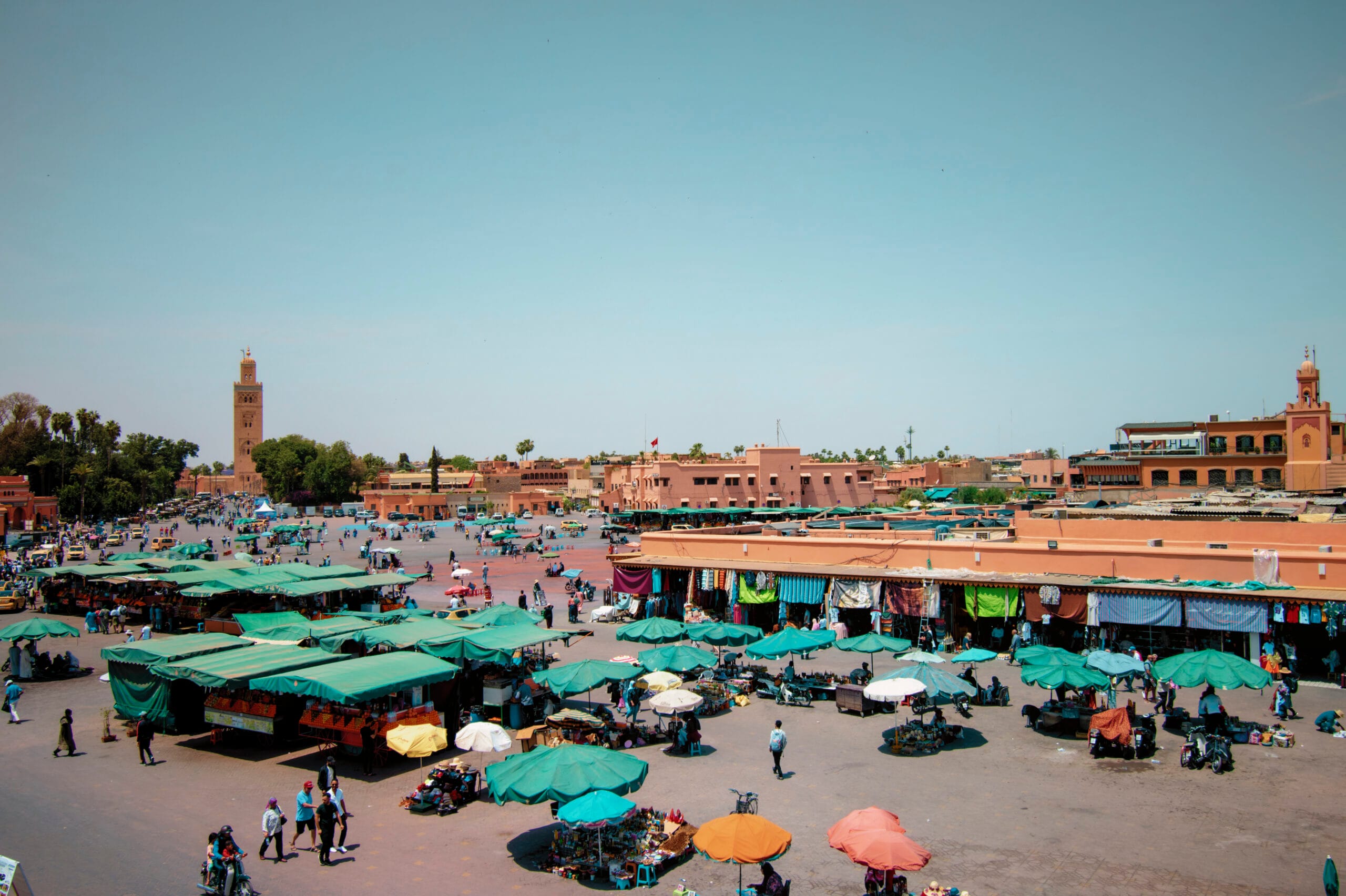
A Marrakech medina tour is unlike any other urban walking experience in the world — and it requires a completely different mindset from exploring a European city.
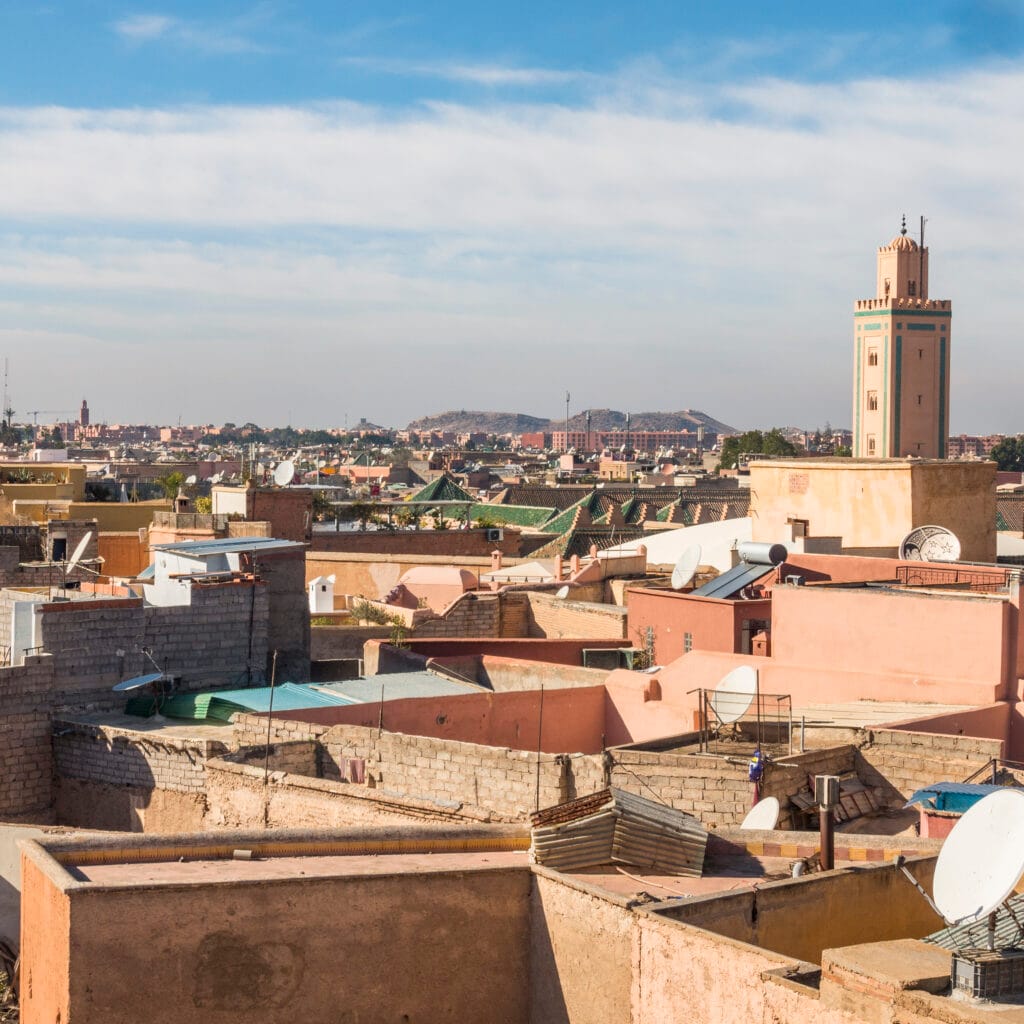
The medina of Marrakech is a UNESCO World Heritage Site founded in the 11th century. Its 9 km of ramparts enclose a labyrinthine world of souks, palaces, mosques, hammams, madrasas and residential neighborhoods that have barely changed in their fundamental logic over 900 years. There is no grid. There are no straightforward routes. The alley that seems to lead somewhere often doesn’t, and the alley that seems to lead nowhere suddenly opens onto a magnificent palace courtyard.
This complete walking guide to the Marrakech medina tour organizes the city’s key sites and neighborhoods into a logical sequence, explains the history that gives each place meaning, tells you exactly what to expect from the souks, and provides the practical knowledge that separates confident medina navigation from anxious wandering. Whether you plan to explore independently or hire a guide, this guide prepares you for what is genuinely one of the world’s great urban adventures.
| Orientation fact: The medina’s two main landmark anchors are Jemaa el-Fna square (the southern medina hub, where most visitors start) and the Ben Youssef Mosque (the northern medina hub, surrounded by the souk quarter). Almost every Marrakech medina tour routes between these two points through the main souk corridor. |
Every first-time visitor to the Marrakech medina gets lost. Every single one. This is not a failure of navigation — it is the designed experience of a city built for a society that moved on foot and valued privacy over grid efficiency. Accept the labyrinth as the feature, not the bug. The travelers who enjoy the medina most are those who treat every dead end as a discovery opportunity rather than a navigation failure.
Practical navigation tools that actually work:
| Time Window | What You Experience | Trade-offs |
| 7:00–9:30 AM | Local life, bread bakers, empty alleys, cool air | Souks not yet open, some sites closed |
| 9:30 AM–12:30 PM | Full souk activity, craftsmen working, sites open | Building heat, more crowds |
| 7:00–10:30 PM | Night souk atmosphere, Jemaa el-Fna at peak, lantern light | Some workshops closed, darker navigation |
| The honest advice: do your medina tour in two sessions rather than one. Morning session (9:30 AM–12:30 PM) for the souks, sites and craft workshops. Evening session (7:30–10:30 PM) for Jemaa el-Fna, the food stalls, the night atmosphere and the souk alleys by lantern light. These are two completely different experiences of the same place. |
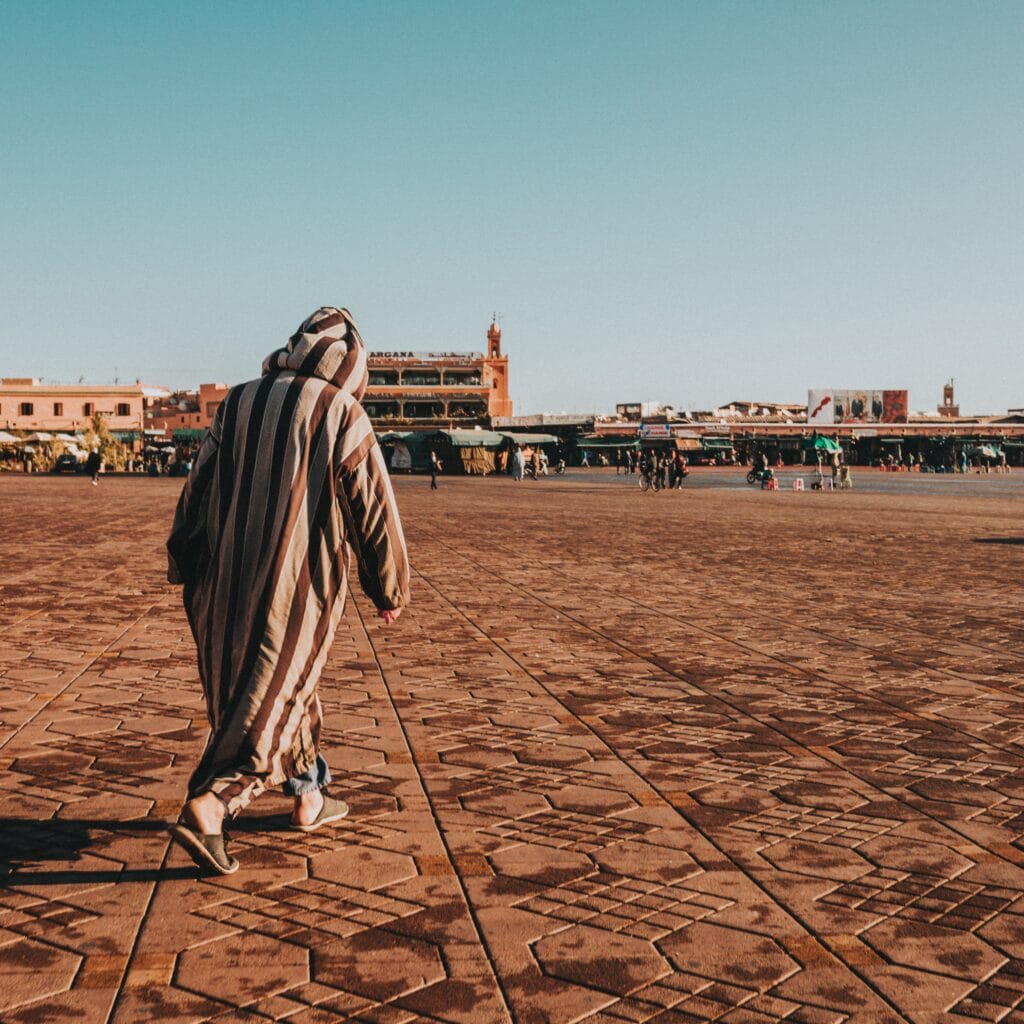
Jemaa el-Fna is not simply a square — it is a performing space with a 1,000-year continuous history of public oral culture. UNESCO designated it an Intangible Cultural Heritage of Humanity specifically for this living tradition: the storytellers (hlaiqiya) who perform in Darija (Moroccan Arabic) for local audiences, the gnawa musicians whose hypnotic ritual music traces back to sub-Saharan spiritual traditions, the healers, the water sellers in their distinctive red costumes. The tourist-facing elements (snake charmers, henna artists) are real but represent only one layer of a much deeper cultural palimpsest.
The Marrakech souks appear chaotic but follow a logic that dates back to the medieval Islamic city model: each trade is concentrated in its own quarter. Spice merchants cluster together. Dyers work in the same neighborhood they have occupied for centuries. Leather workers, lamp makers, carpet weavers, blacksmiths — each guild has its territory. Once you understand this organizational principle, the souk stops feeling overwhelming and starts feeling navigable.
The main souk corridor runs approximately north from Jemaa el-Fna toward the Ben Youssef Mosque, branching into specialized sub-markets on either side. The most visited sequence:
The Marrakech souks sell thousands of products at wildly variable quality. The items that represent the best quality-to-price combination:
Items that frequently disappoint: “leather” goods that smell of synthetic tanning, “handmade” items that have factory tags visible from the reverse, “argan oil” without clear provenance that is often diluted with other oils.
The Koutoubia Mosque (12th century, Almohad dynasty) is Marrakech’s defining landmark and the point from which all measurements in the medina traditionally originate. Non-Muslims cannot enter, but the mosque’s exterior and surrounding gardens deserve 20–30 minutes. The garden (free entry) is one of the medina’s few large green spaces and offers the best ground-level view of the minaret’s exceptional geometric tile work. The proportions of the Koutoubia influenced the Giralda in Seville and the Hassan Tower in Rabat — it is one of North Africa’s most important pieces of medieval architecture.
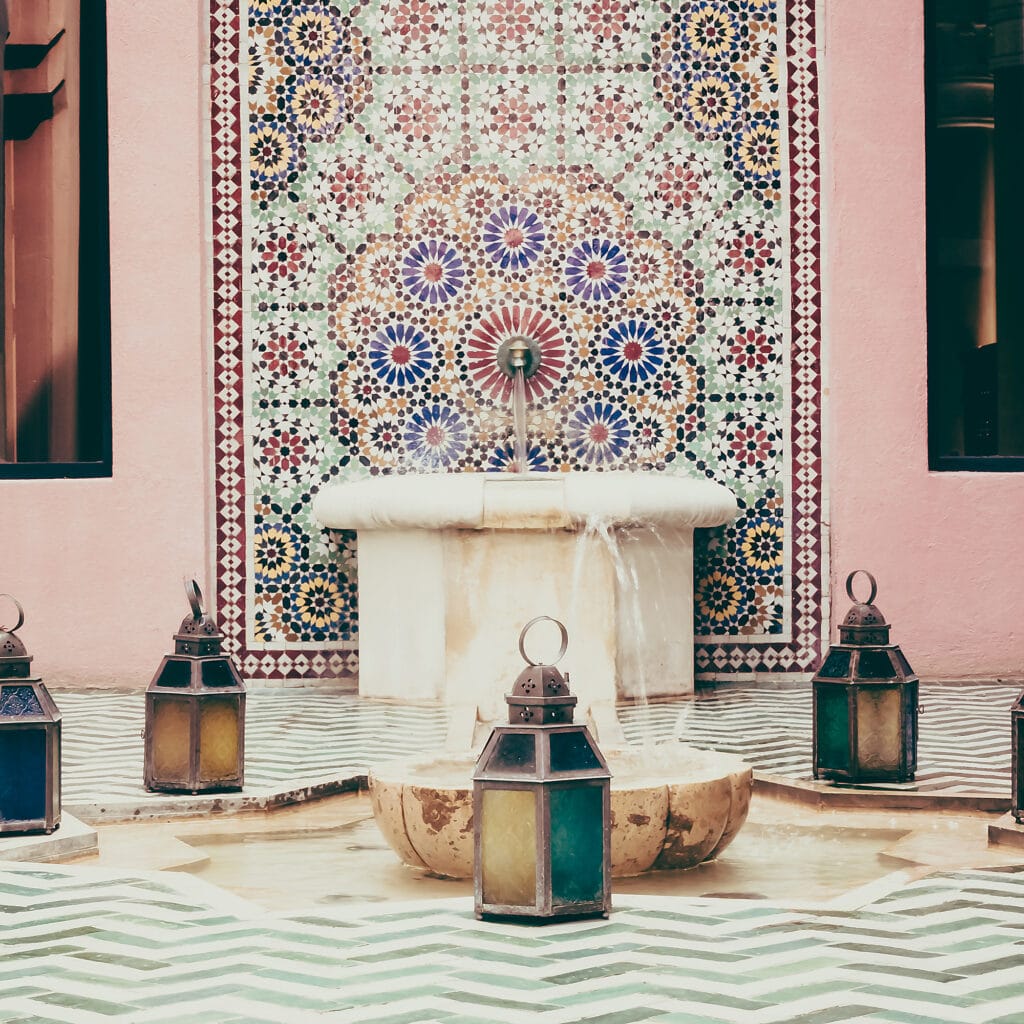
The Ben Youssef Madrasa (14th century, expanded 16th century) is the most architecturally extraordinary site open to non-Muslim visitors in Marrakech. This Islamic school — once the largest in North Africa with 900 students — is a masterpiece of Moroccan craftsmanship: every surface of the central courtyard covered in zellij tilework (geometric mosaic), carved stucco arabesques and cedar woodwork that took decades to complete. The combination of geometric precision and organic complexity is unlike anything in European architecture.
The Bahia Palace (late 19th century) was built over 14 years for Si Moussa, a Grand Vizier of the Sultan, to house his household of four wives and 24 concubines. The complex covers 8 hectares and contains 150 rooms arranged around courtyards of increasing privacy and luxury. The painted wooden ceilings, the zellij-tiled floors, the carved plaster walls and the garden courtyards offer the most accessible immersion in Moroccan interior architecture in Marrakech.
The Saadian Tombs (16th century) were sealed behind a high wall by Sultan Moulay Ismail in the 17th century (his way of erasing the memory of the previous Saadian dynasty) and only rediscovered by aerial photography in 1917. The three mausoleum chambers contain the remains of 66 members of the Saadian royal family, surrounded by extraordinarily preserved decoration: Italian Carrara marble columns, carved cedar ceilings, zellij floors and intricate plaster work. The contrast between the sealed history and the suddenly visible beauty creates a genuine sense of discovery.
The Mellah (Jewish Quarter), established in the 16th century adjacent to the royal palace, offers a completely different architectural and cultural experience from the rest of the medina. The distinctive wrought-iron balconies, the narrower streets with overhanging upper floors, and the Ben Youssef Synagogue (still active) tell the story of a significant Jewish community that numbered over 40,000 at its peak and has now diminished to a small elderly population. The Mellah’s covered market (near Place des Ferblantiers, the tinsmith’s square) is less touristy and more genuinely local than the main souk corridor.
The Chouara Tannery is one of Marrakech’s most viscerally impressive sites: an open-air complex of large stone vats filled with natural dyes (saffron yellow, poppy red, indigo blue, walnut brown) and whitening agents, where workers stand waist-deep treading and stretching leather using techniques unchanged since the 11th century. The best view is from the leather shop rooftop terraces surrounding the tannery — look for signs reading “free tannery view” (it isn’t entirely free — you’ll be expected to look at leather goods afterward, though you’re not obligated to buy).
This route covers the medina’s main highlights in a logical north-south sequence, beginning at Jemaa el-Fna and ending at the Ben Youssef Madrasa. Total walking distance: approximately 3.5 km with stops.
This route focuses on the medina’s southern quarter — the palace complex, the Mellah, the Saadian Tombs and the Bahia Palace. A quieter, less touristy, historically richer experience than the souk corridor.
A licensed Marrakech medina guide (certified by the Moroccan Ministry of Tourism — identifiable by their official badge) provides three things that independent exploration cannot: historical context that transforms mute walls into living narratives, access to craft workshops and households not visible from the street, and navigation efficiency that covers more ground in less time. A 3-hour guided medina tour typically covers 40–50% more meaningful content than the same time spent independently because guides know which alleys to take and which dead ends to avoid.
Self-guided medina exploration is genuinely rewarding on a second or third visit when you already understand the basic geography. It’s also better for travelers who want to set their own pace, linger indefinitely at things they find interesting and move quickly through things they don’t. The morning souk hours and the evening Jemaa el-Fna experience are both ideal for self-guided exploration — the atmosphere itself is the guide.
Men will approach you in the medina offering directions, “free” guidance to a particular souk, or simply walking alongside you uninvited. These individuals earn their income from commissions paid by shops they bring tourists to. This is a legitimate local economic practice but not always the medina experience you want. The effective response: firm, polite, immediate refusal without extended engagement. “La shukran” (no thank you) + continued walking + no eye contact = the formula. Never follow someone who says “the souk is closed today” or “there is a special market” — these are consistent techniques to redirect you to commission shops.
The medina’s high walls create shade but also trap heat. In summer, the temperature between narrow buildings can be significantly higher than the official city temperature. Carry at least 1.5L of water per person for any morning session, more in summer. Fresh orange juice at 4–6 MAD from any street vendor is excellent hydration and genuinely the best orange juice in the world — buy it constantly.
The craftsmen, vendors and residents of the medina are not a tourist attraction — they are people working and living in their neighborhood. Always ask before photographing individuals. Many craftsmen are happy to be photographed and may appreciate a small tip (20–50 MAD). The architecture, the souk corridors, the tanneries (from the terraces) and the anonymous alley shots require no permission. Never photograph inside a mosque, and approach any religious site with visible reverence.
| Key Medina Site | Entry Price | Time to Allow |
| Jemaa el-Fna | Free | 30 min–all day (depends on time) |
| Koutoubia Garden | Free | 20–30 min |
| Ben Youssef Madrasa | 70 MAD | 45–60 min |
| Bahia Palace | 70 MAD | 45–75 min |
| Saadian Tombs | 70 MAD | 30–45 min |
| Majorelle Garden (Gueliz) | 150 MAD adults | 45–75 min |
| Dar Si Said Museum | 30 MAD | 30–45 min |
| Chouara Tannery (terrace view) | Free view + optional purchase | 20–30 min |
| El Badi Palace ruins | 50 MAD | 30–45 min |
The Marrakech medina is not a city that gives itself up quickly. Its beauty is not in the grand monuments, though those are extraordinary — it’s in the light falling through a mashrabiya screen, the smell of cedar from a carpenter’s workshop, the sound of a fountain in a courtyard glimpsed through an open door. The travelers who fall in love with the medina are invariably those who slowed down enough to notice these things.
The key takeaways for your Marrakech medina tour:
After your medina tour, the Agafay Desert provides the perfect counterpoint — the absolute silence of the desert plateau after the beautiful chaos of the souks. Our evening desert packages depart from Jemaa el-Fna area and combine seamlessly with a morning medina tour.
A focused medina tour hitting the main highlights (souks, Ben Youssef Madrasa, Bahia Palace, Saadian Tombs) takes approximately 6–8 hours across one or two sessions. Most visitors find that the medina reveals itself progressively over multiple visits — the first tour establishes geography, subsequent visits deepen the experience. A minimum of 2 full days in the medina is recommended for first-time visitors who want more than a surface impression. The medina rewards slow exploration over multiple shorter sessions rather than one exhaustive marathon day.
Yes — the Marrakech medina is safe for solo travelers, including women, during daylight hours and in the early evening. The main safety consideration is the persistent attention from touts and unofficial guides, which is socially uncomfortable rather than physically dangerous. Standard precautions apply: keep valuables out of sight, be aware of your phone in crowded souk sections, avoid very poorly lit alleys after midnight. The medina’s populated areas are active and well-lit until 11 PM or later, making evening exploration entirely feasible for confident travelers.
A licensed guide is strongly recommended for a first visit, particularly for the first 2–3 hours in the medina. The historical context a guide provides transforms the experience from sightseeing to genuine understanding. After the initial oriented tour, independent exploration is both rewarding and feasible. If budget is a constraint, consider hiring a guide for half a day on your first morning, then exploring independently for the remainder of your stay. The investment (300–500 MAD for 3 hours) pays dividends in the quality of every subsequent independent walk.
If you’re staying in a riad within the medina, you simply step outside your door. If you’re staying in Gueliz (new city), the most common options are: petit taxi (metered, 30–50 MAD from most Gueliz hotels to Jemaa el-Fna, 10–15 minutes), walk (20–25 minutes along the main Rue Mohammed V artery), or the RAMBus No. 1 (10 MAD, slower but interesting). Taxis cannot enter the medina alleys but can drop you at the main gates surrounding Jemaa el-Fna — ask for “Jemaa el-Fna” and all drivers know it.