No products in the basket.

 Zakaria Belkhay
July 9, 2026
Zakaria Belkhay
July 9, 2026
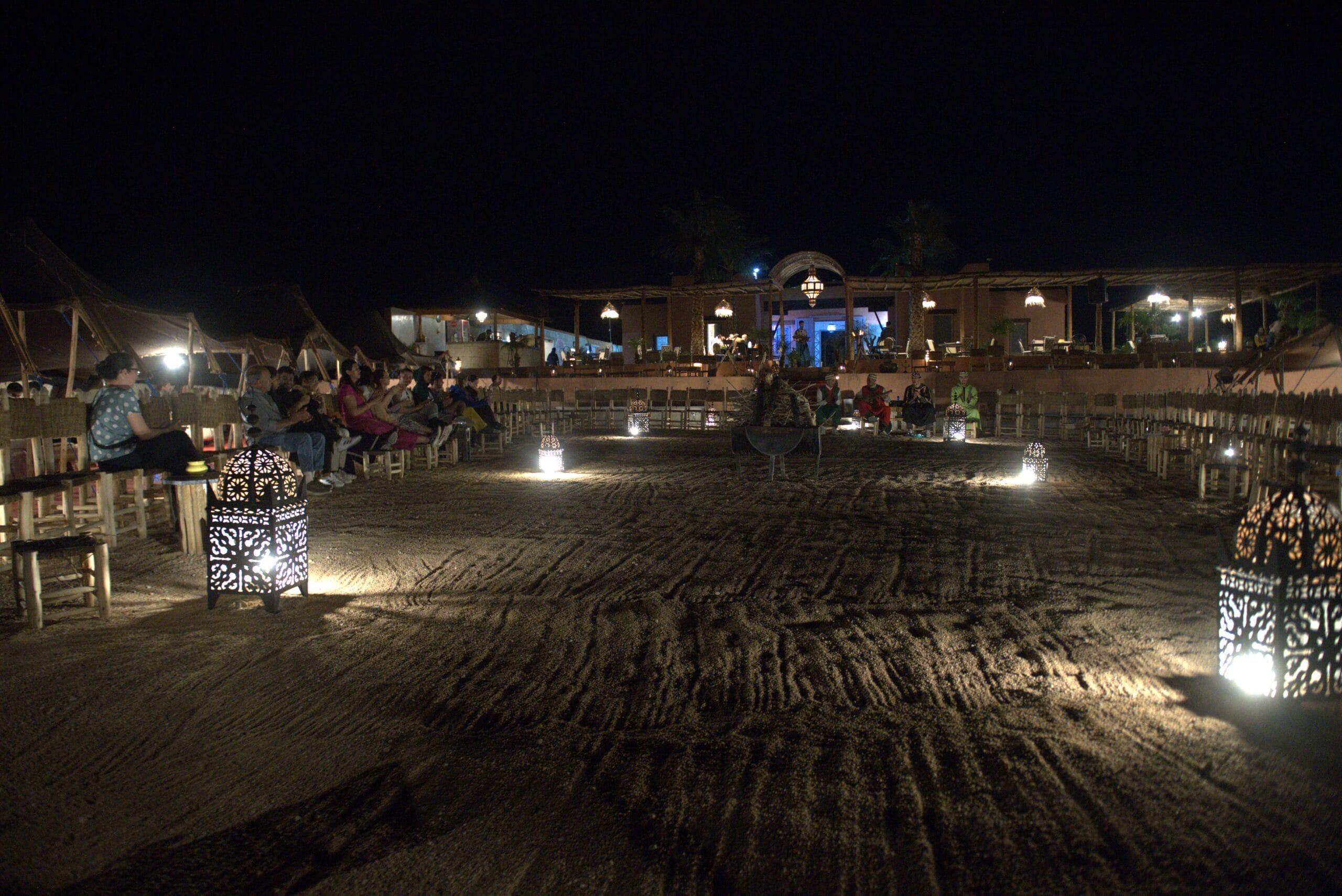
Agafay is not the Sahara. It’s a rocky, semi-arid plateau about 30 kilometres southwest of Marrakech, and that proximity to the city is precisely what makes its nightlife scene so surprising. You can be sitting in a riad in the medina at sunset and watching stars from a desert camp by 9pm.
But what happens after dark in Agafay has become a conversation worth having. Two distinct worlds coexist here: the centuries-old traditions of Berber and gnawa music, performed around open fires with hand-crafted instruments, and a growing wave of curated DJ experiences designed to turn the desert into an open-air venue.
Neither is inauthentic. Neither cancels the other out. They reflect the two sides of modern Moroccan travel — deep cultural roots and a confident, forward-facing energy.
This guide covers 10 specific dimensions of the nightlife vibe in Agafay, giving you the tools to choose the kind of evening that actually matches what you’re looking for. Practical details, honest comparisons, and a few things most visitors don’t know are included throughout.
Before you weigh music genres or dinner menus, it helps to understand what makes Agafay fundamentally different from any other nightlife destination you’ve encountered. The plateau sits at roughly 600 metres above sea level, edged by the foothills of the High Atlas. There are no city lights to dilute the sky. The terrain — pale stone, sparse vegetation, scattered ksar ruins — creates a natural amphitheatre effect where sound travels differently than in enclosed venues.
This isn’t a marketing point. It’s a physical reality that shapes the atmosphere of every event held here. When a guembri player plucks a low note 40 metres from where you’re sitting, you feel it in your chest. When a DJ drops a bassline at a desert gathering, it rolls across the plateau in a way that indoor clubs simply cannot replicate.
The drive from Marrakech takes between 30 and 45 minutes depending on your departure point — long enough to shift your mindset, short enough to make a spontaneous evening feasible. Most camps and venues sit along the road toward Lalla Takerkoust lake, with organised transfers available from the city centre.
Temperatures in Agafay drop noticeably after dark, even in summer. In July and August, evenings settle around 20–22°C after 10pm. In spring and autumn, you’re looking at 14–17°C by midnight. This matters when choosing between a seated dinner show and a more active DJ event where dancing keeps you warm.
The landscape also creates natural acoustics that amplify both intimacy and spectacle — a quality that experienced event producers in the region have learned to use deliberately, whether they’re staging a gnawa circle or a curated electronic set.
Tip : Pack a light layer regardless of the season. Agafay nights cool faster than the Marrakech medina, and the difference can catch first-time visitors off guard, particularly if you’re staying for a late set.
The term “Berber music” is broad enough to encompass several distinct traditions, and knowing the difference helps you choose the right evening. In the Agafay context, you’ll most commonly encounter three styles: Ahwach, gnawa, and the more general Atlas folk traditions that accompany storytelling and communal gatherings.
Ahwach is a collective art form rooted in the Souss and Atlas regions. It involves alternating male and female choruses, hand percussion, and a call-and-response structure that builds slowly and hypnotically over 20 to 40 minutes. Watching a genuine Ahwach performance is less about passive entertainment and more about witnessing a social ritual. Groups perform in coordinated movement, and the music is inseparable from the physical choreography.
Gnawa music is perhaps the most internationally recognised Moroccan sound — low, looping rhythms played on the guembri (a three-stringed bass lute), accompanied by metal krakeb castanets and chanted vocal lines. Gnawa ceremonies (called lila) are traditionally spiritual, but adapted versions performed for visitors in desert camps retain genuine rhythmic power even outside their ceremonial context.
Atlas folk music tends to be more melodic and song-based, often featuring the rbab (a single-stringed bowed instrument) and bendir frame drums. This is the style most commonly heard around campfires at smaller, family-run desert camps.
What distinguishes a well-produced Berber music evening from a token cultural performance is time and space. The best experiences allow the music to breathe — longer sets, quieter audiences, and performers who are given room to improvise rather than rush through a fixed programme. Ask specific questions before booking: how long does the musical portion last, and is it live throughout the evening or only during one segment?
Tip : If you want a more immersive gnawa experience, look for camps that host dedicated lila evenings rather than short performances inserted between dinner courses. The difference in atmosphere is significant.
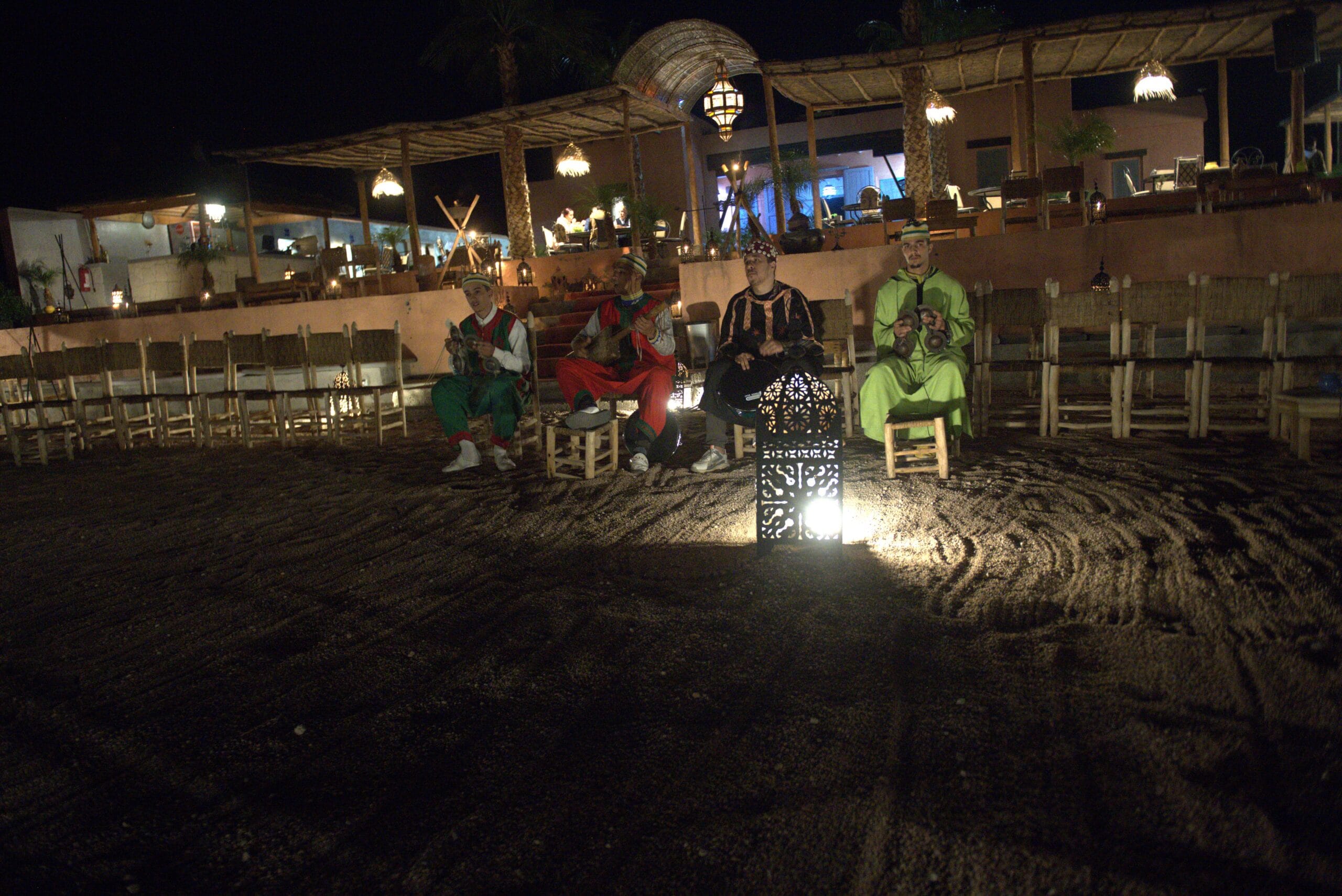
Over the past five years, Agafay has attracted a specific kind of event: curated outdoor DJ gatherings that draw on the desert’s visual drama without trying to replicate a nightclub. The aesthetic leans toward deep house, organic house, and Afro-electronic sounds — genres that sit somewhere between ambient and danceable, suited to open spaces and unhurried evenings.
Several established operators now run monthly or weekly DJ events at permanent desert venues, with setups that include proper sound systems (typically 10 to 20kW rigs), professional lighting, and raised decks positioned to face the Atlas when conditions allow. These are not improvised affairs. The better-organised events invest in technical production that respects the acoustics of the location.
The crowd composition at Agafay DJ events tends to be mixed: Moroccan urbanites from Marrakech and Casablanca, European travellers extending a city break, and a growing contingent of visitors who plan their trip specifically around a desert event. The social atmosphere is generally relaxed and convivial — people come to enjoy themselves, not to compete or perform.
Start times vary. Sunset warm-up sets often begin around 6:30 or 7pm, with the main DJ set running from 9pm to midnight or 1am. Some events extend later on weekends. Unlike urban nightlife, there’s no expectation to arrive late — the desert setting rewards being there for the full arc from dusk to night.
Drink menus at Agafay DJ events typically include mocktails, fresh juices, Moroccan tea, and imported spirits at licensed venues. Food is usually available from a simplified menu or a shared buffet. Admission prices for standalone DJ evenings range roughly from 250 to 600 MAD per person depending on the operator and the calibre of the performer.
Tip : Check whether the event is licensed before booking, particularly if you’re travelling in a group. Licensed desert venues in Agafay operate within clear frameworks and tend to have more consistent production quality.
For many visitors, the choice between Berber music and a DJ set is a false one — because the most popular format in Agafay combines both within a single evening. The dinner show structure typically unfolds in three movements: an aperitif welcome with ambient music or tea ceremony, a seated dinner accompanied by live traditional performance, and a DJ set or live percussion finale that runs until late.
This format works well because it respects the different energies of each art form. Traditional Berber music naturally suits the earlier, quieter part of the evening — the moment when guests are arriving, settling in, and taking in the surroundings. As the night progresses and guests relax into the setting, a DJ set lifts the energy without forcing an abrupt tonal shift.
The quality of dinner shows in Agafay varies considerably. The weakest versions treat both the music and the food as afterthoughts to a theatrical production full of staged elements that feel disconnected from the place. The strongest versions are built around genuine performers — musicians who play full sets rather than snippets, and DJs who understand how to read an outdoor crowd.
When evaluating a dinner show, ask: who are the musicians, how long do they perform, and is the DJ set live or a pre-recorded mix? These details separate a memorable evening from one that leaves you vaguely disappointed. Capacity also matters — a show designed for 200 people operates very differently from an intimate gathering of 30 to 50 guests.
Prices for dinner shows including transport from Marrakech typically range from 600 to 1,200 MAD per person. Higher-end options include a private table, multi-course tagine dinner, and extended programming past midnight.
Tip : Book mid-week if you want a smaller crowd. Weekend dinner shows in Agafay can be heavily attended, which changes the intimacy of the musical performance considerably.
This is a detail that rarely appears in booking descriptions but consistently surprises visitors who pay attention. Agafay’s rocky, relatively flat plateau creates acoustic conditions that are different from both indoor venues and softer sandy desert environments.
Sound in open rocky terrain carries cleanly over medium distances — roughly 50 to 150 metres — then dissipates rather than echoing. This means that without amplification, a gnawa ensemble is best heard within a tight circle. Once you move beyond 20 or 30 metres, the nuance of the guembri’s lower register begins to fade. Intimate seating arrangements are therefore not just about atmosphere — they’re acoustically necessary for traditional music to land properly.
For DJ sets, the same terrain characteristic means that sound engineers need to position speakers carefully. A system calibrated for a flat stone surface behaves differently than one tuned for grass or sand. Experienced desert event operators in Agafay have learned to point speakers slightly downward and use monitor stacks strategically to compensate for sound loss across the plateau.
Wind is the variable that affects both genres unpredictably. Agafay can be still and silent one evening and breezy the next. Traditional music tends to hold up better in moderate wind because acoustic instruments can adjust dynamically. Electronic music suffers more — high frequencies scatter first, which can flatten a DJ set if the wind picks up after 11pm.
This isn’t a reason to avoid either format, but it is a reason to choose operators who have technical experience in this specific environment rather than simply importing a club setup to a desert location.
Tip : If wind conditions are important to you, ask your operator about their backup arrangements. Well-prepared desert venues have partial windbreak structures or can relocate the listening area without cancelling the event.
The nightlife vibe in Agafay is not one-size-fits-all, and the composition of your group genuinely shapes which format will serve you best. This is worth thinking through before booking, because an evening optimised for a couple’s anniversary is structurally very different from one built for a ten-person group celebrating a birthday.
Couples tend to gravitate toward settings that prioritise atmosphere over programming — a private tent with a fire, live gnawa music at a conversational distance, unhurried dining. The Berber music format suits this context well because it rewards presence and listening rather than participation. The slower tempo of a traditional musical evening creates natural space for conversation, and the firelit aesthetic does most of the emotional work without requiring much organisation.
Groups of eight or more, on the other hand, often find traditional music evenings passive to the point of restlessness after the first hour. The social energy of a larger party is better served by a format that allows movement — a DJ set where people can dance, a dinner show with participatory elements, or a hybrid evening that transitions from seated to standing. The collective energy of a group feeding off a good DJ set in an open desert space is a genuinely different and equally valid experience.
Families with children occupy a middle ground. Traditional Berber music — particularly Ahwach with its visual choreography — tends to engage children’s attention in ways that abstract electronic music does not. The earlier portions of a dinner show work well for mixed-age groups, provided the format allows the youngest guests to leave before the DJ set begins.
Solo travellers often report that both formats work, but for different reasons: traditional music evenings feel more socially approachable, while DJ events create organic opportunities to connect with other guests through shared movement and atmosphere.
Tip : If you’re organising a group of more than six, confirm that the venue has a dedicated area for your party rather than placing you in a shared general admission section. Reserved spacing changes the group experience significantly.
Agafay’s outdoor events scene is active year-round, but the experience changes meaningfully across seasons, and the format you choose should take timing into account.
October through April is widely considered the most comfortable period for extended outdoor evenings. Temperatures are cool but manageable — typically 10 to 18°C after dark — and the air is clear enough to make the Atlas visible by moonlight on calm nights. Event organisers tend to run their most ambitious programming during this window, including multi-night festivals and higher-production DJ events. Traditional music evenings are particularly atmospheric in winter, when fires serve a practical purpose and the sensory contrast between cold air and warm flame intensifies the experience.
May and June offer warm but not oppressive nights. This is a transition period where event programming is active but the extreme summer heat hasn’t arrived yet. Visitor numbers increase ahead of the summer peak, which means more options but also higher prices and larger crowd sizes.
July and August are the hottest months, but Agafay evenings cool faster than central Marrakech because of the altitude difference. Late-start events — DJ sets beginning at 10pm or later — are common during summer, allowing guests to arrive after the temperature peak. Traditional music gatherings tend to shift toward midnight fire sessions rather than earlier dinner-adjacent formats.
Ramadan, which falls at different points in the calendar year, changes the rhythm of desert evenings significantly. Many Moroccan musicians and performers observe the fast, and event programming adapts accordingly. Post-iftar (the meal breaking the fast) gatherings can be particularly vibrant — the collective energy of a community emerging from a day of fasting generates a specific social warmth that visitors sometimes find unexpectedly moving.
Tip : Book at least two to three weeks in advance for events falling between mid-October and mid-November. This is one of the busiest periods in Agafay, driven by ideal weather and the post-summer travel surge from Europe.
Understanding what you’re hearing changes what you experience. This is especially true of Berber musical traditions, which carry social and historical meaning that isn’t legible from the outside without some context.
The word Amazigh — the preferred self-designation of Berber peoples — means “free people” in Tamazight, and the music reflects that identity. Berber musical traditions were preserved orally through generations, surviving periods when Tamazight language and culture were marginalised politically. Today, the recognition of Tamazight as an official Moroccan language (a constitutional change that came into effect in 2011) has given these traditions renewed visibility and pride.
When you watch an Ahwach performance, you’re watching a community art form that historically had no audience — it was made by and for the participants. Adapting it for visitors involves inherent compromise, but the best performers maintain the internal logic of the form: the leader sets the tempo and direction, the group responds collectively, and the music evolves through group listening rather than individual virtuosity.
Gnawa music carries an even more specific cultural weight. Rooted in the history of sub-Saharan African communities brought to Morocco over centuries, gnawa ceremonies are traditionally associated with healing and trance. The music’s repetitive, hypnotic structure serves this function deliberately. Even in a non-ceremonial context, an experienced gnawa musician will take a set somewhere — there’s an arc and an intention that rewards patient listening.
None of this means you need to be reverential or silent during a performance. But approaching these evenings with genuine curiosity rather than treating them as background ambience tends to produce a much richer experience. Ask your guide or host questions. Performers generally appreciate engagement over polite passivity.
Tip : If your guide or camp host is Amazigh, ask them about their regional musical tradition specifically. Morocco’s Berber cultures vary significantly across the Souss, Middle Atlas, Anti-Atlas, and Rif regions, and a local perspective adds considerable depth.
The distance between Marrakech and Agafay is short enough to make evening logistics manageable, but requires more planning than a night out in the medina. A few practical realities are worth knowing in advance.
Transport is the most important variable. Most visitors rely on one of three options: organised transfer included in the event ticket, private taxi negotiated in advance, or a rental car. The road to Agafay is paved and well-maintained to the major camp areas, but final approach tracks to some smaller venues can be rough. If you’re driving, confirm whether the camp is accessible by standard car or requires a 4×4 for the last stretch.
Organised transfers leave from fixed pickup points in Marrakech — typically near Djemaa el-Fna or from major hotels. Departure times are usually set between 6 and 7pm for sunset experiences, and return transfers run at a fixed hour (often midnight or 1am). If you want flexibility to stay later, a private arrangement is worth the extra cost.
What to bring depends on the format of your evening. For dinner shows and traditional music events, smart casual clothing works well — nothing too light, since the temperature drop is real. For DJ events where dancing is likely, layers you can remove are practical. Closed footwear is more comfortable on rocky terrain than sandals, particularly after dark.
Photography is generally welcomed at desert events, but ask before photographing performers up close. In traditional musical contexts especially, a moment of respect before pointing a camera tends to be appreciated. Most desert venues have areas with strong ambient lighting that make good natural photos without flash.
Connectivity is limited in Agafay — mobile signal is patchy and venue Wi-Fi is often inconsistent. This is, for many visitors, a feature rather than a problem.
Tip : Confirm your return transfer time at the start of the evening, not at the end. Some operators are flexible about late departures if the event is running long, but you need to arrange this while the event manager is available rather than at midnight.
After nine distinct dimensions of the nightlife vibe in Agafay, the practical question remains: which format do you actually choose?
Choose a traditional Berber music evening if your priority is cultural depth and a slower pace. This format rewards you most if you’re willing to listen actively, if you’re in a couple or small group, and if you value the texture of an experience over its energy. It works particularly well for people visiting Morocco for the first time who want to understand something real about the culture rather than simply enjoying an impressive setting.
Choose a DJ-led desert event if your priority is atmosphere and social energy. This format suits groups, celebratory occasions, and travellers who want to feel the specific pleasure of dancing in a landscape that is genuinely extraordinary. It does not require any specific cultural knowledge to enjoy — it asks only that you show up and let the setting do its work.
Choose a dinner show that combines both if you want to avoid the trade-off entirely. This is the most popular format for a reason: it gives you cultural grounding in the earlier hours and a livelier finale without demanding a single-minded commitment to either register. The risk is that hybrid formats sometimes execute both elements at a moderate level rather than either at a high level. Research the specific operator, not just the concept.
The nightlife vibe in Agafay is genuinely plural — it holds traditional and contemporary without contradiction. The Atlas doesn’t care what’s playing at its feet. What matters is that you choose deliberately, arrive curious, and stay long enough to let the desert night settle into you properly.
Tip : If you’re undecided, start with a dinner show on your first visit. You’ll get enough exposure to both worlds to know which one you’d want more of on a return trip — and Agafay is the kind of place that does generate return trips.
The nightlife vibe in Agafay isn’t defined by a single genre or format — it’s shaped by the tension between two very different kinds of energy, both of which feel entirely at home on this rocky plateau outside Marrakech.
Whether you spend an evening inside the slow, hypnotic pull of a gnawa set or dancing under a speaker stack as the Atlas disappears into darkness, you’re experiencing something that exists almost nowhere else: a landscape that makes both intimacy and spectacle feel natural at the same time.
At Quad Marrakech, we’ve spent over 14 years helping travellers find their way into the Agafay experience — from adrenaline-filled afternoons on quads and buggies to immersive desert dinner shows as the sun goes down. Our team knows this terrain, these camps, and these performers by name.
Ready to plan your Agafay evening? Browse our desert experiences or contact our team directly to build an evening around what you’re actually looking for.
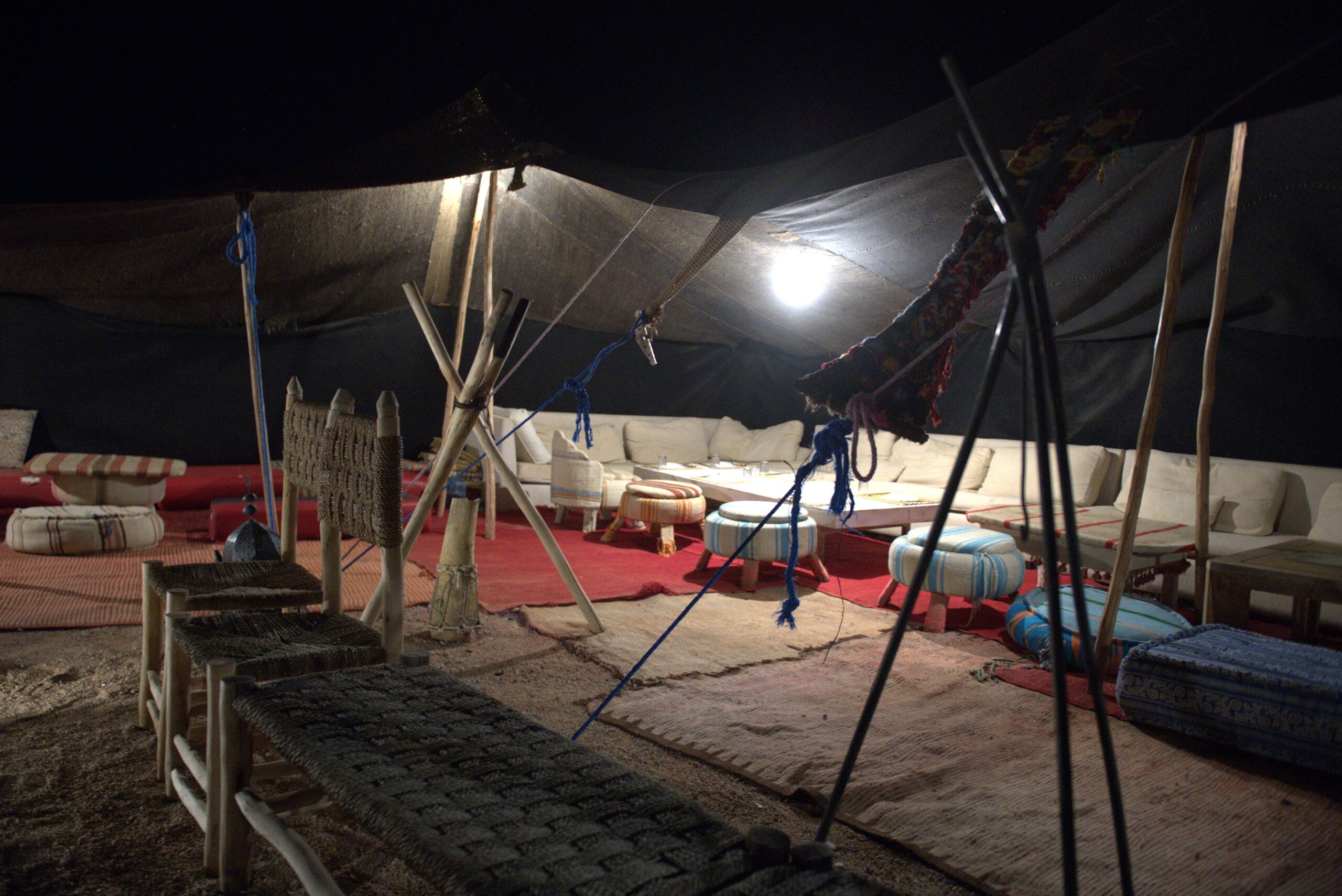
Agafay nightlife is quieter and more atmospheric than the medina scene in Marrakech. The desert setting — 30 kilometres from the city — creates an open-air experience centred on dinner shows, live Berber music, and curated DJ events rather than traditional bars or clubs. The pace is generally slower and more deliberate.
Yes, most reputable desert camps and dinner shows in Agafay include live Berber music performed by local musicians. The styles most commonly featured are gnawa and Ahwach. Quality varies between operators — ask specifically whether the performance is live throughout the evening or limited to a short segment.
Yes. Several venues in Agafay host regular DJ evenings, particularly on weekends. These events typically feature deep house, organic house, or Afro-electronic music and run from sunset into the early hours of the morning. Some are standalone events; others are included within a broader dinner show format.
Agafay evenings are noticeably cooler than Marrakech city. In summer, temperatures drop to around 20–22°C after 10pm. In autumn and spring, nighttime temperatures can fall to 12–16°C. Bringing a light jacket or layer is always recommended, regardless of the season.
Agafay is approximately 30 kilometres southwest of Marrakech city centre, a journey of 30 to 45 minutes by road. Most evening events include organised transfers from central Marrakech pickup points. Private taxis and rental cars are also options, though some camps require 4×4 access for the final approach.
Yes, many dinner shows in Agafay are family-friendly, particularly the earlier parts of the programme featuring traditional music and dinner. Families with young children typically leave before the DJ portion of the evening. Confirm the programme schedule and child pricing with the operator before booking.