No products in the basket.

 Zakaria Belkhay
May 15, 2026
Zakaria Belkhay
May 15, 2026
An Essaouira day trip from Marrakech delivers a complete change of scenery, climate, pace and atmosphere within a 2.5-hour drive — making it the most refreshing single-day escape available from Morocco’s Red City.
Where Marrakech is landlocked, ochre-hued and sensory-intense, Essaouira is blue, white and silver — an 18th century fortified Atlantic port city where the wind never quite stops blowing, the light is completely different, the seafood is extraordinary and the pace of life feels like it operates in a different time zone. Artists, musicians and surfers have been drawn here for decades by precisely this quality of gentle otherness.
This complete guide to the Essaouira day trip from Marrakech covers everything: the best way to get there, what to see and do in the time available, where to eat for the definitive fresh fish lunch, what makes Essaouira unique, practical tips for managing a day trip efficiently, and whether you should consider staying overnight instead of returning the same day.
| Quick Facts: Essaouira is 190 km west of Marrakech on the Atlantic coast. Drive time: 2.5 to 3 hours by car or organized transfer. The city is a UNESCO World Heritage Site, known for its 18th-century Portuguese-influenced ramparts, exceptional seafood, argan oil products, Gnawa music tradition and world-class windsurfing conditions. |
One of the paradoxes of an Essaouira day trip from Marrakech is that it often makes travelers appreciate Marrakech more deeply. The sensory intensity of the Red City medina, when contrasted with Essaouira’s breezy, unhurried blue-and-white calm, gives both places their full character. Travelers who spend their entire Marrakech trip within the city often miss this perspective.
Essaouira offers what Marrakech fundamentally cannot: the ocean, Atlantic seafood cooked on harbourside grills, the sound of wind and waves rather than motorcycle engines, and a medina that is navigable, unfrantic and genuinely relaxed. For many visitors, a day in Essaouira resets their entire travel energy and allows them to return to Marrakech with fresh eyes.
A day trip from Marrakech to Essaouira with a 2.5-hour each-way transfer gives you approximately 5 to 6 hours in the city. This is enough to:
It is not enough to explore the argan cooperatives in depth, do a full surfing session, or take the long beach walk to Diabat village. If any of these are priorities, consider an overnight stay.
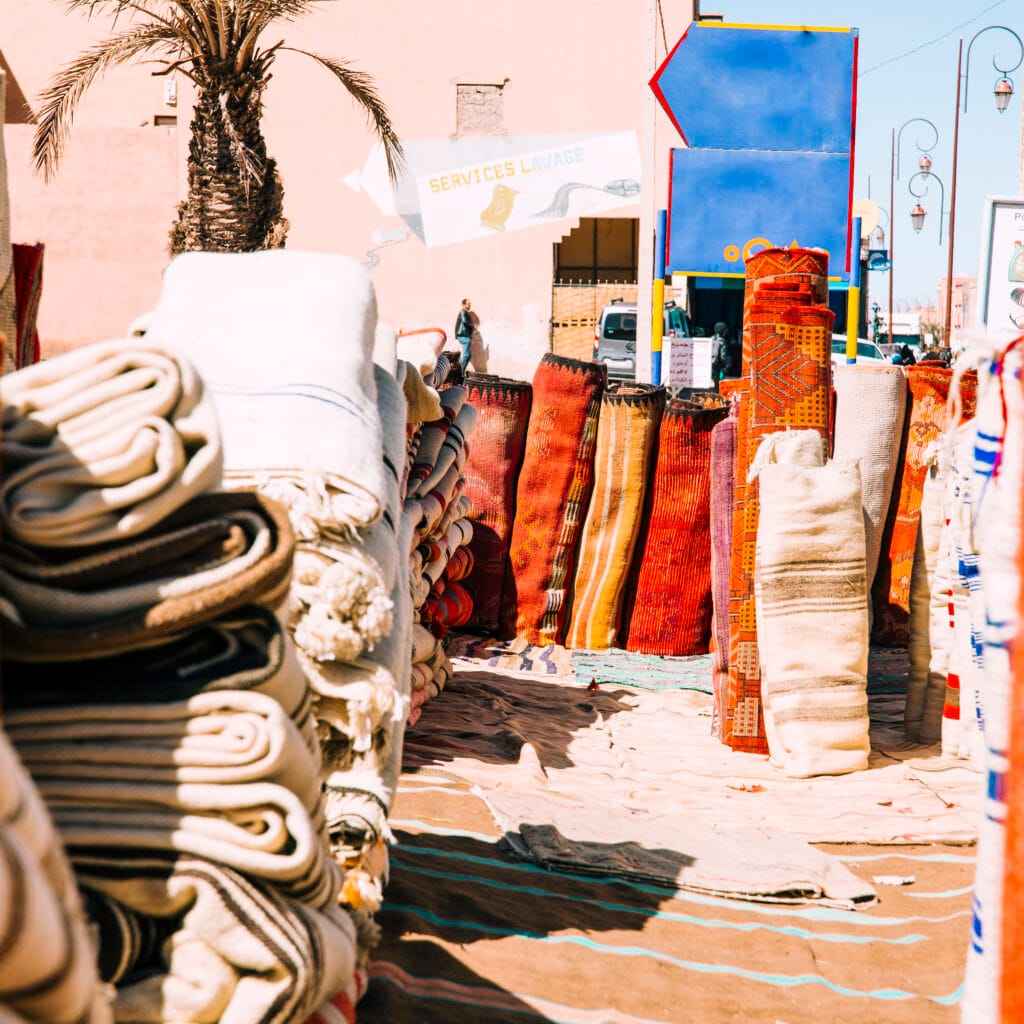
An organized day tour from Marrakech to Essaouira picks you up from your accommodation, transfers you comfortably to Essaouira, provides either a guided walk or free exploration time, organizes the return transfer and delivers you back to your riad in the evening. This format eliminates all logistics decisions on the day and is particularly good for first-time visitors who want to maximize the experience without navigating bus stations and timetables.
CTM (the main Moroccan long-distance bus company) runs regular services between Marrakech’s Bab Doukkala bus station and Essaouira. Journey time: approximately 3 hours. Price: 80–100 MAD (7–9 €) one way. The bus is comfortable, air-conditioned and reliable. The trade-off is fixed departure times (typically 8:00 AM and 2:00 PM from Marrakech, similar from Essaouira) which constrain the day’s flexibility — particularly the return timing.
The drive from Marrakech to Essaouira is genuinely beautiful. The route crosses the Jbilet hills, descends into the Haouz plain, enters argan forest territory (the extraordinary silver-trunked trees that produce Morocco’s most prized culinary oil) and eventually arrives at the Atlantic coast with its distinctive grey-blue light. With a rental car, you control every stop, every timing decision and can detour to an argan cooperative or a coastal viewpoint without asking anyone’s permission.
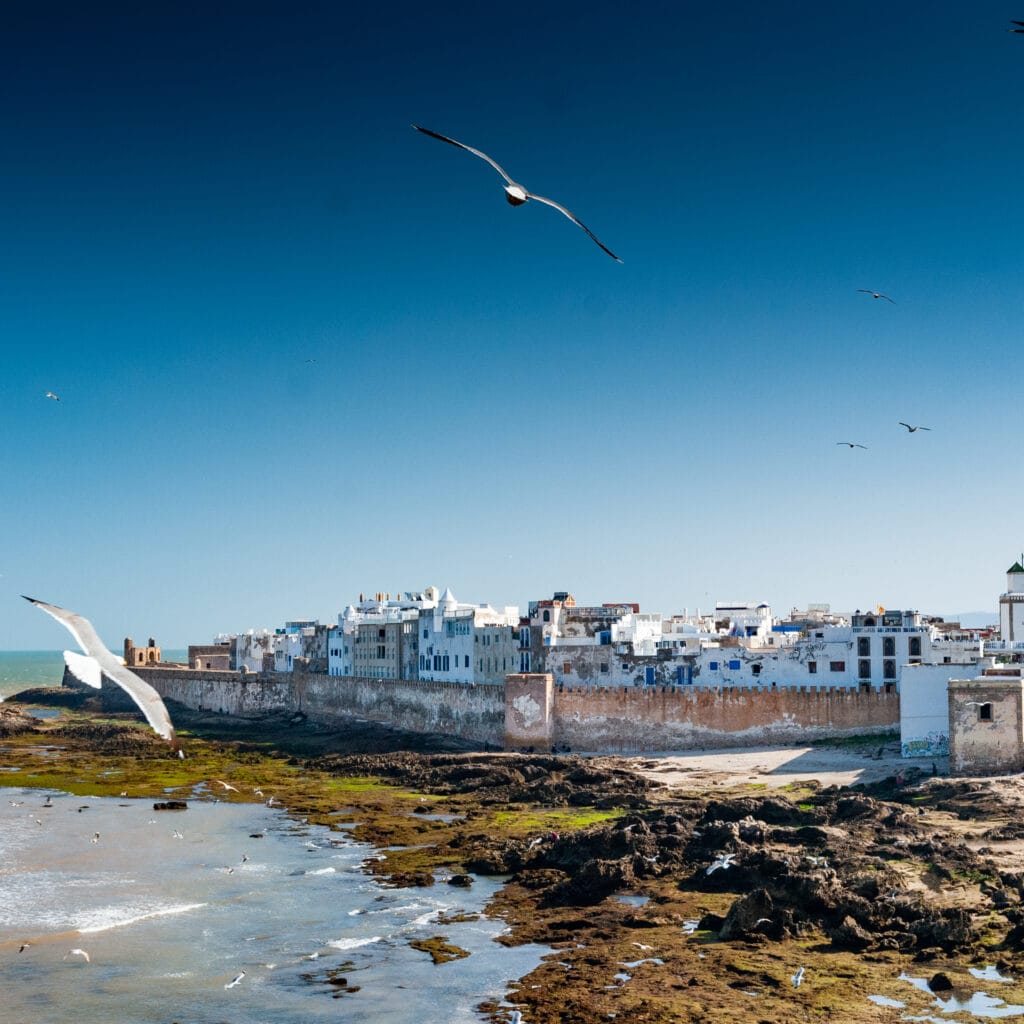
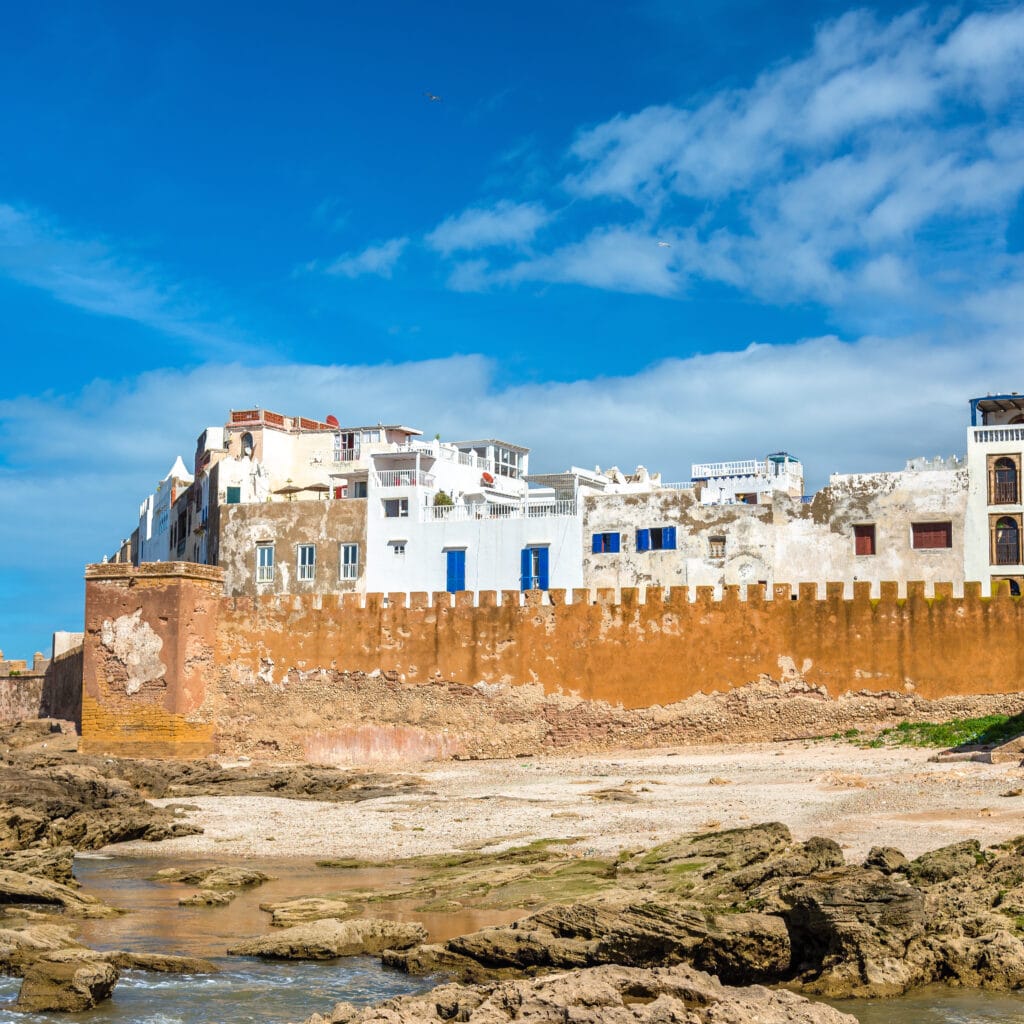
The best introduction to Essaouira is to walk the Skala de la Ville — the sea-facing rampart walkway that runs along the city’s western wall above the Atlantic. From here, the full geometry of the fortified city is apparent: the 18th-century Portuguese-influenced defensive architecture, the row of ancient bronze cannons pointing seaward, the blue fishing boats below, and the grey-green Atlantic stretching to the horizon. The wind hits you full force and immediately explains Essaouira’s reputation as Africa’s wind capital.
Unlike Marrakech’s medina, Essaouira’s walled city is compact, navigable and genuinely unhurried. The main artery, Avenue de l’Istiqlal, runs through the heart of the medina and is lined with blue-shuttered workshops selling the thuya wood marquetry (an Essaouira specialty — the distinctive warm-grained wood from the local arborvitae tree), silver jewelry, leather goods and argan oil products.
The artisan quarter near the northern bastion is where you find the working craftsmen: marquetry workshops where you can watch the inlay process, silversmith studios, djellaba tailors. This area is less commercially aggressive than Marrakech’s main souk corridor and the craftsmen are generally more willing to show their work without sale pressure.
The fresh fish grills at Essaouira’s working harbour are the most compelling culinary reason to make the trip. A row of identical stalls operates along the quayside, each selling the morning’s catch grilled to order over charcoal: whole sea bream, red mullet, sardines, squid, prawns, crab, sole. You walk along the stalls, select your fish from the fresh display, and it’s grilled in front of you and served with bread, olives and harissa.
The experience is noisy, competitive (stall owners invite you to sit with theatrical enthusiasm) and entirely worth the gentle chaos. The key is to look at the fish quality rather than responding to the loudest invitation. Fresh fish has clear eyes, red gills and firm flesh — avoid anything that looks dull or smells strongly. Once you sit, the price is typically a flat rate per fish type — ask the price before the fish hits the grill.
Essaouira’s beach — a vast 15-km crescent of sand stretching south from the ramparts — is unlike any Mediterranean beach experience. The Atlantic wind is constant and strong (Essaouira is consistently rated among the world’s top windsurfing and kitesurfing destinations). The beach is dramatic, wide, wild and beautiful. Swimming is possible but the currents can be strong — check local advice before entering the water. The beach scene is active: local footballers, horse riders, kitesurfers, and in summer, a significant beach camp culture.
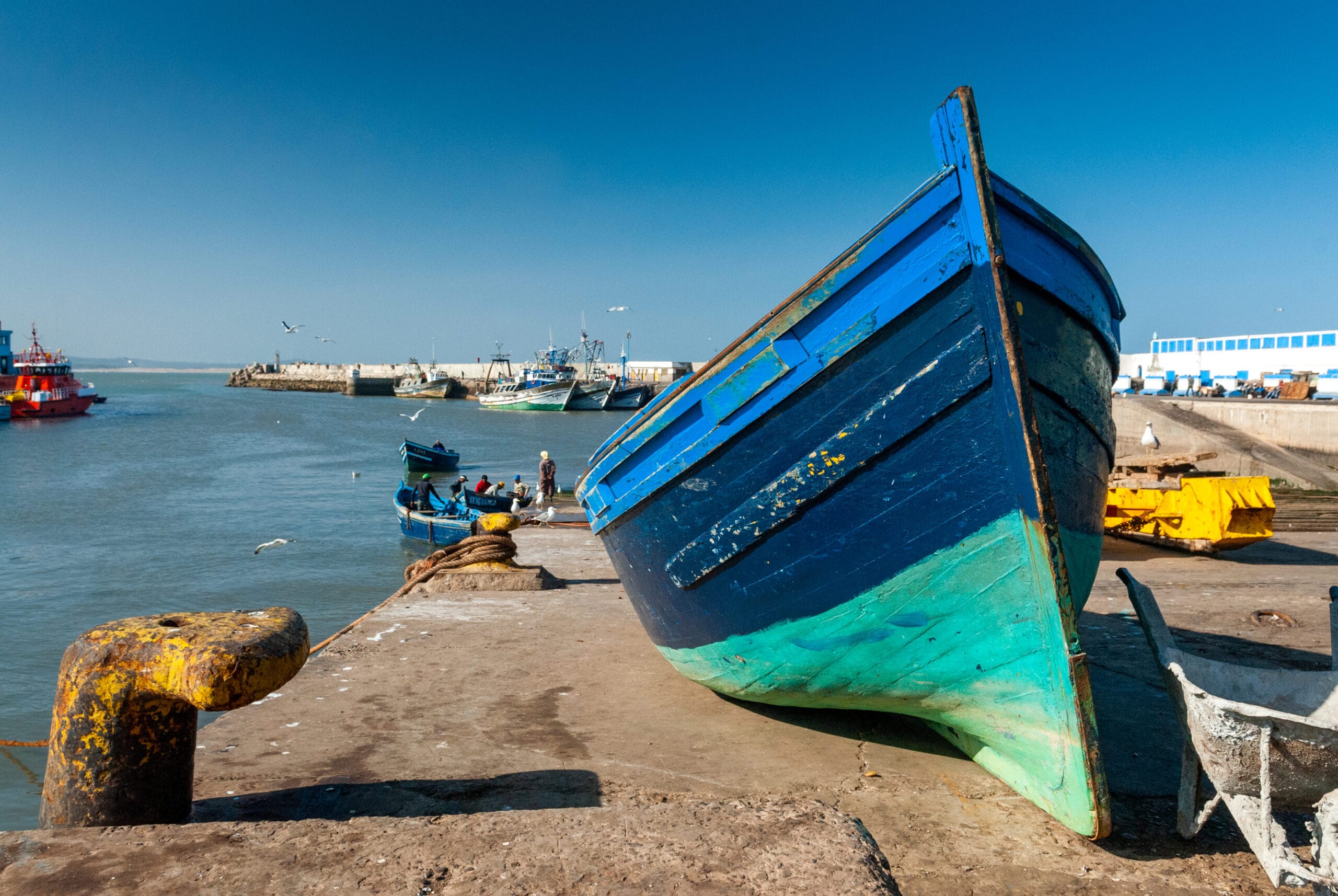
Essaouira’s working fishing port, entered through the southern gate of the medina, is one of Morocco’s most photogenic working harbours. The fleet of vivid blue wooden fishing boats — the same shade of cobalt as the medina shutters — contrasts spectacularly with the grey-white rampart walls and the silver Atlantic light. Fishermen repair nets, unload catch, prepare for the evening’s departure. Seagulls wheel overhead in enormous flocks. The smell is intense and authentically oceanic.
The afternoon light (2:00–5:00 PM) is particularly beautiful here — low-angle Atlantic sunlight on blue boats with minimal tourist crowds. Allow 30–45 minutes and bring your camera.
Reserve the final hour before departure for unhurried browsing in the medina’s quieter back streets. The rue de la Scala and the alleys near the northern bastion have a different quality in the afternoon light — less crowded, more atmospheric. This is also when any final purchases make the most sense: you’ve seen everything, you know the prices, and you can negotiate without time pressure.
Essaouira has a particularly strong Gnawa music tradition. The Gnawa World Music Festival, held annually in June, attracts international artists who collaborate with local Gnawa masters in a unique fusion. Even outside festival time, Gnawa musicians play in the medina’s cafes and public spaces with a frequency and authenticity that gives the music its full context. If you encounter a Gnawa circle in Essaouira, stop and listen — the hypnotic guembri bass, the qraqeb castanets and the call-and-response chanting reach their most transportive form here.
The landscape between Marrakech and Essaouira passes through one of the world’s only argan forests — the ancient arborvitae trees that produce the oil used in Moroccan cooking and cosmetics. Women’s cooperatives processing argan oil operate along the main road and in the Essaouira region. A cooperative visit (usually free) shows the full process: crushing the nuts, grinding the paste, pressing the oil. Buying argan oil directly from a certified cooperative guarantees quality, fair trade practice and direct economic benefit to Amazigh women producers.
Essaouira’s defining physical characteristic is the wind — the alizé trade wind that blows consistently from the north throughout spring and summer, moderating temperatures (Essaouira is 10–15°C cooler than Marrakech in summer) and creating the conditions that have made it one of the world’s premier windsurfing destinations. If you visit in summer, the wind is an active relief from Marrakech’s heat — bring a light windproof jacket. In winter, it can feel cold. Year-round, it gives the city a breezy, invigorating energy that is completely absent from inland Marrakech.
In the late 1960s and early 1970s, Essaouira (then known as Mogador) became a gathering point for musicians, artists and travellers following the hippie trail through Morocco. Jimi Hendrix visited and reportedly considered buying land in the area. Cat Stevens, Frank Zappa and numerous European artists passed through. This bohemian history left a cultural imprint that persists — Essaouira remains more artistically and culturally diverse, more cosmopolitan and more musically oriented than almost any comparably-sized Moroccan city.
| Factor | Day Trip | Overnight Stay |
| Cost | Transfer only (80–600 MAD) | Transfer + accommodation (500–2,000 MAD extra) |
| Time in city | 5–6 hours | 18–24+ hours |
| Evening atmosphere | Missed | Essaouira’s best kept secret |
| Surfing/kitesurfing | Not practical | Full sessions possible |
| Pacing | Efficient but rushed | Relaxed, unhurried |
| Logistics | Simple, one base | Extra pack/unpack |
| Season | Conditions | Notes |
| Spring (Mar–May) | 18–22°C, moderate wind | Best overall — comfortable, clear Atlantic light |
| Summer (Jun–Aug) | 20–26°C, strong wind | Relief from Marrakech heat; wind can be strong |
| Autumn (Sep–Nov) | 18–24°C, calmer | Excellent — harvest season, calmer seas |
| Winter (Dec–Feb) | 14–18°C, variable | Cold and potentially rainy — pack warm layers |
| Summer Essaouira secret: Essaouira in July and August is genuinely pleasant — the Atlantic wind keeps temperatures 10–15°C cooler than Marrakech. When Marrakech is unbearable at 40°C, Essaouira is a refreshing 24°C with a sea breeze. A summer day trip from Marrakech to Essaouira is one of the best strategies for escaping the heat. |
The Essaouira day trip from Marrakech is the one excursion that most consistently exceeds expectations — travelers who arrive uncertain whether the 2.5-hour drive was worth it almost universally leave saying they wish they’d stayed overnight. The fish lunch alone, the cobalt boats against silver water, the breezy medina that feels like nobody is trying to sell you anything, the rampart walk above the Atlantic — these are experiences that add a completely different dimension to a Marrakech trip.
Key points to remember:
Looking for other spectacular day trips from your Marrakech base? Our Agafay Desert evening packages offer the completely opposite experience — total desert silence, camel rides at sunset and a starlit Berber dinner, all 30 km from the city. The perfect complement to an Essaouira Atlantic day.
Essaouira is approximately 190 km west of Marrakech, on Morocco’s Atlantic coast. By car or organized transfer on the N1 highway, the journey takes 2.5 to 3 hours depending on traffic leaving Marrakech and any stops along the route. The road passes through the distinctive argan forest landscape and climbs over the Jbilet hills before descending to the coast. By CTM bus from Marrakech’s Bab Doukkala terminal, the journey takes approximately 3 hours.
Absolutely — the Essaouira day trip from Marrakech is consistently rated as one of the best single-day excursions in Morocco. The combination of the UNESCO-listed medina, the working harbour with its cobalt fishing boats, the extraordinary fresh fish lunch on the quayside grills, the sea rampart walk and the breezy Atlantic atmosphere creates an experience completely unlike anything available in Marrakech itself. The 5-hour drive round trip is the only real cost — and the experience justifies it entirely.
Essaouira is famous for four things: its stunning 18th-century Portuguese-influenced fortifications and medina (UNESCO World Heritage Site), its extraordinary fresh seafood particularly at the working harbour grills, its status as one of the world’s premier windsurfing and kitesurfing destinations (the consistent alizé trade wind creates ideal conditions), and its Gnawa music tradition which reaches its annual peak during the international Gnawa World Music Festival in June. The city is also the heart of Morocco’s argan oil production region.
A day trip works well if you want the medina, the fish lunch, the ramparts and the beach view — all achievable in 5–6 hours. Stay overnight if you want to experience Essaouira in the evening when the daytime wind calms and the medina takes on a different character, if you want to surf or windsurf, or if you simply want a relaxed pace without the return transfer pressure. Many travelers who arrive on a day trip find themselves wishing they had booked accommodation and stayed — consider treating the day trip as a reconnaissance and returning for longer on a future Morocco visit.