No products in the basket.

 Zakaria Belkhay
June 27, 2026
Zakaria Belkhay
June 27, 2026
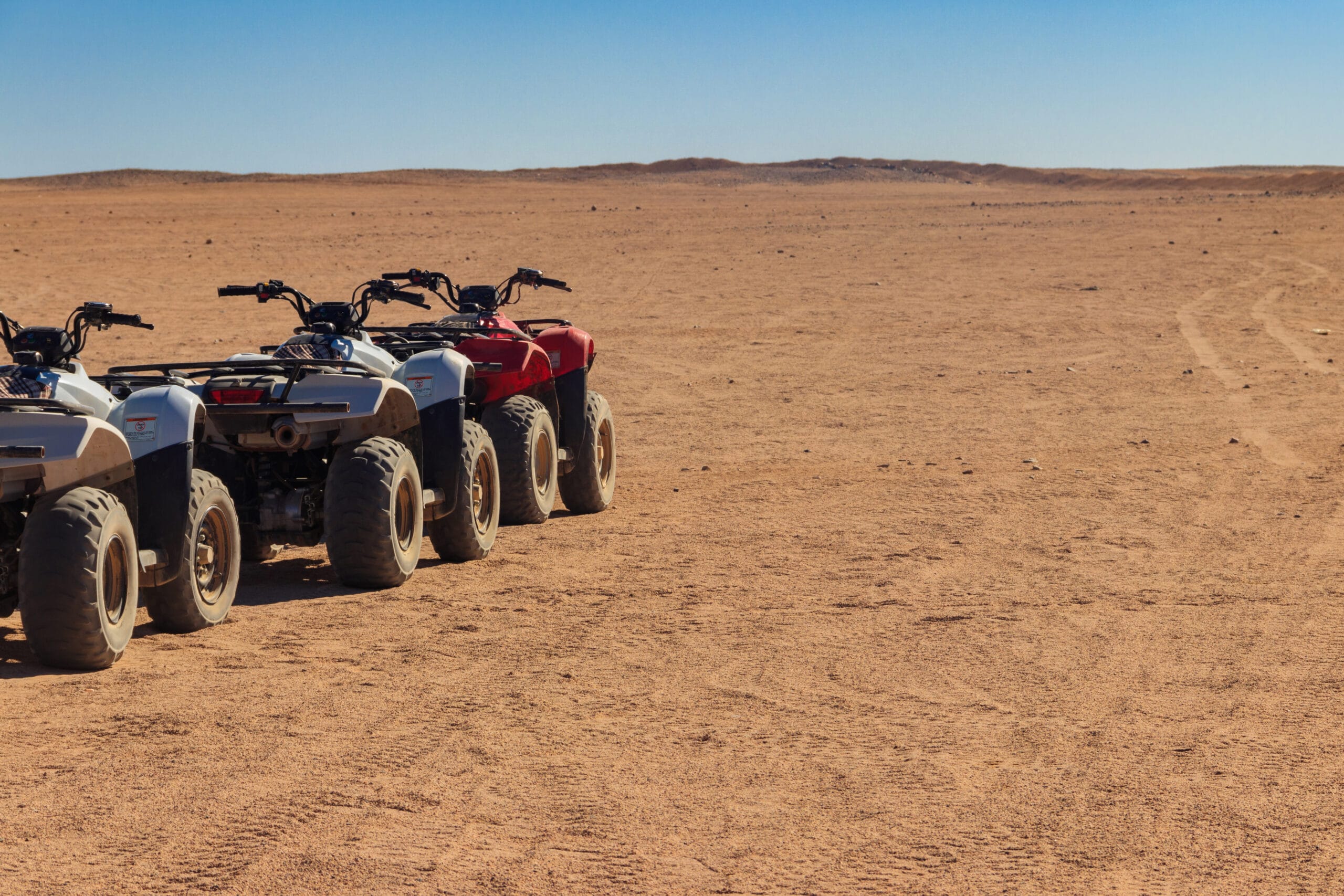
Most people picture Marrakech quad biking as a sweaty, sun-scorched affair — dust rising off the Agafay desert, hands tight on the handlebars under a blazing July sky. Winter flips that entirely.
From November through February, temperatures in the Greater Marrakech area hover between 6°C and 18°C depending on the hour. The light is softer, the landscape more textured, and the trails far less crowded. For families, couples, and first-time riders especially, these months offer some of the most rewarding conditions of the year — provided you know what to bring and what to expect.
This guide breaks down 10 essential things to know before you book a winter quad ride near Marrakech. We cover clothing layers that actually work at speed, terrain and visibility conditions specific to the season, timing tips, safety considerations, and what makes a cold-weather ride in the Agafay or the Atlas foothills genuinely different from its summer equivalent. No guesswork — just practical, ground-level advice from people who run these routes year-round.
The first thing most winter riders underestimate is the wind chill factor. Marrakech’s daytime temperatures in December or January might read a comfortable 14°C on your phone, but at 40–50 km/h on a quad, that same air feels closer to 5°C or below. Even a 30-minute ride without wind protection can leave you genuinely cold by the halfway point.
The physics here are straightforward: moving air strips heat from your body far faster than static cold. A light jacket that works perfectly for a stroll through the medina will be completely inadequate on the trail. This is true even on sunny afternoons.
Morning departures — typically between 8:00 and 10:00 — are the coldest windows. The desert around Agafay retains almost no heat overnight, so the air at that hour is sharp and dry. Afternoon rides (from 14:00 onward) tend to offer warmer conditions, though the temperature drops again quickly after 16:30 as the sun lowers toward the Atlas.
The practical takeaway: always dress for 5°C warmer than you think you need, then strip a layer if you overheat. You can tie a jacket around your waist or stow it in a small bag. You cannot add a layer you didn’t bring.
Families with young children should be especially careful here — kids lose body heat faster than adults and are less likely to flag discomfort before it becomes a problem. Build in an extra layer for anyone under 12.
Tip : Check the forecast the night before and look at the ‘feels like’ temperature at the time of your ride, not just the daytime high. Apps like Weather Underground or Meteoblue give more granular data for the Marrakech-Agafay corridor than standard weather apps.
Dressing for marrakech quad biking in winter follows the same logic as any wind-exposed outdoor activity: base layer, mid layer, outer shell. But there are specifics worth knowing for this particular terrain and pace.
Base layer: A fitted thermal top — merino wool or synthetic — worn directly against the skin. Avoid cotton entirely. Cotton absorbs sweat and holds moisture against your body, which accelerates heat loss. A merino base layer the thickness of a long-sleeve t-shirt is enough for most winter days in Marrakech.
Mid layer: A fleece or lightweight insulated jacket (down or synthetic). This is your primary insulation. It should fit close enough that it doesn’t billow open at speed but still allow free arm movement for steering. A full-zip fleece gives you the option to ventilate if the pace drops and you warm up.
Outer shell: A windproof layer is more important than a waterproof one in Marrakech’s dry winter climate. A softshell or windbreaker stops the wind chill without adding unnecessary bulk. If rain is forecast — rare but possible between December and February — a packable rain jacket doubles perfectly as a wind layer.
For the lower body, thermal leggings under regular trousers or dedicated hiking pants work well. Jeans are a common choice but they restrict movement slightly and take a long time to warm up if cold at the start.
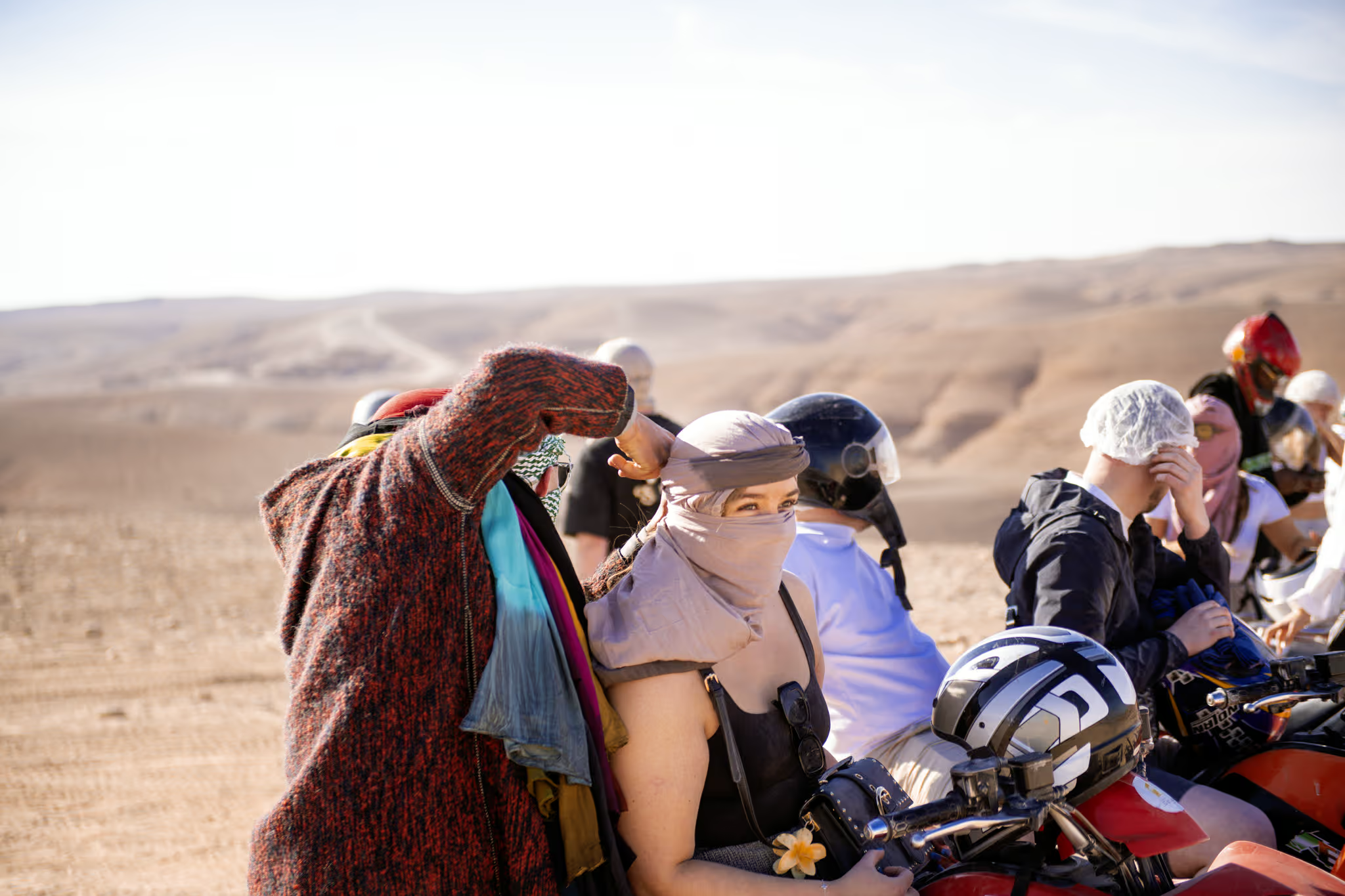
Gloves deserve a specific mention: handlebar vibration on rough desert tracks is constant, and bare hands in cold wind become uncomfortable within minutes. Lightweight touchscreen-compatible gloves are a sensible addition to any winter kit.
Tip : Most quad operators provide helmets and sometimes basic goggles, but not cold-weather clothing. Bring your own gloves and a neck gaiter or buff — these two items make more difference than any extra jacket.
Feet are often the forgotten variable in winter quad preparation, and they’re also one of the hardest to fix mid-ride. Exposed or inadequately insulated feet in cold, dry desert air become uncomfortable fast — and on longer rides of 1.5 to 2 hours, that discomfort compounds significantly.
The key risk is twofold: cold and vibration. Quad bikes transmit a continuous low-frequency vibration through the footrests. Over time, this reduces circulation in the feet, making them feel colder than the air temperature alone would suggest. A thin sole accelerates this.
The right choice is a closed-toe shoe or boot with at least moderate ankle support and a sole thick enough to dampen vibration. Hiking boots or sturdy trail runners are ideal. Avoid flip-flops or sandals entirely — most reputable operators will decline to let you ride in open-toe footwear regardless of season. Avoid very rigid motorcycle boots unless you’re experienced with them, as they can limit your ability to dismount quickly if needed.
Wool or thermal socks make a meaningful difference. A single pair of merino hiking socks, worn inside a trail shoe, will keep your feet comfortable across the full duration of a standard Agafay circuit. If you tend to run cold in general, consider a thin liner sock underneath.
One practical note for families: children’s shoes tend to have thinner soles than adult footwear. Make sure younger riders have their warmest trainers or light hiking boots, not canvas shoes or school plimsolls.
Tip : If you’re arriving directly from a warm climate and your regular footwear isn’t suitable, a basic pair of trail runners can be found at the Marrakech Marjane or Carrefour before your excursion for under 300 MAD.
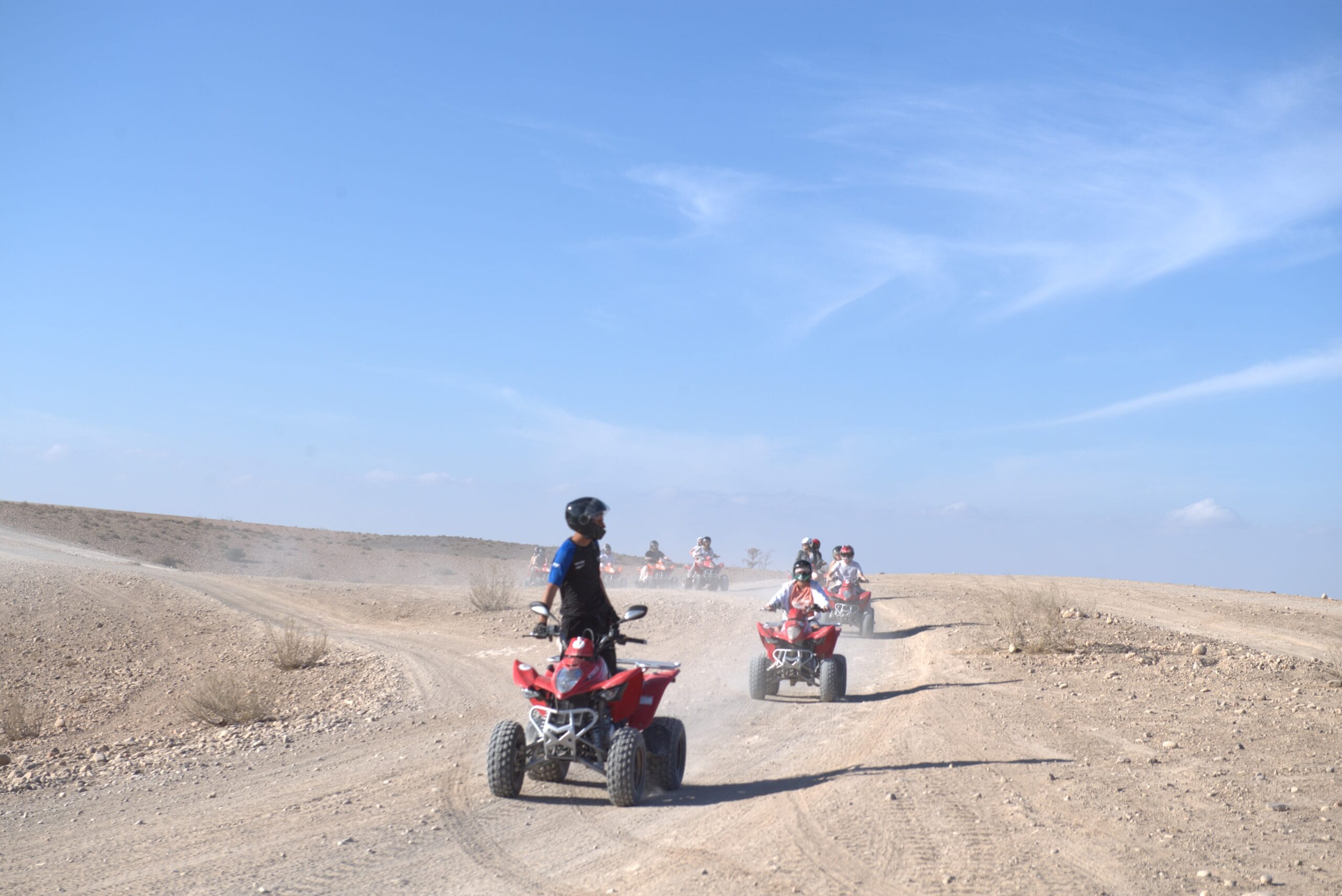
Winter fundamentally changes the calculus of when to ride. In summer, the opposite logic applies: early mornings are essential to beat the heat. In winter, timing is more about light, temperature arc, and what kind of experience you’re after.
Morning rides (8:00–11:00): These offer the most dramatic visual conditions. The low winter sun cuts across the Agafay plateau at an acute angle, casting long shadows across the rocky terrain and making the Atlas peaks — often snow-capped from November onward — stand out in extraordinary relief. Photographers and couples particularly appreciate this light. The tradeoff is cold: expect 6–10°C at departure, rising gradually. Dress your warmest and you’ll be rewarded.
Midday rides (11:00–14:00): The warmest window of the winter day. Temperatures can reach 16–18°C in a calm, sunny spell. Good for families with young children or anyone who prefers comfort over dramatic light. The Atlas backdrop is still clear on most days, though haze can build by early afternoon.
Afternoon rides (14:00–17:00): Warming midday air means a comfortable start, but temperatures fall noticeably from around 16:00. Sunset rides (arriving back at dusk) combine reasonable warmth with beautiful evening light. This slot is popular for couples combining a quad experience with an Agafay dinner show — the timing works naturally.
One consideration worth raising: winter days are short. Sunset in Marrakech falls between 17:30 and 18:00 depending on the month. Any ride that starts after 15:30 will end in diminishing or post-sunset light. That’s not necessarily a problem, but it’s worth factoring into your plans if you’re combining activities.
Tip : For an Agafay dinner show combo, a 14:30 quad departure followed by a sunset transfer to the camp works well logistically and covers two very different experiences in one afternoon.
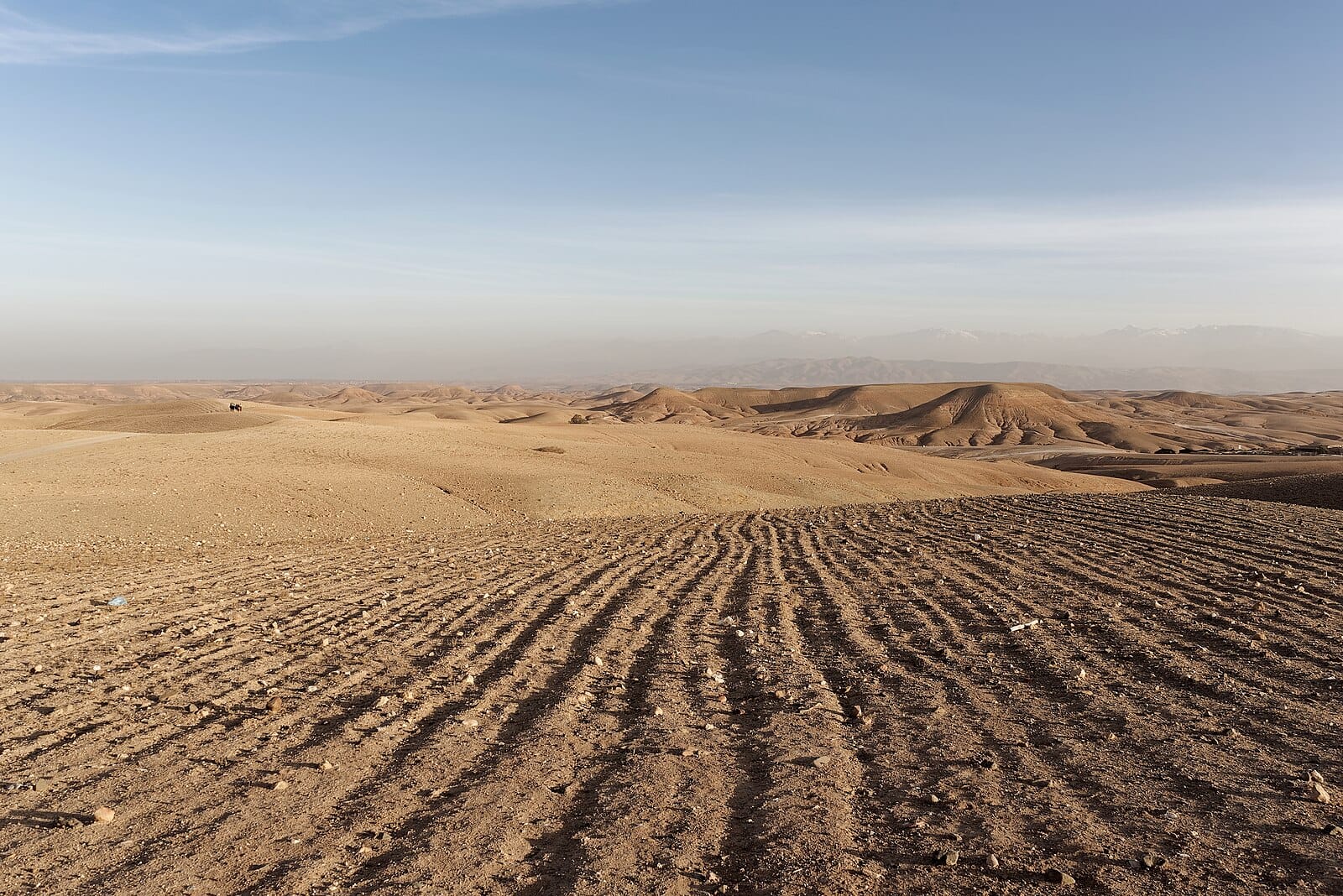
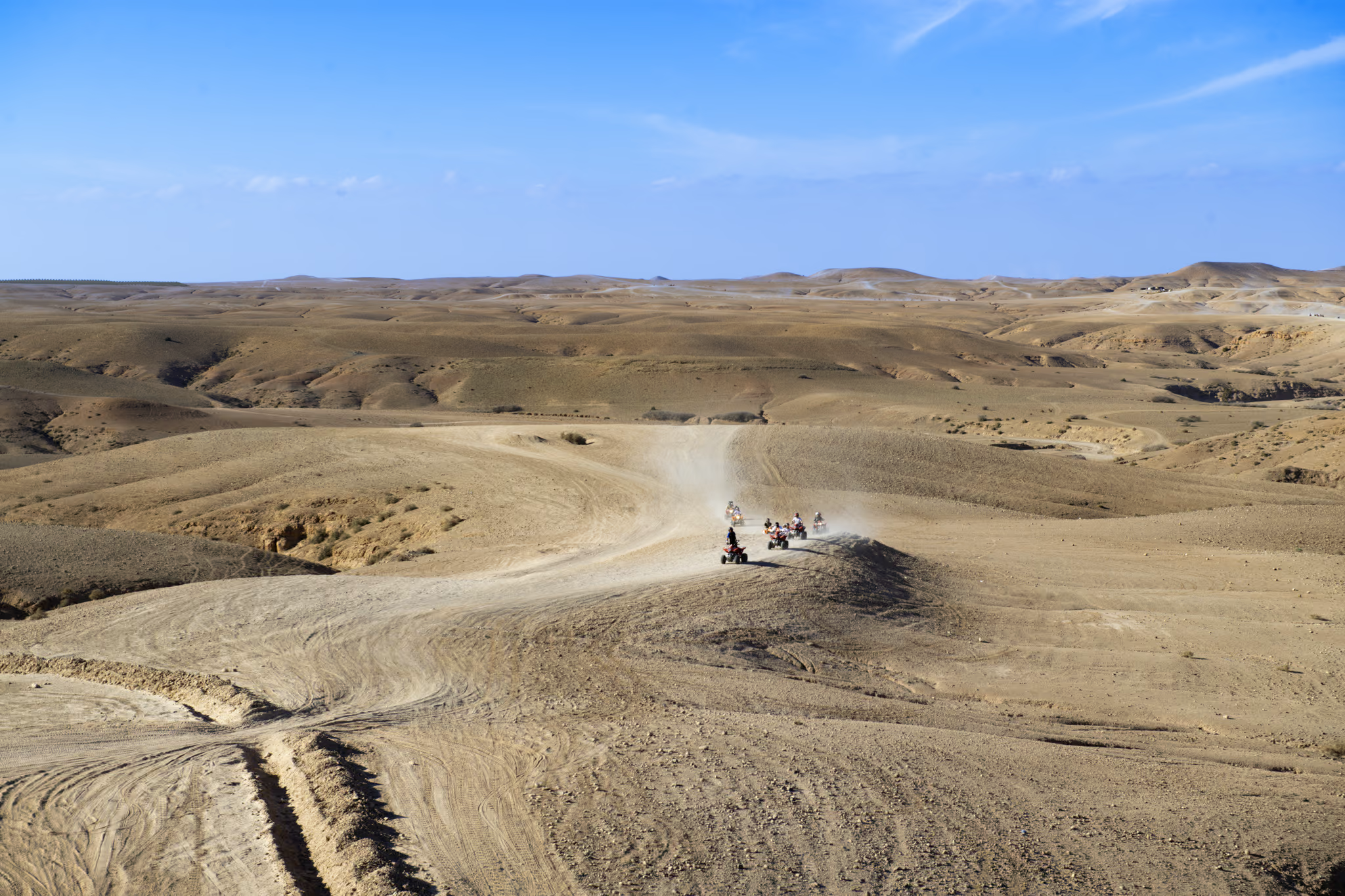
The Agafay desert — the rocky, mineral plateau roughly 30 km southwest of Marrakech — is the primary quad biking terrain in the region, and it changes character meaningfully across seasons. Winter brings its own set of conditions that affect both the ride quality and the visual experience.
Dust is significantly reduced compared to summer. The drier months from June to September turn the trails powdery and visibility-impairing at pace. In winter, residual moisture in the soil and the occasional light rainfall bind the surface, making tracks firmer and cleaner. This actually improves traction for quad bikes, particularly on the steeper sections of the circuit.
The vegetation — sparse scrub and the occasional argan tree — takes on a deeper green after autumn rains. The contrast between the pale rocky plateau and this seasonal greenery makes the landscape more visually interesting than in high summer, when everything is uniformly dry and bleached.
If there has been recent rainfall, some sections of the trail may have shallow ruts or temporary mud patches. Reputable operators adjust routes in these conditions and will brief you accordingly before departure. It adds a small element of unpredictability that experienced riders often enjoy.
One weather condition worth noting: fog can settle over the Agafay plateau in early winter mornings, particularly in December. This is relatively rare but worth checking on the morning of your ride. Your operator will either delay departure or adjust the circuit to avoid low-visibility sections.
In clear conditions — which describe the majority of winter days in Marrakech — the Atlas view from the Agafay plateau is markedly better in winter than summer. Cooler, drier air means less atmospheric haze, and snow-capped peaks add a visual dimension that simply doesn’t exist in July.
Tip : After recent rainfall, the Agafay soil produces an earthy, mineral scent that’s quite distinct. It’s one of the small sensory details that regular riders mention most often about winter excursions.
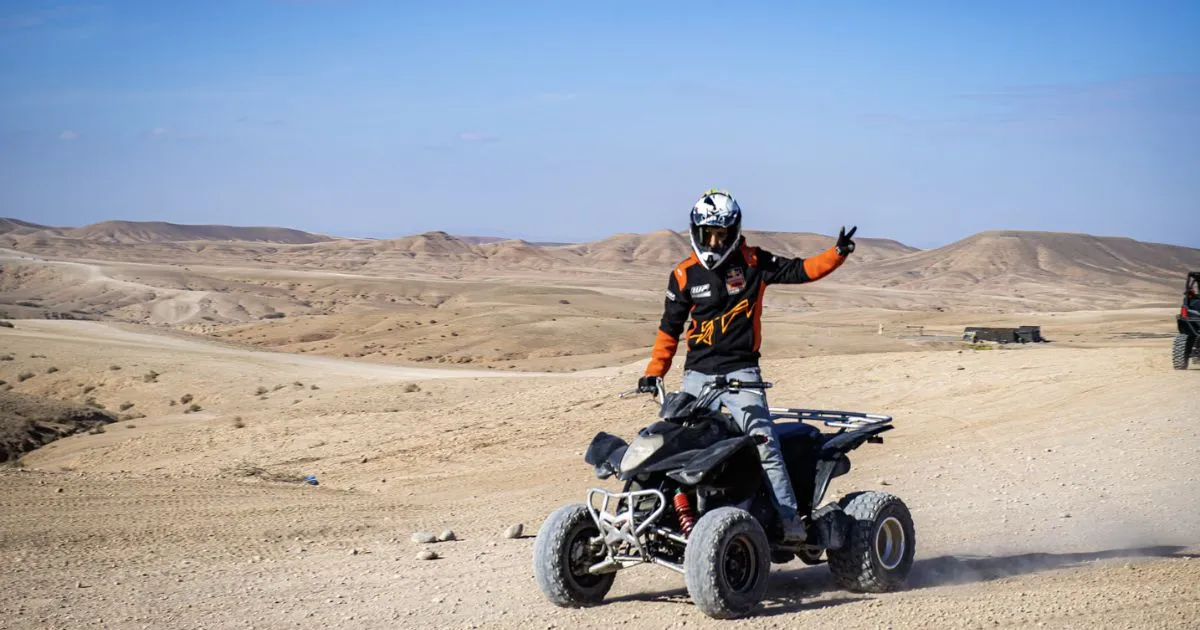
The safety fundamentals of marrakech quad biking don’t change between seasons — helmets, supervised briefing, speed guidelines, staying on marked circuits — but cold weather introduces a few specific factors that both guides and riders should be aware of.
Cold hands reduce grip precision. This is worth stating plainly: if your fingers are numb or stiff, your fine motor control on the handlebars is impaired. This is one of the clearest practical arguments for wearing gloves, and it applies from about 10°C downward at riding speed. Good gloves maintain dexterity; bulky ski gloves can actually reduce it. Aim for insulated cycling or light winter hiking gloves.
Engine performance: quad bikes generally run well in cooler temperatures, but operators typically spend a minute or two warming engines before departure. This is normal procedure in winter and accounts for why cold-weather departures may have a slightly longer pre-ride preparation time.
Visibility considerations: low winter sun at certain angles can create significant glare, particularly on the lighter rocky sections of the Agafay. If you wear prescription glasses, polarised clip-ons or a visor with UV protection make a real difference. Most helmets provided on-site have an integrated visor, but bringing your own goggles gives you more control.
Rider fatigue sets in slightly faster in cold conditions — the body expends more energy maintaining core temperature. Longer rides of 1.5–2 hours in winter may feel more physically demanding than the same distance in mild weather. This is not a reason to avoid longer circuits, but it’s worth noting for anyone with health considerations or young children who may communicate fatigue less effectively.
Tip : Tell your guide if you start feeling unusually cold during the ride. It’s easy to push through mild discomfort, but early wind chill on extremities can progress. A short pause to adjust layers is always possible on a guided circuit.
One of the most compelling reasons to choose winter for a quad ride near Marrakech is the Atlas backdrop. From November through February, the High Atlas peaks above 2,500 metres — including Toubkal, which rises to 4,167 metres — accumulate snow that’s visible from the Agafay plateau on clear days.
This visual dimension is not available in summer. From June to September, the upper Atlas range is brown and rocky, and atmospheric haze further flattens the silhouette. In winter, the white peaks stand in sharp relief against a deep blue sky. At certain points on the Agafay circuit, particularly the elevated sections in the eastern area of the plateau, the view is wide enough to take in perhaps 60–70 km of mountain ridge in a single frame.
For couples and families visiting Marrakech during school holidays — Christmas, New Year, half-term in February — this is worth factoring into the overall trip experience. A quad ride in these conditions offers something that a visit to the medina or a day at a spa simply cannot: scale, space, and a reminder of how geographically extraordinary the Marrakech region is.
The Atlas is also closer than many visitors realise. The foothills begin roughly 20 km from the city, and some quad circuits in the Ourika Valley area bring you into direct contact with the lower mountain terrain — pine-scented trails, narrow valley tracks, and elevated viewpoints that look back toward the city.
Photographers should note that the combination of low winter sun, clear air, and snow-capped peaks creates genuinely excellent conditions for wide landscape shots, particularly in the morning hours.
Tip : If the Atlas view is a priority, check the weather the morning before your ride. After a storm passes, the following one or two days typically offer the clearest mountain visibility of the season.
Winter is one of the better seasons for family quad biking near Marrakech, primarily because moderate temperatures make the experience more comfortable for children who might otherwise struggle with heat. That said, there are practical parameters specific to families that are worth understanding before you book.
Most operators apply a minimum age of around 8–10 years for children riding as passengers on an adult’s quad. Independent rider minimums are typically higher — around 14–16 depending on the circuit. These rules exist for legitimate safety reasons and are applied regardless of the season. Confirm the specific age and weight policy with your operator when booking, as they vary slightly.
Shared quads (one adult driving, one child or adult as passenger) are the standard family configuration. The rear passenger position is actually warmer than the front, since the driver’s body blocks the direct wind chill. This is a minor but useful consideration in winter: if a child is cold, position matters.
Buggy rides are worth considering as a family alternative to quads in winter. Side-by-side buggies offer a slightly more enclosed experience that’s less wind-exposed, particularly relevant for younger children. The driving dynamics are also different — lower centre of gravity, more stable — which some parents find reassuring on their first off-road experience.
Logistics tip: plan for extra time before the ride to layer up properly. With a family of four, getting everyone into the right clothing takes 10–15 minutes longer than you’d expect. Factor this into your departure and return window, particularly if you have onward plans for lunch or a riad check-in.
Tip : Pack a small bag with an extra fleece and a pair of warm socks for each child. Luggage space on quads is limited, but a small daypack can often be secured at the operator’s base while you ride.
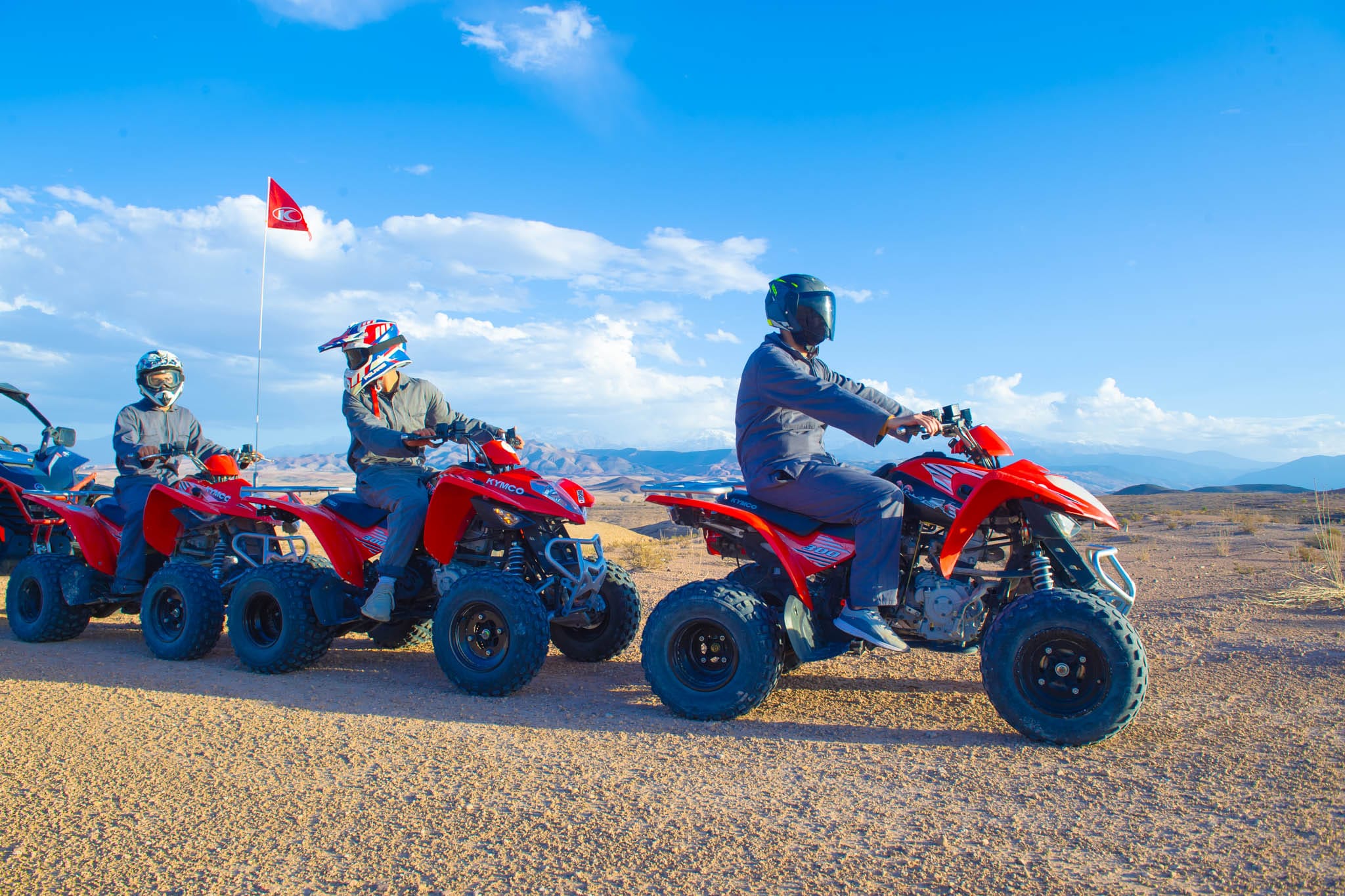
The winter calendar in Marrakech is well-suited to multi-activity days, and a morning quad ride pairs naturally with several other experiences that work particularly well in cooler temperatures.
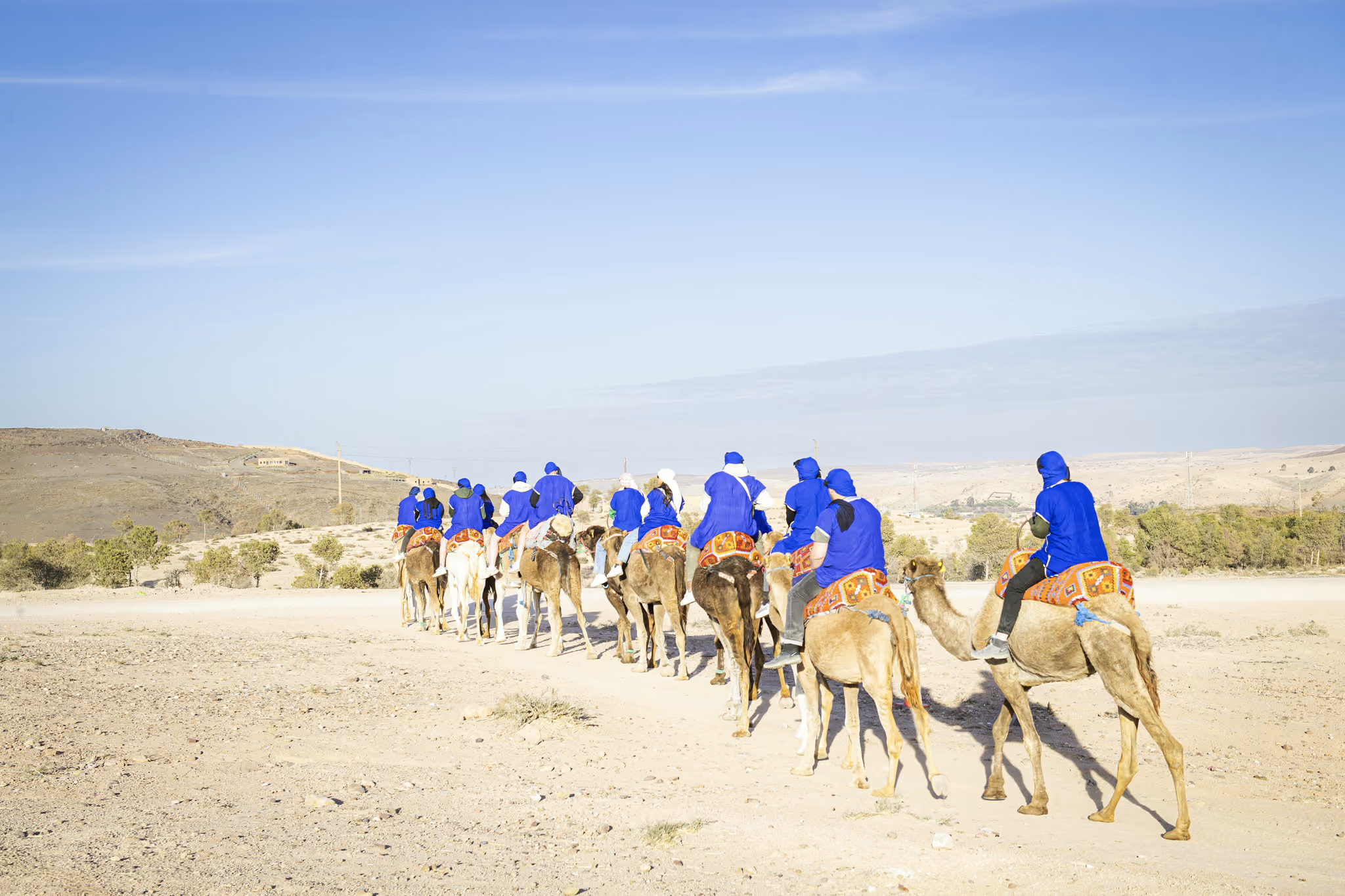
Camel trekking in the Agafay or Palmeraie area is an obvious complement. A camel walk is slower, quieter, and more contemplative than quad biking — an effective contrast that works well for couples and families who want range in a single day. Many operators, including those based in Agafay, offer combination packages that cover both activities with a break for mint tea between them.
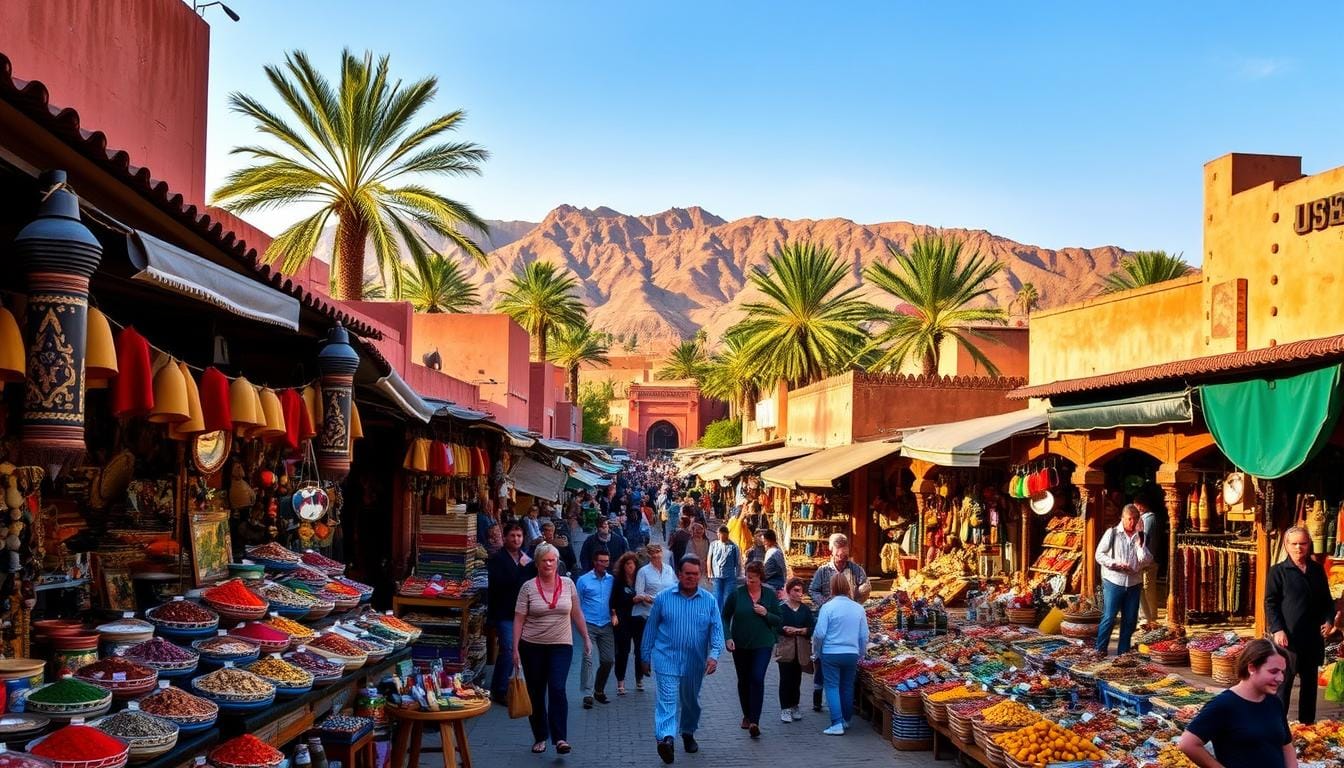
The medina of Marrakech is genuinely more pleasant to explore on foot in winter than in summer. Post-quad afternoons in the souks, around Jemaa el-Fna, or in the quieter northern medina around the tanneries are cooler, less crowded, and more navigable. A morning of outdoor activity followed by an afternoon of urban exploration is a rhythm many visitors find satisfying.
Jet skiing on the Lalla Takerkoust reservoir — located roughly 38 km southwest of Marrakech near the Atlas foothills — is available year-round but is noticeably cooler in winter. If you’re combining this with a quad excursion, be prepared for two cold-weather activities in succession. Dress in layers that can get wet without becoming dangerously cold, and allow time to warm up between sessions.
The Agafay desert dinner show is perhaps the most popular winter combination. An afternoon quad ride transitions naturally into sunset at the Agafay camp, followed by dinner, music, and the kind of open-sky evening that defines the Marrakech desert experience. The cooler air at night is comfortable around a fire and adds to the atmosphere rather than detracting from it.
Tip : For a full Agafay day, a standard sequence works well: quad at 14:30, transfer to the dinner show camp at 17:00, dinner and entertainment from 19:00. Book both in advance during peak winter periods around Christmas and New Year.
December through February covers a range of very different crowd dynamics. Understanding them helps you plan more effectively and set the right expectations for your visit.
Christmas and New Year (20 December – 5 January): This is the busiest period of the winter season. European and American school holidays drive strong demand, particularly for the Agafay dinner show and multi-activity packages. Quad biking slots fill quickly during this window, and price premiums can apply. Book 2–3 weeks in advance minimum, or earlier for groups of more than four.
January and early February: Quieter. This is arguably the best period for a calm, unhurried marrakech quad biking experience. Guide-to-rider ratios are more favourable, briefings are more detailed, and the overall pace of the operation is less pressured. Some operators may adjust circuit schedules if demand is low, so confirm the day before.
February half-term: A second, smaller peak — primarily driven by UK and French school holiday calendars. The Agafay and Palmeraie circuits are noticeably busier, though still well below summer volume.
On-site expectations in winter: most operators have a covered waiting area and offer hot drinks before departure. This is not guaranteed, but it’s common practice among the more established providers. The pre-ride safety briefing is conducted outdoors, so expect to stand in cool air for 10–15 minutes. Wear your base and mid layers before arriving rather than planning to put them on when you get there.
Finally: cancellation policies in winter typically allow for weather-related postponements, though clear cancellation weather in Marrakech is genuinely rare. If a ride is postponed, operators usually offer a same-day or next-day alternative. Confirm the specific policy when you book.
Tip : If your trip dates span the Christmas-to-New-Year window, consider booking quad biking for the 26th or 27th rather than the 24th or 25th — the quietest days in an otherwise busy period, and often the clearest weather days of late December.
Winter is not a compromise for marrakech quad biking — in many ways, it’s the season that shows the Agafay and the wider landscape at their most dramatic. Snow on the Atlas, firm desert tracks, clear air, and half the crowds of July: the conditions are genuinely good, provided you’re dressed for them.
The ten points above cover everything from thermal layering to booking timing, from footwear specifics to the logic of combining a quad ride with a desert dinner show. None of it is complicated — it’s just the kind of detail that separates a comfortable, confident experience from a cold, underprepared one.
If you’re ready to ride, the team at Quad Marrakech has been running these circuits for over 14 years and knows the winter terrain by heart. Reach out to book your session, ask any remaining questions, or build a full-day itinerary around your quad experience.
Yes, quad biking operates year-round in Marrakech, including throughout winter. Most operators run daily circuits in the Agafay desert and Atlas foothills from November through February. Weather cancellations are rare given Marrakech’s dry climate, though morning fog or heavy rainfall can occasionally delay departures.
Daytime air temperatures range from roughly 6°C to 18°C depending on the month and hour. At quad biking speeds of 40–50 km/h, wind chill reduces the perceived temperature by 5–8°C. Morning rides feel coldest; afternoon rides are considerably more comfortable. Layered clothing is strongly recommended regardless of the forecast.
Wear a thermal base layer, an insulating mid layer such as a fleece, and a windproof outer shell. Add thermal or hiking trousers, insulated gloves, a neck gaiter, and closed-toe shoes with thick soles. Avoid cotton and open-toe footwear. Helmets are provided by the operator.
Winter is an excellent time for outdoor activities in Marrakech. Temperatures are mild compared to European winters, crowds are significantly lower than in summer, and the Atlas Mountains are snow-capped, creating a striking landscape backdrop. December through February suits quad biking, camel treks, and Agafay desert experiences well.
Yes. Children can ride as passengers on adult quads, typically from around age 8 upward depending on the operator’s policy. Winter is manageable for families provided children are dressed in proper warm layers. Buggy rides are a practical alternative for younger or less confident riders, as they offer a more sheltered experience.
For the Christmas and New Year period, book 2–3 weeks in advance. For January and most of February, shorter lead times of 3–7 days are usually sufficient. Groups larger than four should always book ahead regardless of the travel date.