No products in the basket.

 Zakaria Belkhay
July 8, 2026
Zakaria Belkhay
July 8, 2026
Marrakech sits at a geographic crossroads that most visitors never fully appreciate. The city itself is dense, layered, and endlessly stimulating — but step twenty minutes south and you are in the Agafay desert, a rocky semi-arid plateau that rolls toward the High Atlas mountains with almost no development in sight. It is here, and in the palmeries to the north of the medina, that quad biking and camel riding have found their natural home.
These two activities complement each other in a way that feels almost designed. Quad biking is fast, physical, and loud — you read the terrain in real time and make split-second decisions. Camel riding is slow, rhythmic, and oddly meditative. Back to back, they give you a complete experience of this landscape rather than just a single angle on it.
Below are ten things every traveller should know before booking their quad biking and camel riding afternoon in Marrakech — from choosing the right terrain to what to pack in your back pocket.
This is the first decision you will face, and it shapes everything that follows. Marrakech offers two distinct natural environments for quad biking and camel riding, each with a genuinely different character.
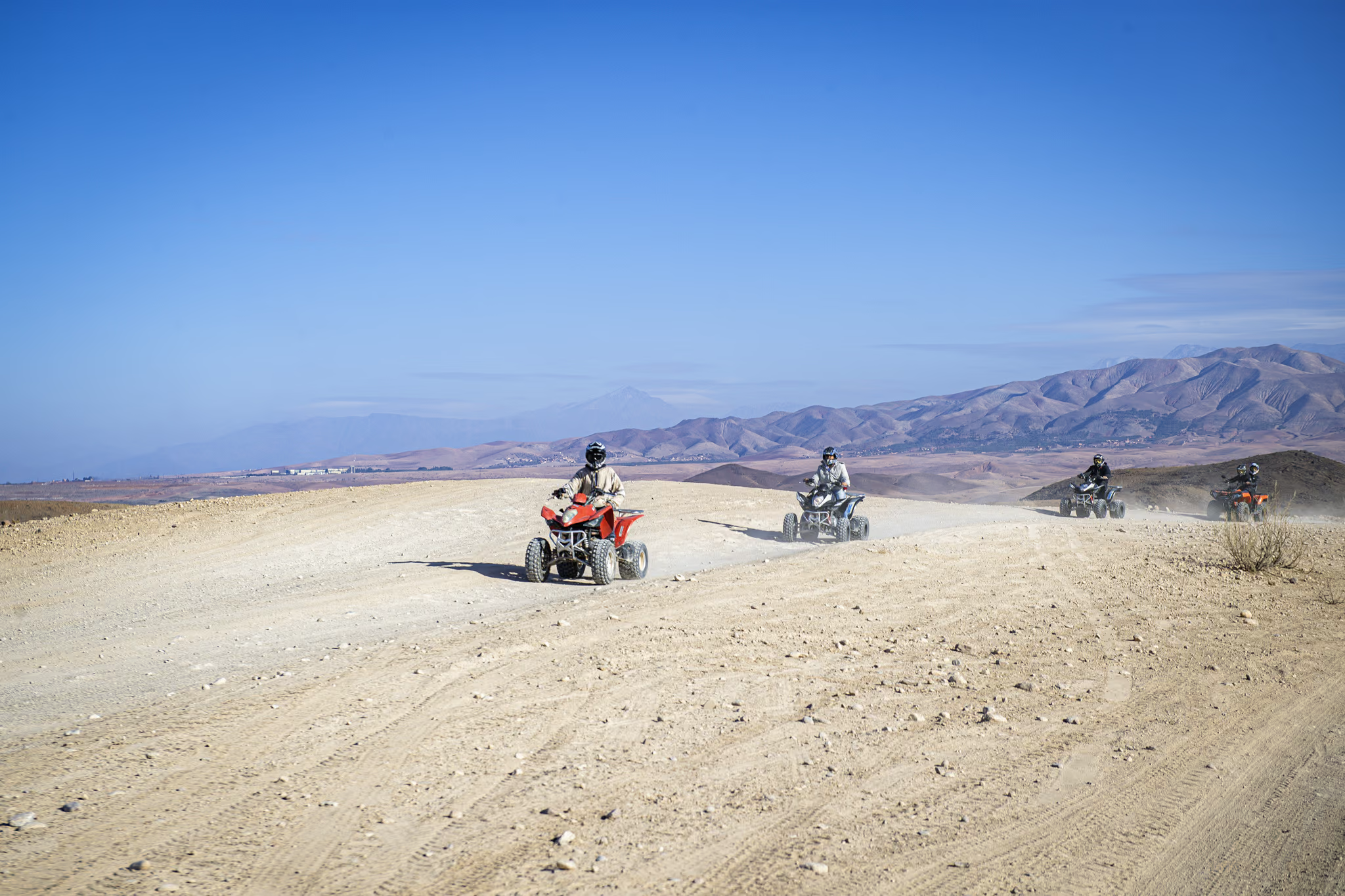
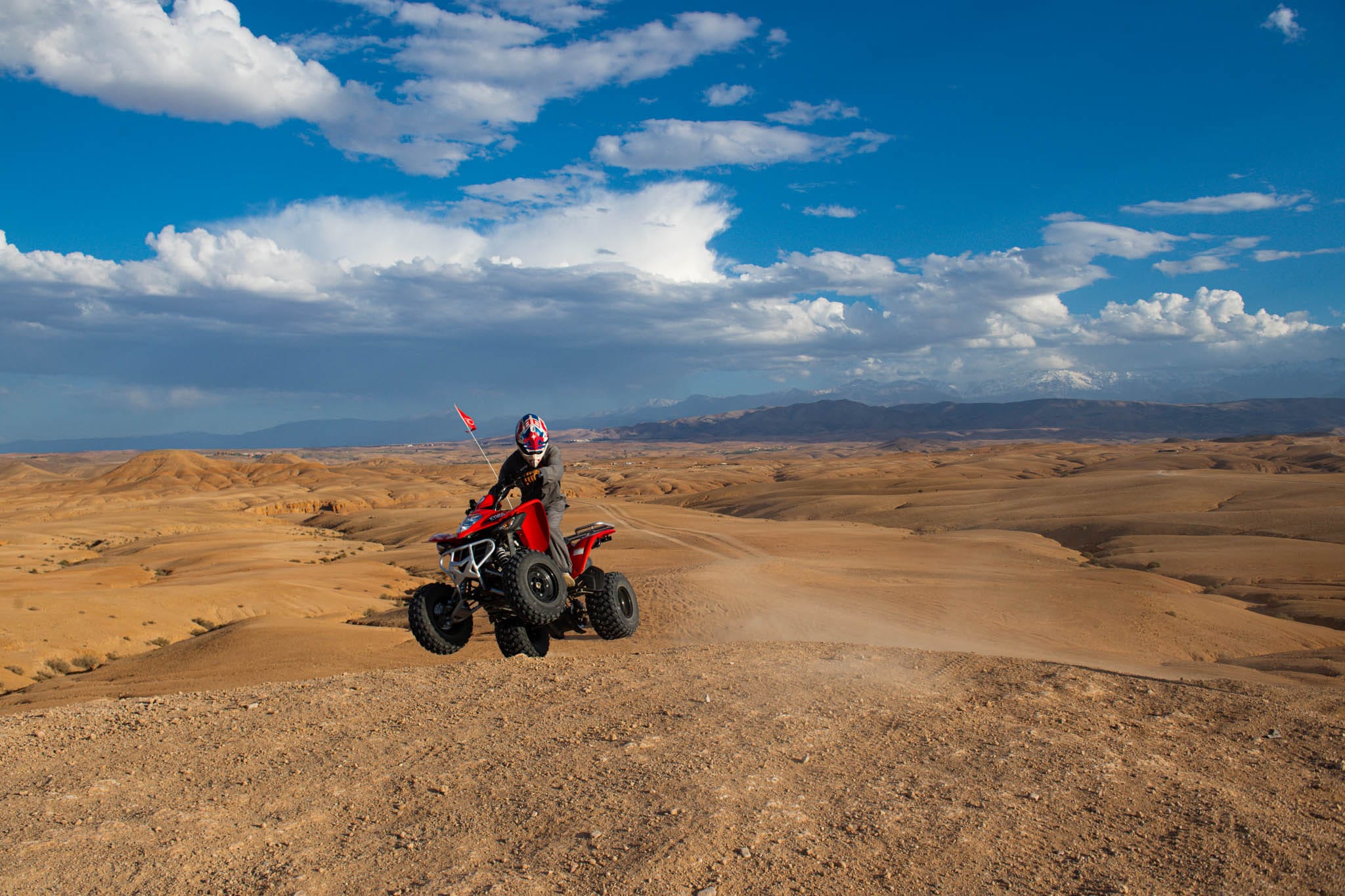
The Agafay desert sits roughly 30 kilometres south of the medina, a plateau of pale stone and dry earth framed by the High Atlas on the horizon. It is not a sand desert — the terrain is harder, more mineral, and more demanding on a quad. The light here in the late afternoon turns the landscape to amber, and the silence is something you feel rather than just hear. Camel treks in Agafay move through this open space with a slow deliberateness that suits the environment perfectly.
The palmerie of Marrakech — the ancient palm grove north of the city — is closer, greener, and more sheltered. Quad trails here wind through narrow paths between palms and irrigation channels, which makes for a more technical, stop-start ride. Camel rides in the palmerie feel more intimate, partly because the vegetation closes in around you.
For first-timers who want drama and space, Agafay is the stronger choice. For families with young children or travellers short on time, the palmerie is more practical. Both work for the quad biking and camel riding combination — the difference is one of mood and distance, not quality.
Most operators, including Quad Marrakech, offer both locations depending on the time of day and group size. It is worth asking specifically which circuit you will be on before you confirm.
Tip : If you are visiting between October and April, Agafay in the late afternoon gives you the Atlas snow line as a backdrop. It is worth timing your departure from the medina to arrive by 4 p.m.
There is a gap between what quad biking looks like in photos and what it feels like under your hands. Closing that gap before you arrive makes the experience considerably better.
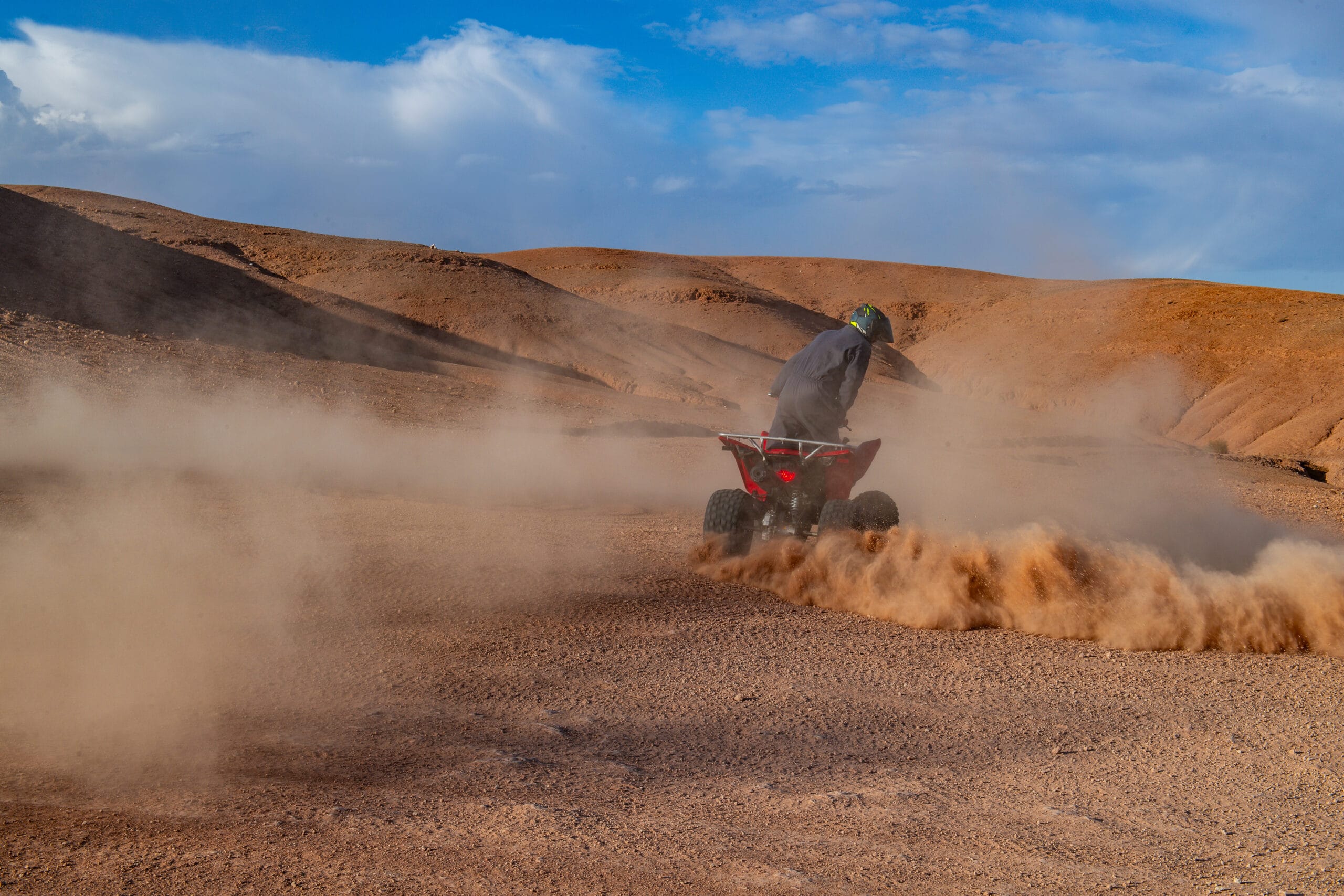
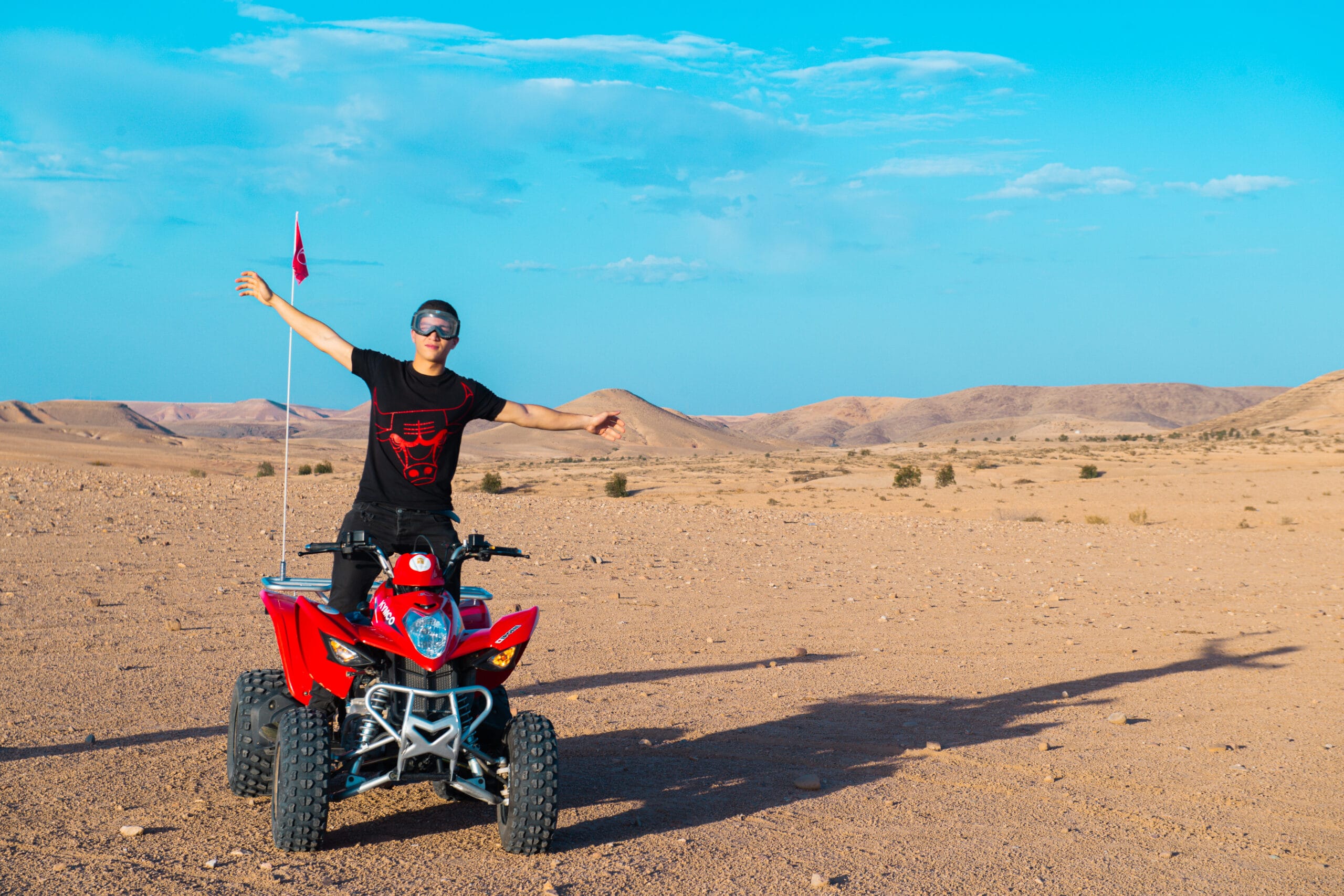
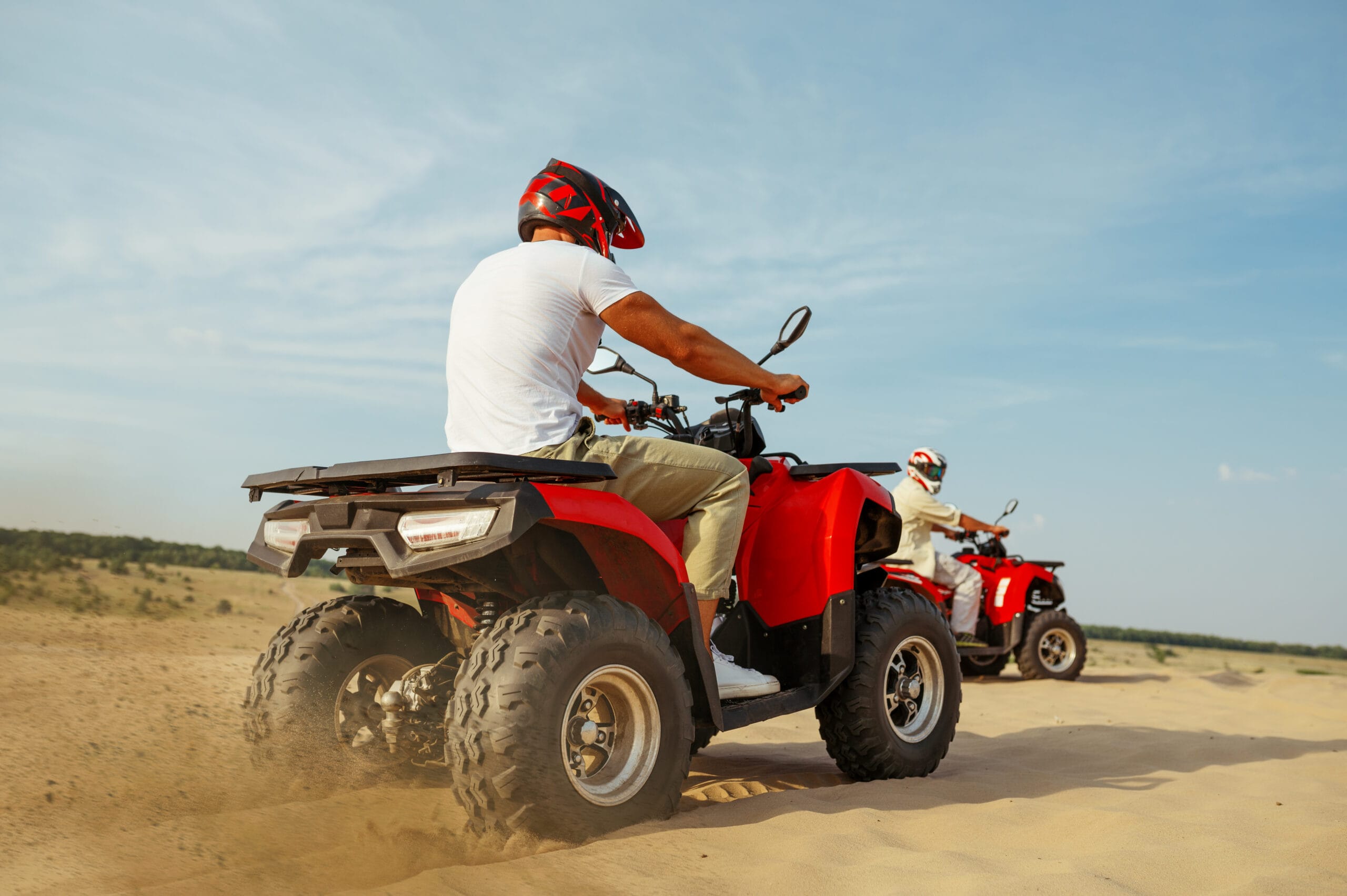
In Agafay, the circuits typically cover between 20 and 40 kilometres depending on the package. The surface alternates between hard-packed earth, loose gravel, and occasional dry riverbeds called oueds. You will hit moments where the trail drops away in front of you and you need to brake and steer simultaneously — this is where quad biking becomes genuinely engaging rather than just a seat on a machine.
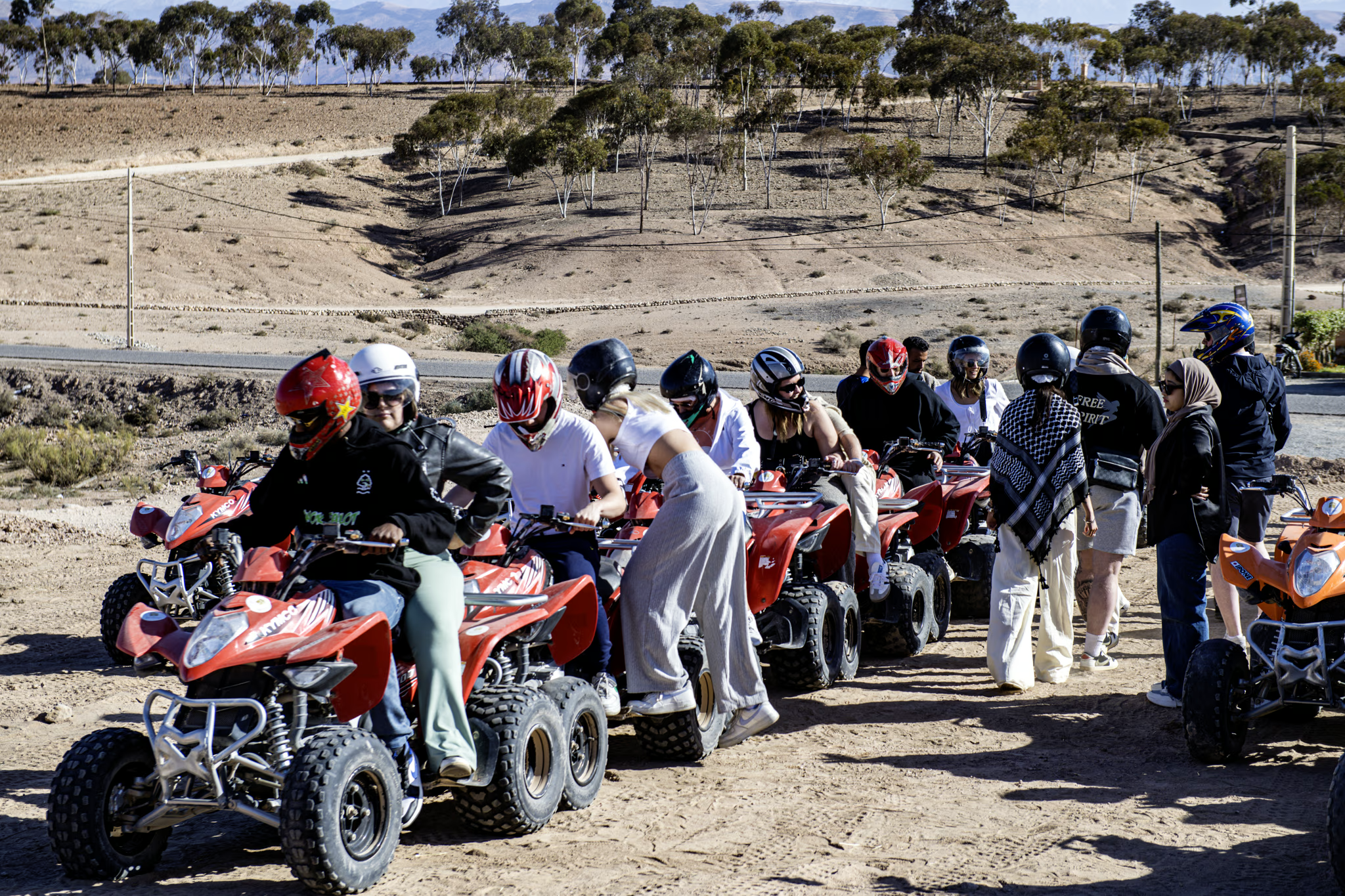
The quads used by established operators in Marrakech are generally 150cc to 250cc automatic or semi-automatic machines. You do not need a driving licence or prior experience for the standard circuits. A briefing covers controls, braking distance, and how to handle loose surfaces. For more experienced riders, manual quad options are sometimes available on request.
Speed is regulated on guided circuits — typically 30 to 60 km/h depending on the section. This is not a race track. The point is to move through the landscape, not across a finish line. Guides ride ahead and behind the group, which means you are never navigating alone.
Dust is the one thing most people underestimate. In dry months, a full circuit will leave a visible layer on your skin and clothes. Goggles and a bandana or buff are not optional accessories — treat them as part of the riding kit.
For families, most operators offer a tandem option where a child can ride behind a guide. This works well for children between 8 and 12 who want to be part of the action without solo control of the machine.
Tip : Wear clothing you do not mind washing twice. Lightweight long trousers protect your legs from the sun and from the occasional stone chip off the trail.
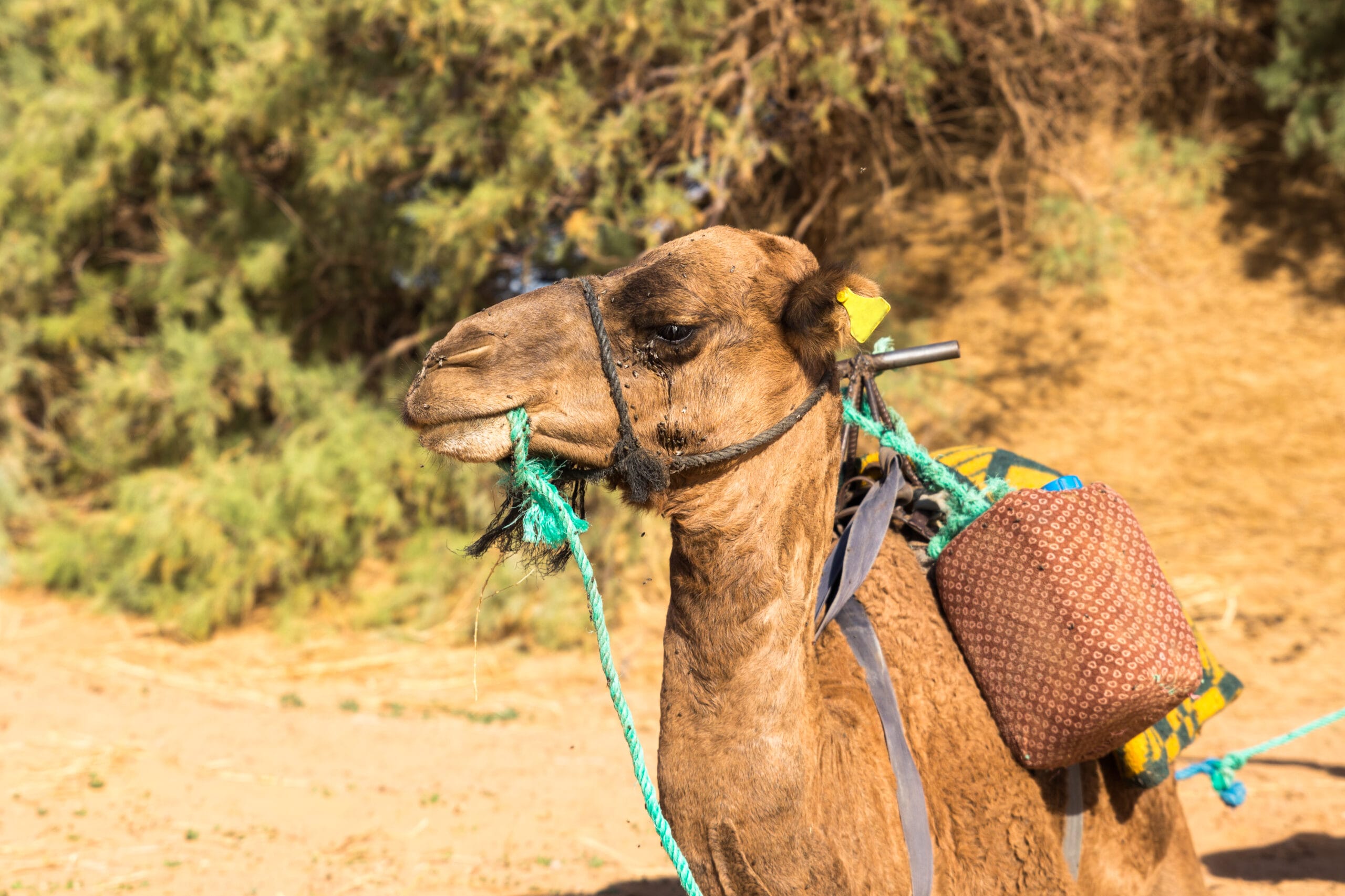
The camel ride portion of the afternoon gets less attention in most descriptions, but it is often the part that people talk about most afterward. There is something about the movement — the long rolling sway, the height, the animal’s general air of indifference — that leaves a strong impression.
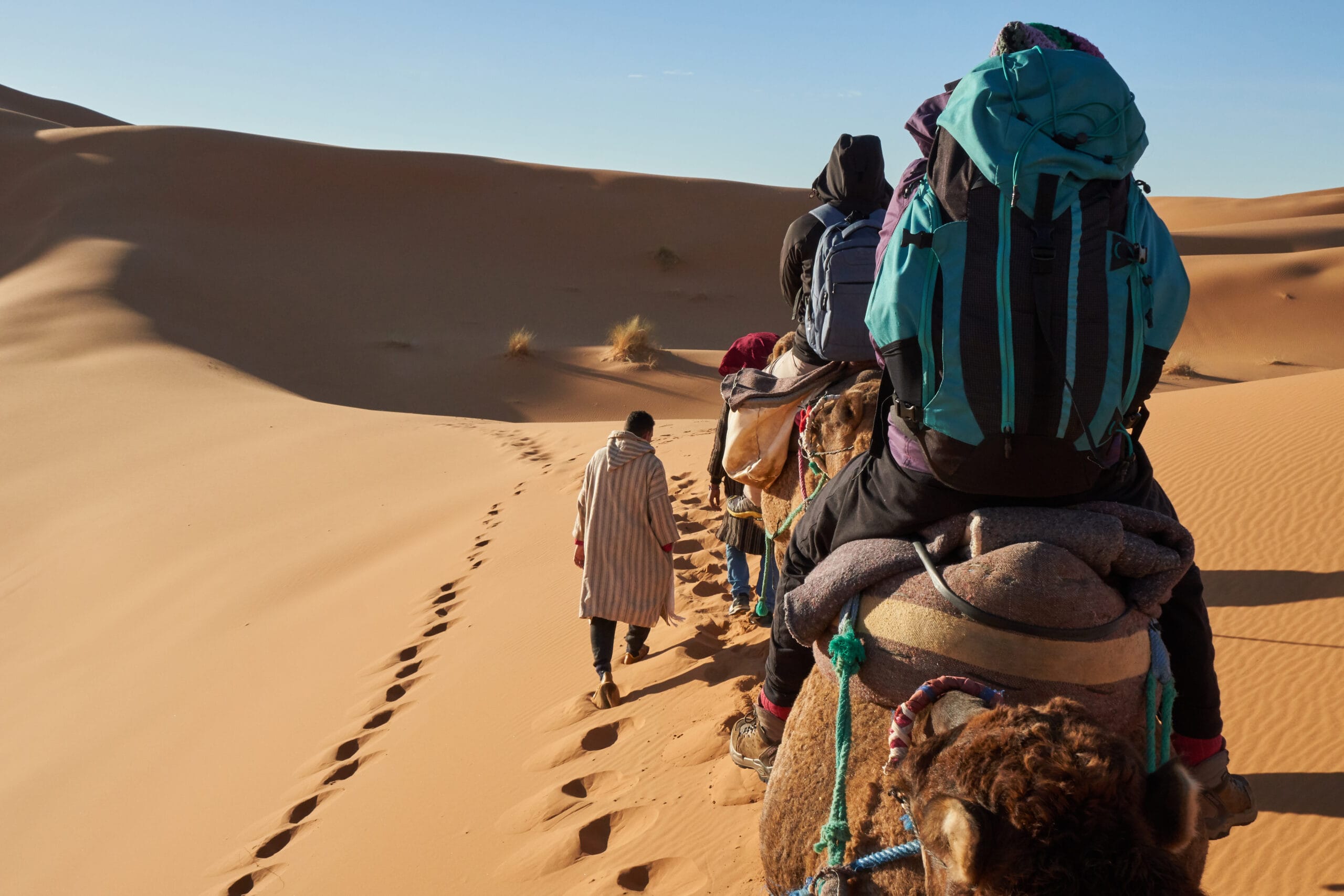
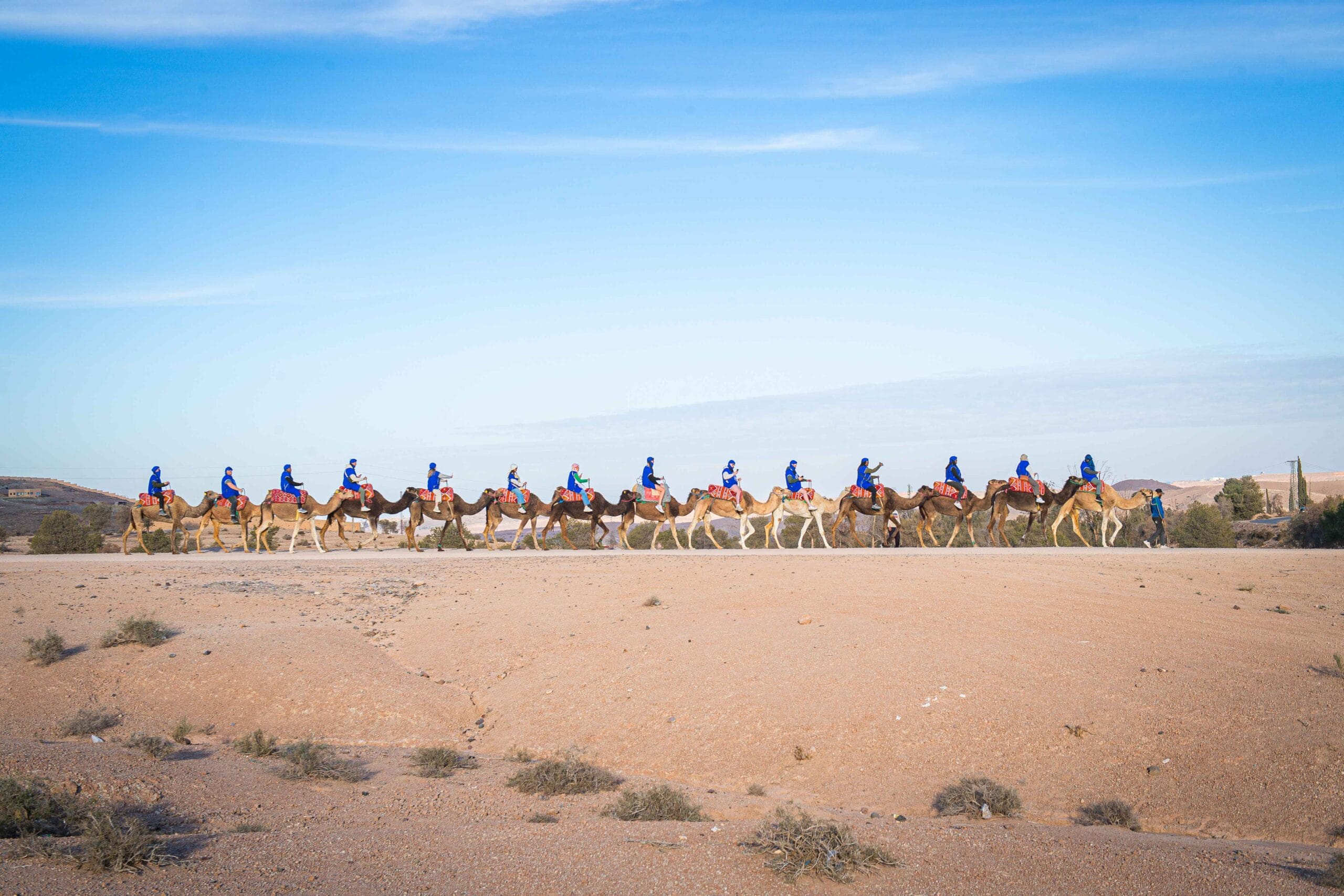
In the Marrakech context, camel treks are typically 30 to 45 minutes for the standard afternoon combination package. This is enough time to settle into the rhythm, take photographs, and actually look at the landscape rather than just survive the experience. Longer treks of one to two hours are available separately if the camel riding is the primary focus of your visit.
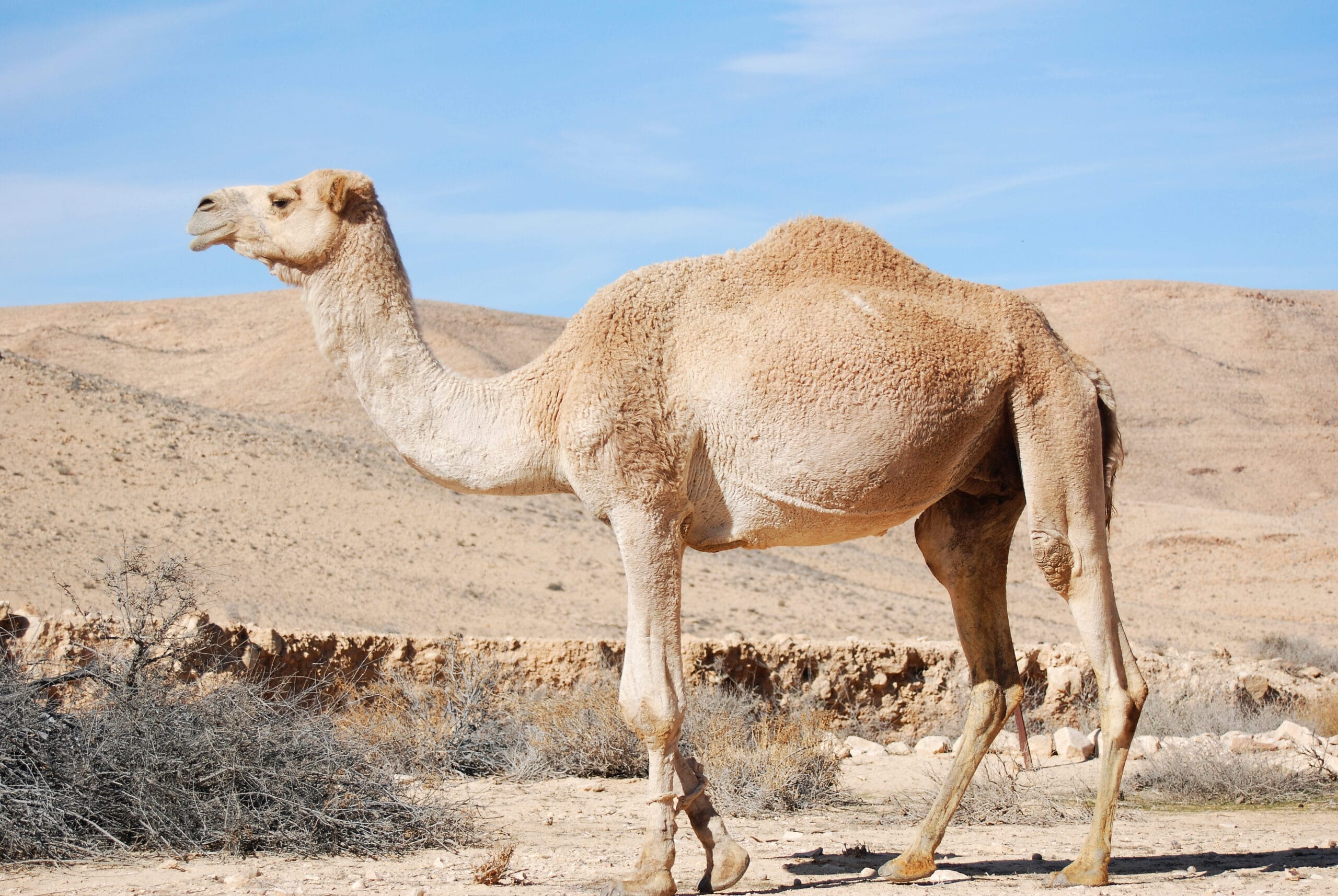
The camels used for trekking in Marrakech are dromedaries — single-humped, bred and trained for this purpose. The mounting and dismounting process is the most physically awkward moment: the animal kneels, you get on, and then it stands front legs first, which pitches you sharply backward before levelling out. Hold the pommel, lean slightly forward, and trust the process. It takes about three seconds.
The pace of a camel trek is genuinely slow — around 4 to 5 km/h. Guides walk alongside or lead the animals from the front. There is no racing, no overtaking, and no sudden movements. It is, in the best possible way, completely unhurried.
For travellers with back or hip sensitivities, it is worth mentioning this to the guide before mounting. Most reputable operators have handled this situation before and can advise on whether to proceed or suggest an alternative pace.
Tip : Sit back into the saddle rather than perching forward. The camel’s movement is easier to absorb through your lower back than through your thighs.
Timing matters more than most travellers expect when planning an outdoor afternoon in Marrakech. The city sits at an altitude of roughly 460 metres, but the surrounding terrain heats up quickly and stays hot well into October.
The sweet spot for a quad biking and camel riding combination is late afternoon departure — typically leaving Marrakech between 3 and 4 p.m. This gives you two practical advantages. First, the temperature has dropped from its midday peak, making both activities considerably more comfortable. Second, the light in Agafay or the palmerie from 4 p.m. onward is genuinely spectacular — warm, directional, and flattering to the landscape in a way that midday light simply is not.
Morning departures work well from November through March, when temperatures are mild and the Atlas is snow-capped. A 9 a.m. start gets you into the terrain before the day crowds arrive and gives you the option of extending the experience.
Summer departures (June through August) should be planned exclusively for late afternoon or early evening. Heat in Agafay between noon and 3 p.m. can reach 40°C, which makes sustained physical activity uncomfortable and potentially risky for children and older travellers.
Some operators combine the afternoon quad and camel experience with a sunset dinner in the desert, which adds a natural endpoint to the outing and removes the pressure of watching the clock. This is worth considering if you are planning a full evening rather than just an activity.
Tip : Book your departure for 3:30 p.m. in summer and 10 a.m. in winter. These times consistently get the most positive feedback from guests who have done both.
Combination packages for quad biking and camel riding in Marrakech vary between operators, so knowing what to look for prevents unpleasant surprises on arrival.
A well-structured package should include: return hotel transfer from central Marrakech, a pre-ride safety briefing, all protective gear (helmet, goggles, gloves), a guided quad circuit of at least 20 kilometres, a camel trek of 30 to 45 minutes, and water throughout. Some packages also include Moroccan mint tea at the end, which is a small but appreciated detail after two hours in the dust.
What is often not included: travel insurance, personal accident coverage specific to the activity, gratuities for guides, and any photographs taken by staff. Ask about photos in advance — some operators charge separately for a photo package, while others include a set number of images in the base price.
Exclusions to clarify before booking:
Price ranges in Marrakech for a combined quad and camel package typically sit between 400 and 650 MAD per person depending on circuit length, group size, and whether transfers are included. Private bookings cost more but offer more flexibility on timing and pace.
Reading the inclusions list carefully before confirming is not overcaution — it is just good travel practice.
Tip : Ask the operator directly whether the listed price is per person or per group. Some platforms quote group prices that look like per-person rates.
Neither quad biking nor camel riding requires athletic preparation, but a few practical steps make a real difference to how much you enjoy the afternoon.
From a clothing standpoint, prioritise coverage over ventilation. Loose long trousers protect your legs on the quad without restricting movement. A light long-sleeved layer handles sun exposure and dust simultaneously. Closed shoes with a flat sole are mandatory — sandals and flip-flops are not permitted on the quad circuits for safety reasons, and they are equally impractical on the camel.
Sun protection deserves its own paragraph. In Agafay or the palmerie, you are exposed to direct sun for the duration of both activities. Apply SPF 50 to all exposed skin before departure. A hat is useful for the camel segment when your helmet comes off. Sunglasses with UV protection are worth bringing even if goggles are provided for the quad portion.
Hydration: drink water before you leave your accommodation and carry a personal bottle in addition to whatever the operator provides. The combination of heat, dust, and physical activity dehydrates faster than most people expect.
For anyone with a medical consideration — heart conditions, pregnancy, recent surgery, severe back problems — a conversation with your doctor and with the operator before booking is the right sequence. Reputable operators in Marrakech are accustomed to these questions and have clear policies about who can participate safely.
Leave valuables at the hotel. A phone, a small amount of cash, and your sunscreen are all you need to carry.
Tip : A lightweight buff or tube scarf doubles as sun protection for the neck during the quad ride and as a head cover during the camel trek. It takes up no space in a day bag.
The Agafay plateau and the Marrakech palmerie are photogenic in completely different ways, and understanding the light and logistics helps you capture the afternoon well without it becoming the main focus.
For quad biking shots, the challenge is motion. If you want action photographs rather than portraits of people sitting still on machines, either hire the operator’s photographer for the session or ask your group to ride past a fixed point while one person hangs back. A phone camera on burst mode works surprisingly well for this at moderate speeds.
Camel riding photography is considerably more straightforward. The animals move slowly, the compositions are naturally dramatic, and the late afternoon light in Agafay does most of the work for you. Shooting from camel height gives you a perspective that ground-level photography cannot replicate — use it.
Practical notes on cameras and quads: a phone in your pocket during the quad ride is fine. A phone in your hand on a moving quad is a fast way to lose it. Most operators have a simple clip mount for phones on the handlebars if you want to capture footage; ask about this during the briefing. Action cameras mounted to helmets are generally permitted but require your own mount setup.
The best single photograph of the afternoon tends to be the one you take in the last fifteen minutes before sunset — the landscape, the animals, and the quality of light all converge at that point. Plan for it rather than hoping it happens.
Tip : Set your phone to portrait mode for camel shots and video mode for quad sections. Switching between the two in the moment is slower than it sounds when your hands are occupied.
Marrakech’s outdoor activities are among the more family-friendly options in Morocco, but the quad biking and camel riding combination requires some honest assessment before booking with children.
For quad biking, most operators set a minimum age of 8 to 10 years for tandem riding with an adult, and 16 years for solo riding depending on the circuit. These are not arbitrary rules — they reflect the physical demands of steering and braking on uneven terrain. Children under 8 can sometimes observe from a support vehicle, which is worth asking about if your child is just below the age threshold.
Camel riding is more accessible for younger children. Most operators allow children as young as 4 or 5 on the animal with an adult seated behind them. The slow pace and the guide walking alongside make this a genuinely low-risk activity. Children tend to find the experience either thrilling or briefly terrifying and then thrilling — there is rarely indifference.
A few practical points for family bookings:
Families consistently rate the combined quad and camel afternoon among the most memorable experiences of a Marrakech trip. The key is matching the pace and duration to the ages in your group rather than defaulting to the longest available option.
Tip : If you are travelling with a child who is nervous about the quad, ask the guide to do a slow demonstration lap before the group departs. Seeing it at close range almost always reduces anxiety.
One of the more satisfying ways to extend the quad biking and camel riding afternoon is to follow it with a desert dinner in Agafay. The logistics work naturally: the activities finish as the sun is dropping, a camp or permanent venue is nearby, and the transition from movement to stillness feels earned rather than abrupt.
Agafay desert dinner experiences in Marrakech range from simple Moroccan spreads under open sky to fully staged dinner shows with live music, traditional dance, and fire performances. The format has become genuinely popular over the past decade, and the quality varies accordingly — some camps are thoughtfully run with good food and atmosphere, while others lean heavily on spectacle at the expense of substance.
What to look for in a good Agafay dinner pairing with your afternoon activity:
Combined quad biking, camel riding, and Agafay dinner packages are available from several operators in Marrakech, including Quad Marrakech. Booking the full sequence as a single package is almost always more cost-effective than arranging each element separately, and it removes the logistical headache of coordinating transfers between activities.
The full afternoon-into-evening arc — quad circuit, camel trek, sunset, dinner — runs approximately five to six hours. It is a substantial commitment, but one that leaves you with a genuinely complete picture of the Agafay landscape across different hours and light conditions.
Tip : Bring a light jacket for the Agafay dinner even in summer. The desert plateau drops temperature quickly after sunset, and sitting still feels considerably colder than riding did.
The difference between a well-run outdoor experience in Marrakech and a frustrating one often comes down to what was clarified before booking rather than what happened during the activity itself. A few direct questions save significant friction.
Start with safety credentials. Ask whether guides hold a first aid certification and whether the vehicles are serviced on a regular schedule. Any established operator should be able to answer both questions without hesitation. If the response is vague, treat it as useful information.
Ask about group sizes. Quad circuits with more than twelve participants per guide start to feel impersonal and can slow down considerably on technical sections. Smaller groups — six to eight riders per guide — move better and give you more individual attention if you need it.
Confirm the pickup location and lead time. Most operators offer hotel pickup from central Marrakech, but the radius covered varies. If you are staying outside the medina or in a riad with difficult vehicle access, confirm the exact meeting point at the time of booking rather than the morning of the activity.
Cancellation policy matters, particularly in Morocco where weather in the Agafay — rare but genuine sandstorms, winter rain — occasionally disrupts outdoor activities. A fair policy should offer rescheduling or a full refund for operator-initiated cancellations and at least partial credit for cancellations made more than 24 hours in advance by the customer.
Finally, read recent reviews specifically for the activity you are booking, not just for the operator overall. An operator with excellent buggy reviews may run a less polished quad circuit. The specifics tell you more than the average score.
Tip : Send a WhatsApp message rather than relying solely on the booking platform for confirmation. Most Marrakech operators respond faster on WhatsApp, and you get a direct contact number in case of changes on the day.
A well-planned afternoon of quad biking and camel riding in Marrakech is not just two activities stacked together — it is a genuine change of pace from the medina, a way to see the landscape around the city on its own terms, and one of the more physically satisfying things you can do with four hours in this part of Morocco.
The ten points above cover the terrain choices, the practical preparation, the timing, the family logistics, and the booking process honestly. None of it requires prior experience or exceptional fitness. What it does require is a degree of intention — choosing the right location, the right time of day, and an operator whose safety standards and group management actually hold up.
Quad Marrakech has been running these experiences for over fourteen years in the Agafay desert and Marrakech palmerie. If you are ready to move beyond the tourist checklist, the booking page is below.
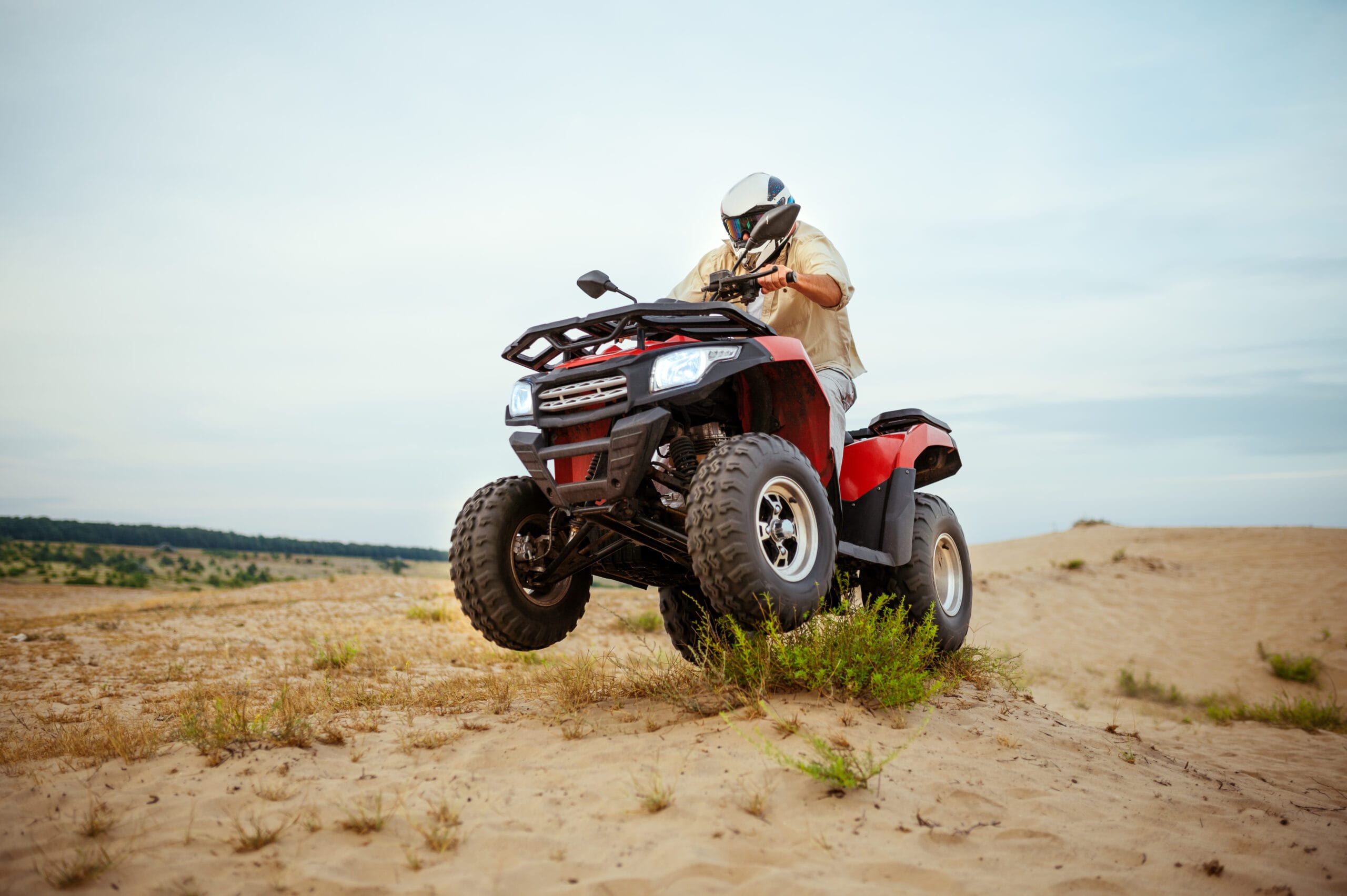
No driving licence is required for the standard quad circuits in Marrakech. A safety briefing before departure covers everything you need. Circuits are designed for complete beginners, and guides accompany the group throughout the ride.
A standard combination package lasts approximately two to three hours, including transfer time within the site, the quad circuit of 20 to 40 kilometres, and a camel trek of 30 to 45 minutes. Full afternoon-to-dinner packages run five to six hours.
Camel riding is accessible for children from around age 5 with an adult. Quad biking requires a minimum age of 8 to 10 for tandem riding depending on the operator. Solo riding is generally available from age 16. Confirm specific age policies when booking.
Agafay is an open rocky plateau 30 kilometres south of Marrakech with dramatic Atlas views and wide circuits. The palmerie is a palm grove closer to the city, with narrower more sheltered trails. Agafay suits travellers who want space and landscape; the palmerie suits families or shorter outings.
October through April offers the most comfortable conditions with mild temperatures. Summer visits should be timed for late afternoon departures to avoid peak heat. Winter mornings from November to March are particularly good for clear Atlas views.
Wear closed shoes, long trousers, and a long-sleeved light layer. Apply SPF 50 sunscreen before departure. A buff or neck scarf handles dust on the quad. Leave jewellery and valuables at your accommodation. Helmets and goggles are provided by the operator.