No products in the basket.

 Zakaria Belkhay
July 1, 2026
Zakaria Belkhay
July 1, 2026
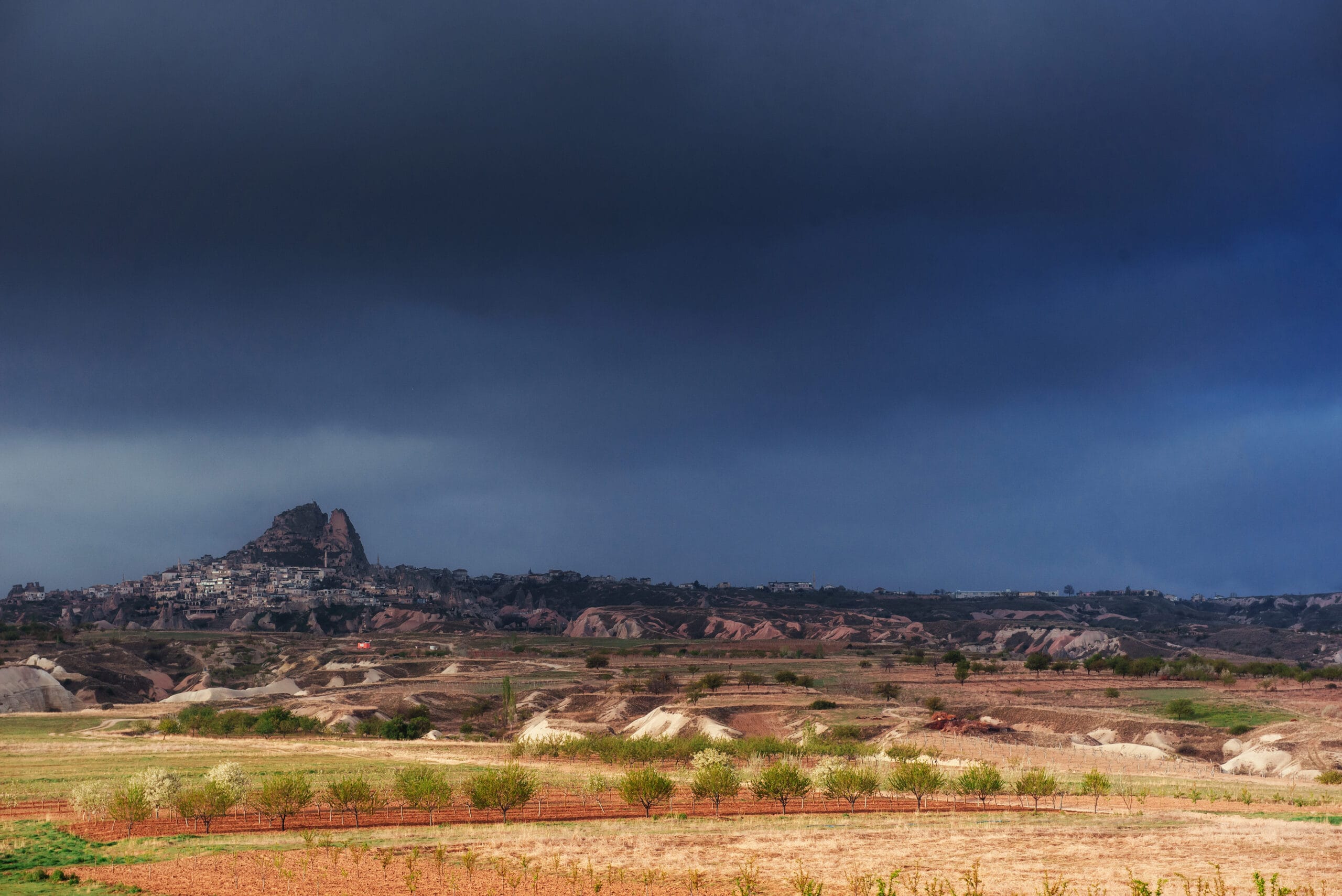
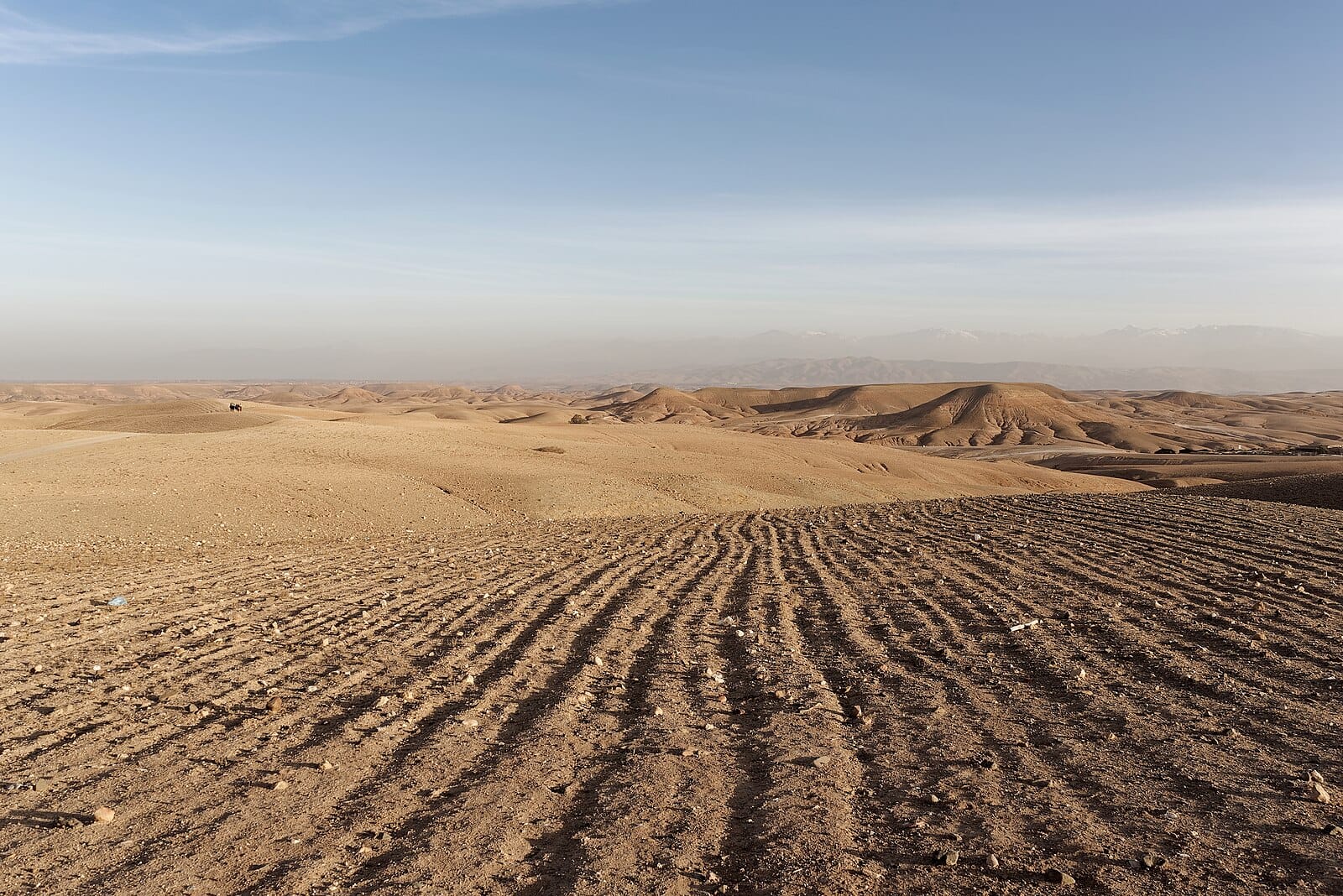
The Agafay Desert has a reputation for wide open skies, dusty lunar landscapes, and sun-drenched afternoons that stretch all the way to the Atlas Mountains. But every traveller eventually asks the same honest question: does it rain in the Agafay Desert?
The short answer is yes — occasionally. Agafay is a rocky semi-arid plateau, not the Sahara. It sits at roughly 700 metres above sea level, just 30 km from Marrakech, and it experiences a Mediterranean-influenced climate with a distinct wet season in winter. Rain is infrequent, but it happens, and when it does, it can change conditions quickly.
The more useful question is not whether it rains, but what happens when it does. How do activity operators respond? Which experiences are still possible? What should you wear, and when should you reschedule?
Below, we break down 10 key things every traveller should understand about rain and bad weather in Agafay — from climate data to cancellation policies, terrain safety, and the surprising ways a cloudy day can actually enhance your visit.
Agafay is often called a desert, and visually it earns the label — bare rock plateaus, sparse scrub, a landscape that feels vast and elemental. But it is technically a semi-arid rocky plateau, not a sand desert like Merzouga or Zagora. That distinction matters when it comes to weather.
The region operates on a semi-arid Mediterranean climate, with two fairly distinct seasons. Summer, running roughly from May through September, brings consistent heat and almost no rainfall. Days regularly reach 35–40°C, skies stay clear, and the terrain bakes dry. This is peak season for outdoor activities, though the midday heat demands sensible scheduling.
Winter, from November through March, is a different story. Temperatures drop significantly — evenings can fall to 5–8°C — and the region receives most of its annual rainfall during these months. Annual precipitation across the Marrakech-Agafay area averages around 250 mm, concentrated in the cooler months. That is not much by global standards, but it is enough to occasionally disrupt outdoor plans.
Spring and autumn are transitional: generally pleasant, with mild temperatures and occasional showers that rarely last long. October and April tend to be particularly reliable months for weather, combining comfortable temperatures with low precipitation risk.
Understanding this seasonal rhythm is the first step to planning an Agafay visit that works with the climate rather than against it. Agafay’s terrain can shift quickly when wet — rocky paths that are bone-dry in August can become slippery within minutes of a downpour in January.
Tip : If flexibility is possible, aim for late September through early November or April through May. You get pleasant temperatures, quieter crowds, and a very low chance of rain disrupting your day.
Rather than thinking of Agafay as either rainy or dry, it helps to look at the calendar month by month. Rainfall in the region is uneven and somewhat unpredictable, but there are clear patterns that experienced guides recognise.
June, July, August: Effectively rain-free. These are the safest months for guaranteed dry conditions. The trade-off is intense heat, particularly between 11am and 4pm.
September and May: Occasional brief afternoon showers are possible, but rare. Most days remain clear.
October and April: Light showers occur a handful of times per month on average. They tend to pass quickly and rarely last more than an hour. Temperatures are comfortable — 20–25°C during the day.
November and March: The transition into and out of peak wet season. Rain becomes more probable, sometimes arriving as sustained showers over a half-day. Activity operators are generally prepared for this.
December, January, February: The wettest months. Rain can last several hours, and temperatures at night drop sharply. There is even a small chance of snow on the nearby Atlas peaks during January, which creates a striking visual backdrop — white mountains above a grey desert plateau.
None of this means Agafay becomes inaccessible in winter. Many travellers specifically choose December and January for the dramatic skies, cool air, and far smaller crowds. But it does mean that booking activities with a clear understanding of the operator’s weather policy is essential during these months.
Tip : Check a local weather service like Météo Maroc or Windy for a 7-day forecast before your visit, rather than relying on long-range predictions. Agafay’s weather can shift in 24 hours.
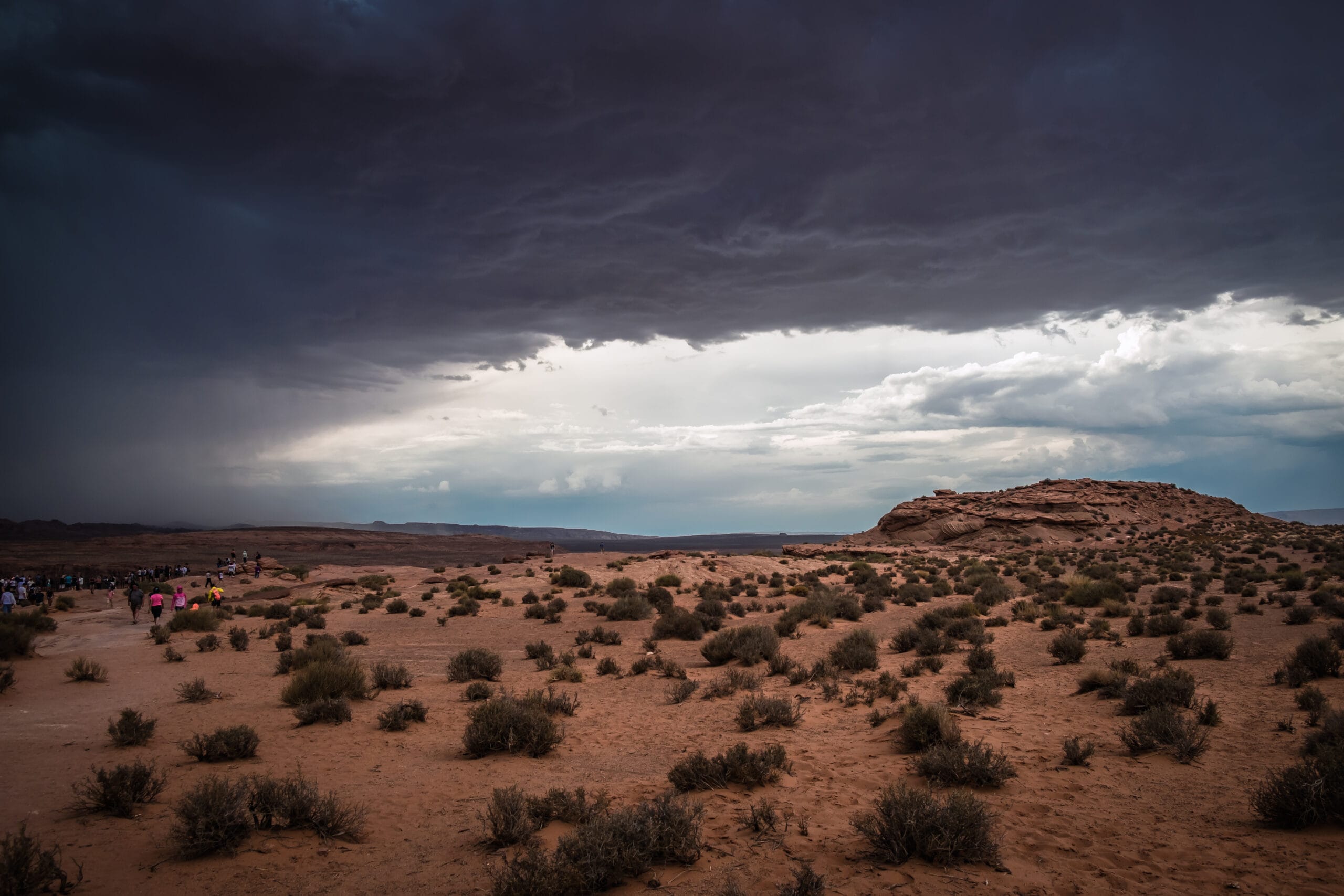
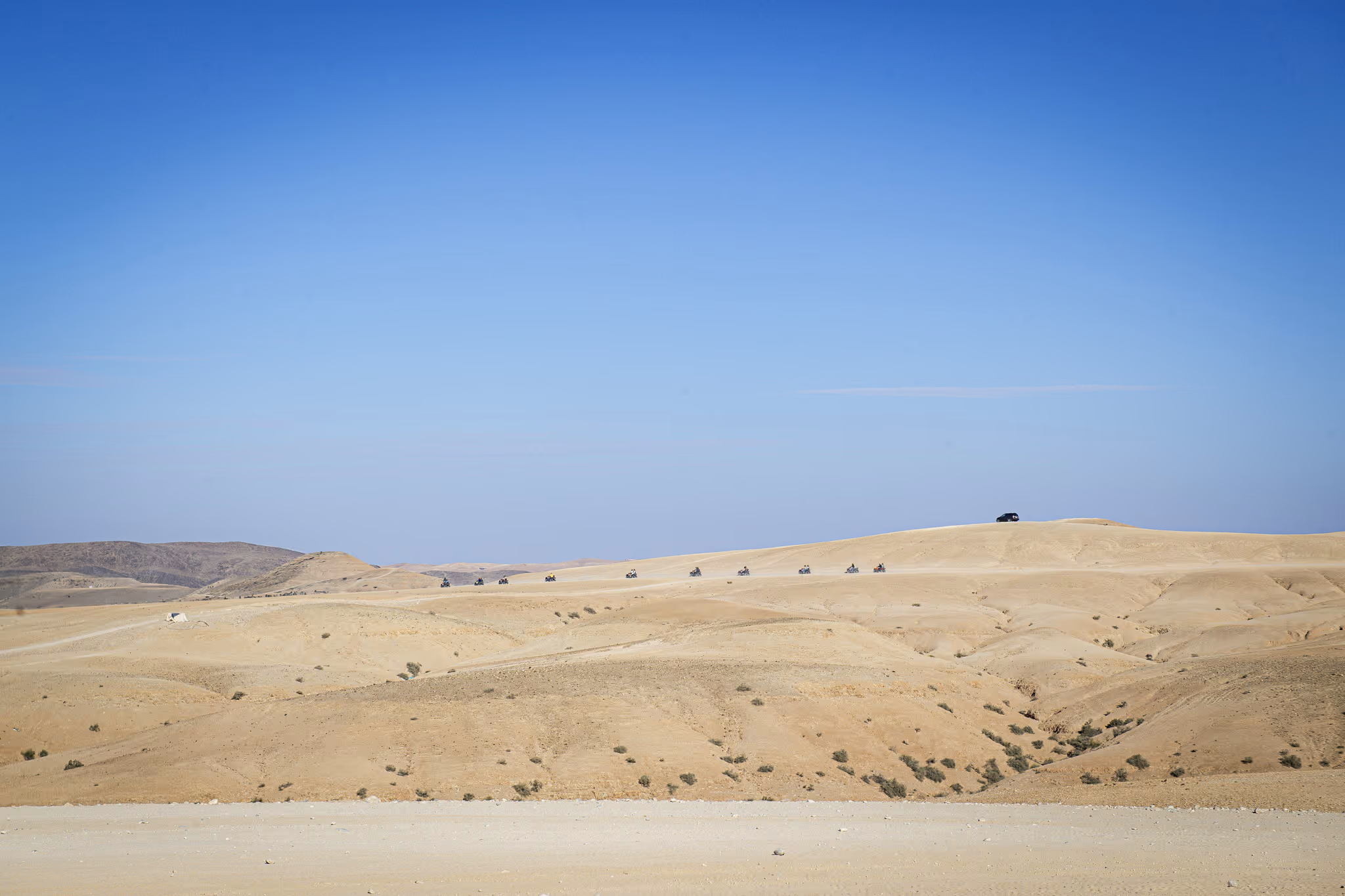
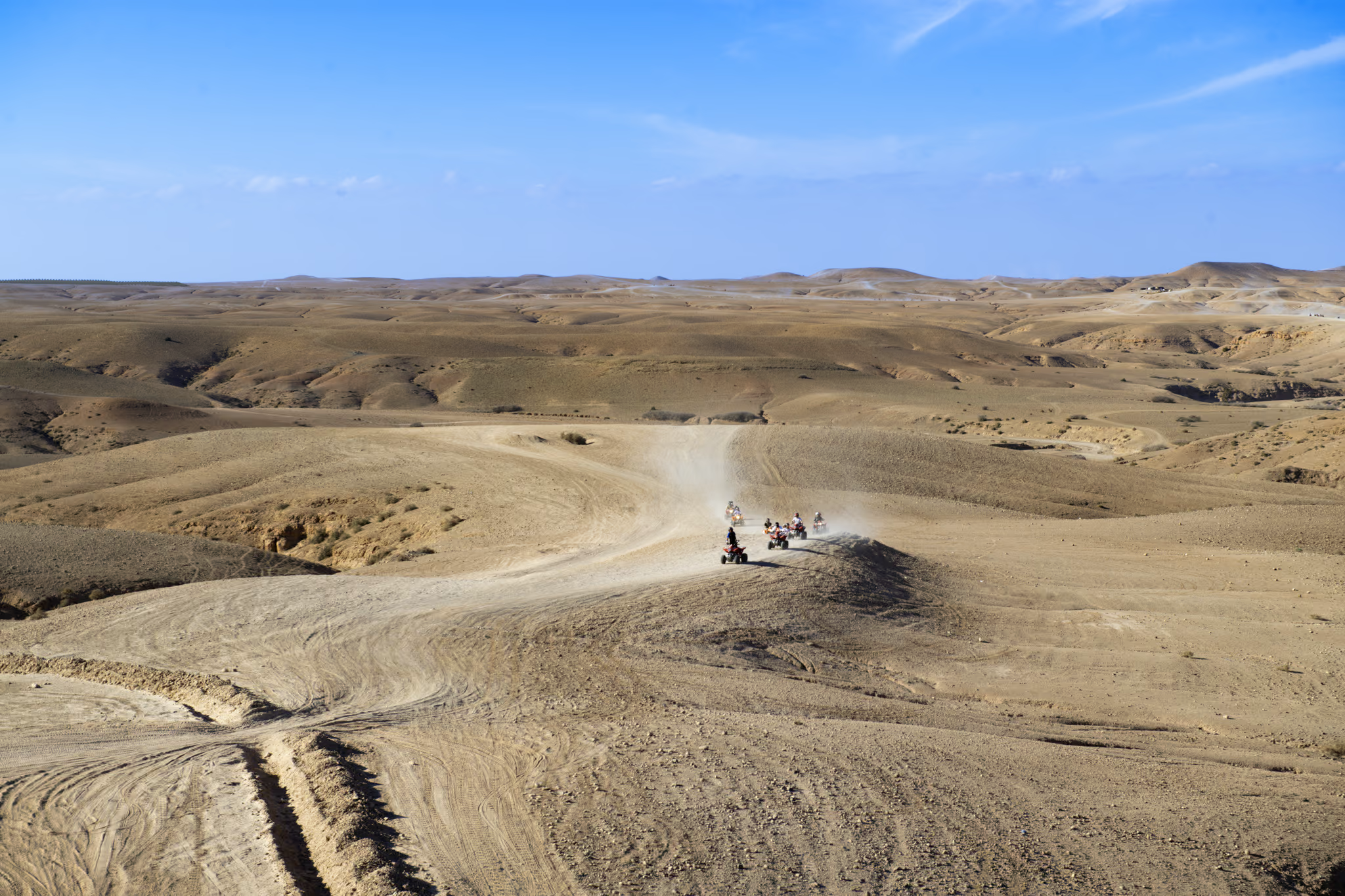
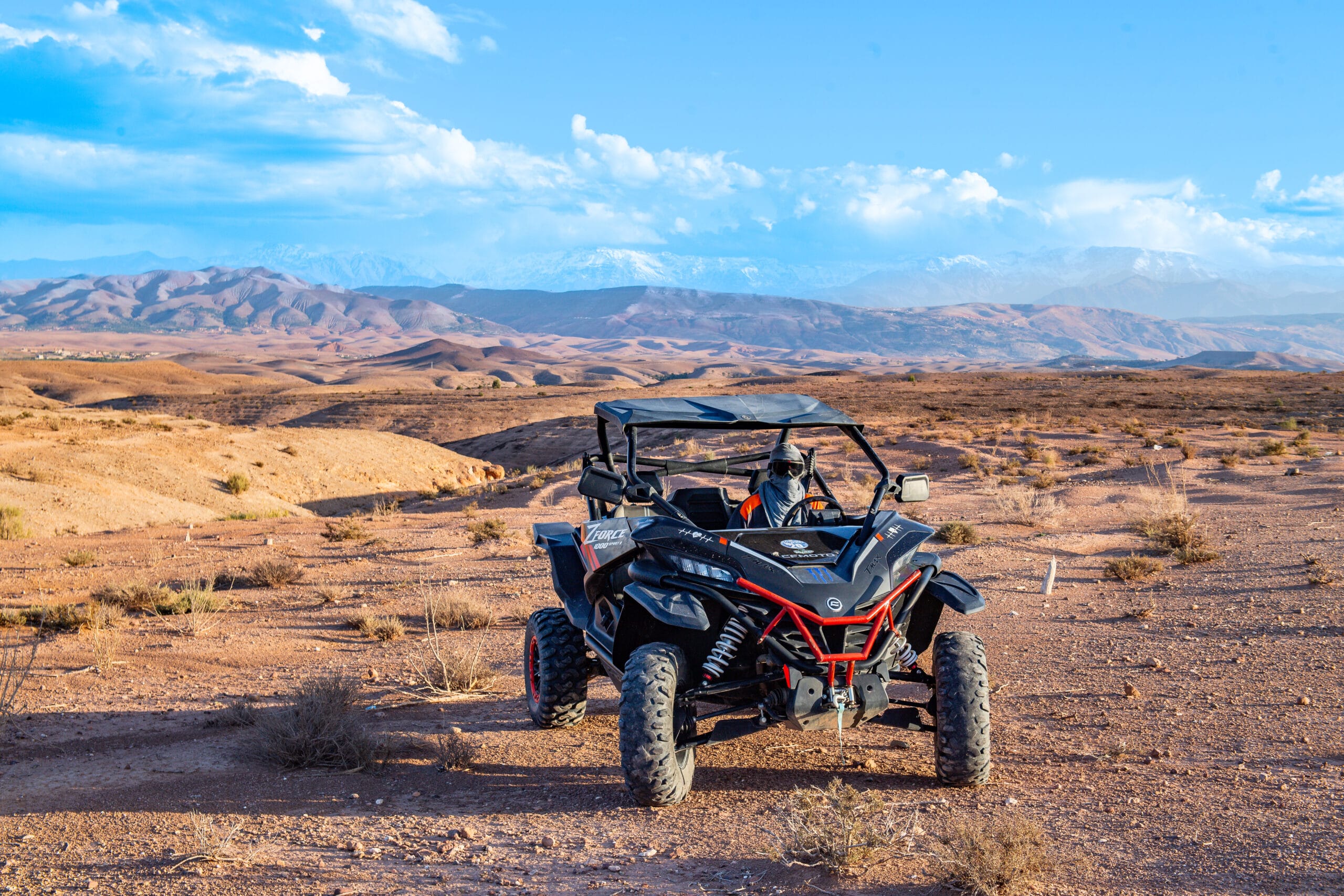
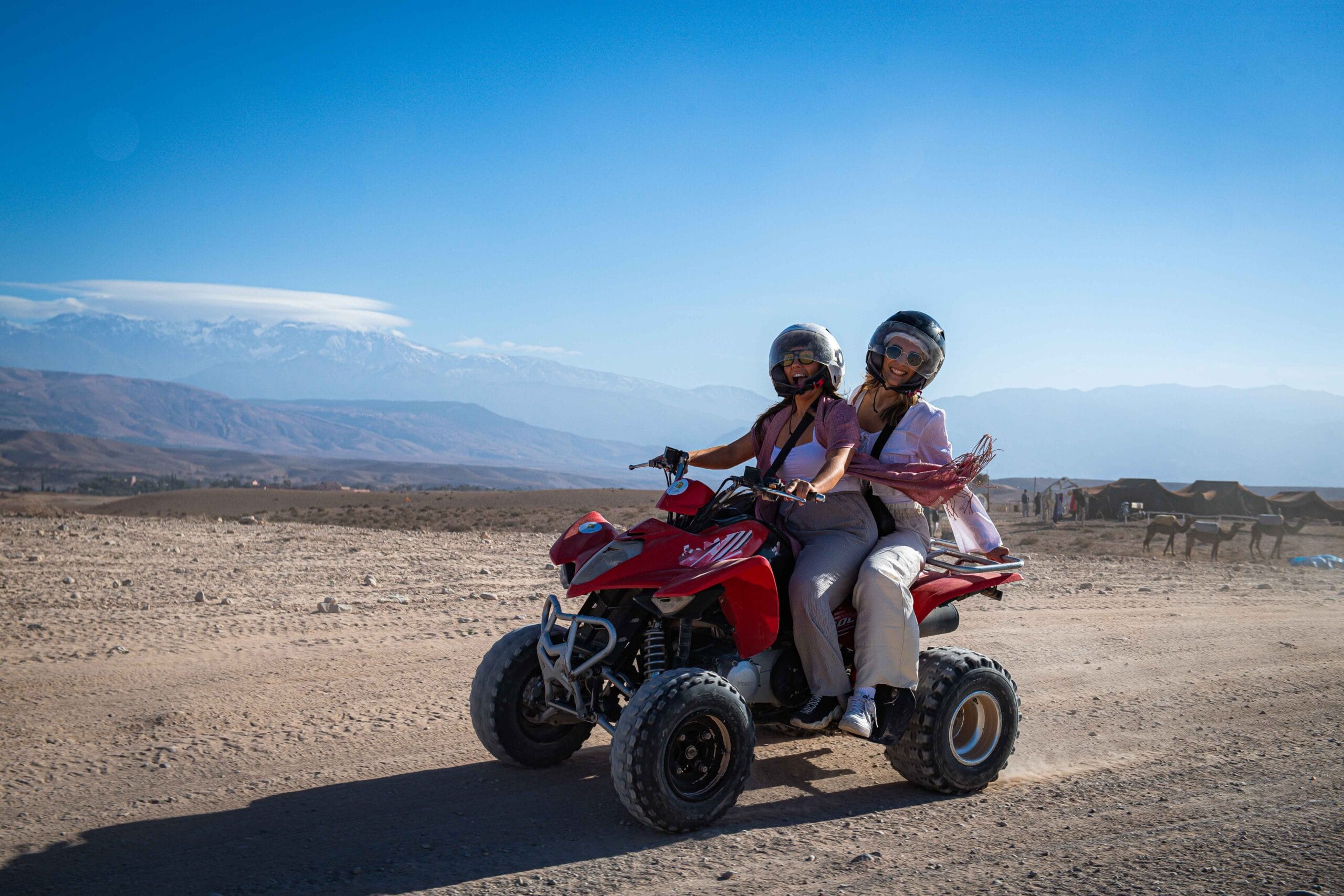
Quad biking is one of Agafay’s signature experiences — tearing across rocky trails and dried riverbeds with the Atlas range filling the horizon. But rain changes the terrain in ways that matter for safety and fun alike.
When Agafay receives significant rainfall, the rocky surface develops a thin layer of clay-like mud that can reduce traction noticeably. Dry creek beds — known locally as oueds — can fill with fast-moving water within an hour of heavy rain upstream. Visibility also drops in a downpour, and the dust that normally coats the track turns into a slick paste.
Professional operators adjust to these conditions in several ways. Light drizzle that has already stopped? Guides typically carry out the session with additional briefings on reduced speed and corner technique. Active rain or wet surfaces following heavy showers? Most operators will postpone the departure by one to two hours, wait for the terrain to drain and dry slightly, and then resume.
In genuinely poor conditions — sustained rain, strong wind, or poor visibility — a responsible operator will reschedule or offer a full alternative. At Quad Marrakech, guides have over 14 years of experience reading Agafay’s conditions. They know which trails drain quickly and which sections become unsafe, and they make those calls based on direct knowledge of the land rather than a generic policy.
If rain catches you mid-ride, guides are trained to bring groups back safely. Helmets and goggles protect against light rain, and most operators provide waterproof ponchos or can advise on appropriate clothing before departure.
Tip : Wear closed shoes with grip and bring an extra layer. Even in summer, Agafay’s terrain kicks up dust and debris during rides, and a thin jacket adds comfort on the return leg as the sun drops.
There is something quietly cinematic about a camel trek when clouds are building over the Atlas — the light turns silver, the scrub takes on a greener edge, and the usual tourist buzz dies down completely. Some travellers actually prefer overcast conditions for camel rides, because the heat is less intense and the pace feels more meditative.
Camels themselves are remarkably unfazed by light rain. These animals are built for variable desert climates, and a brief shower does not distress them. The main considerations for travellers are comfort and grip on the mounting and dismounting points, which can become slippery on wet rock surfaces.
Guides manage this by adjusting the route slightly in wet conditions, choosing paths with better drainage and more stable ground. Sessions may start slightly later to allow terrain to stabilise after morning rain. Riders are advised to wear closed shoes rather than sandals, and if sustained rain is forecast, the experience may be rescheduled to protect both the enjoyment and the safety of participants.
For sunset camel treks — one of Agafay’s most popular formats — overcast skies can actually produce dramatic results. Filtered light and cloud formations often make for more interesting photographs than a plain blue sky. It is worth keeping an open mind if conditions are partially cloudy rather than fully stormy.
Children and first-time riders should be dressed in layers during cooler or rainy periods, as sitting still on a camel for 45–60 minutes without much physical movement means body temperature drops faster than on a quad bike.
Tip : If your camel trek is scheduled at sunset and clouds are in the forecast, do not cancel automatically. Partially cloudy evenings often produce the most atmospheric light in Agafay — go and see what the sky does.
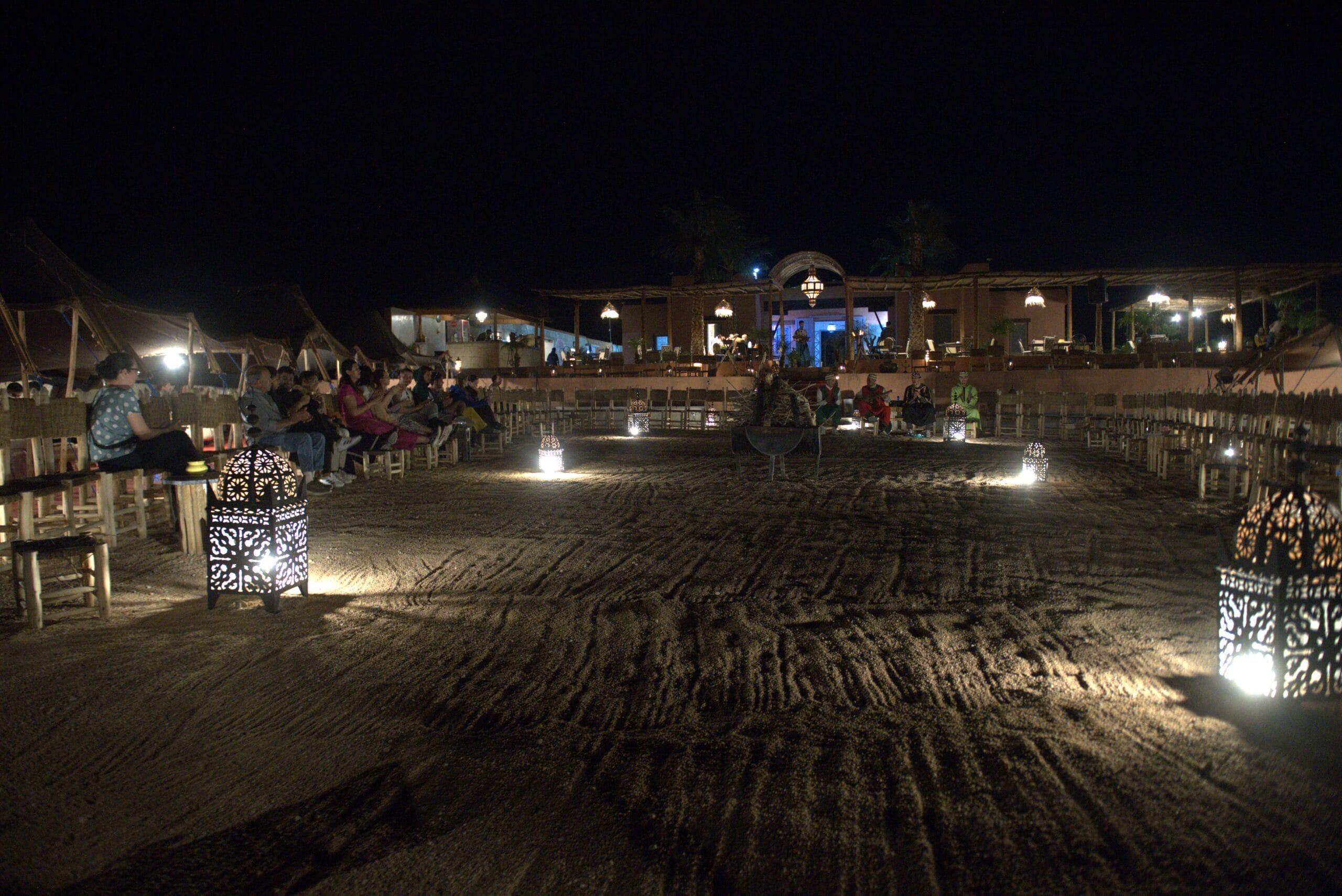
The dinner show under the stars is one of Agafay’s most sought-after experiences — open-air dining, live Gnawa music, fire dancers, and a sky full of stars above a candlelit camp. It is inherently an outdoor experience, which raises a fair question: what happens when it rains?
Established operators structure their camps with covered areas specifically because Agafay’s weather is not always predictable. Large Berber-style tents provide full shelter while maintaining the atmosphere — fabric panels, lanterns, low tables, cushioned seating. A shower during dinner does not necessarily mean the experience collapses; it simply moves inward, and the sound of rain on canvas has its own particular atmosphere.
Performances may be adapted in heavy rain — certain fire acts or large-scale outdoor demonstrations require dry conditions — but the core of the evening, the meal, the music, and the conviviality, continues under shelter. Operators who have been running these events for years carry spare canopies, additional staff for quick cover changes, and contingency set-ups for exactly these situations.
If forecasts show genuinely severe weather — thunderstorms, sustained heavy rain, strong winds — most operators will contact guests in advance to discuss rescheduling or, where dates are inflexible, arrange an equivalent indoor experience in Marrakech. Communication is key: ensure you have a working local number for your operator before the day of the event.
In practice, the dinner show is one of the more weather-resilient Agafay experiences because shelter is built into the format. Outdoor activities like quad biking are more directly affected by rain than a seated evening event.
Tip : Bring a light jacket or shawl even in summer. Agafay evenings drop 8–12°C compared to daytime highs, and after sunset, the temperature falls quickly regardless of cloud cover.
One of the most practical concerns travellers have about rain in Agafay is what happens to their booking. Policies vary significantly between operators, and reading the fine print before you pay matters more than most people realise.
A well-structured weather policy typically distinguishes between three scenarios. First, light or passing rain that does not compromise safety: activities proceed, possibly with minor adjustments to timing or route. Second, moderate rain that has cleared but left wet terrain: departure is delayed by one to two hours while conditions improve. Third, sustained poor weather that makes activity unsafe or significantly degrades the experience: full rescheduling or a credit toward another date is offered.
What you want to avoid is any operator whose policy defaults to non-refundable regardless of conditions. Reputable operators in Agafay — particularly those with multi-year track records — understand that weather is outside anyone’s control and build flexibility into their booking terms.
When booking with Quad Marrakech, it is worth confirming directly what the weather threshold is for rescheduling and how much notice you will receive. Most operators contact clients the evening before or on the morning of the activity if conditions look problematic. Having WhatsApp communication established with your operator in advance makes this much smoother.
Travel insurance is also worth considering if your Agafay activities are part of a larger trip with non-flexible elements. Some policies cover weather-related activity disruptions; check the wording before assuming this applies to your policy.
Tip : Ask your operator specifically: ‘What is your policy if it rains on the day?’ A confident, clear answer from a reputable company is a good sign. Vague responses are worth noting before you commit.
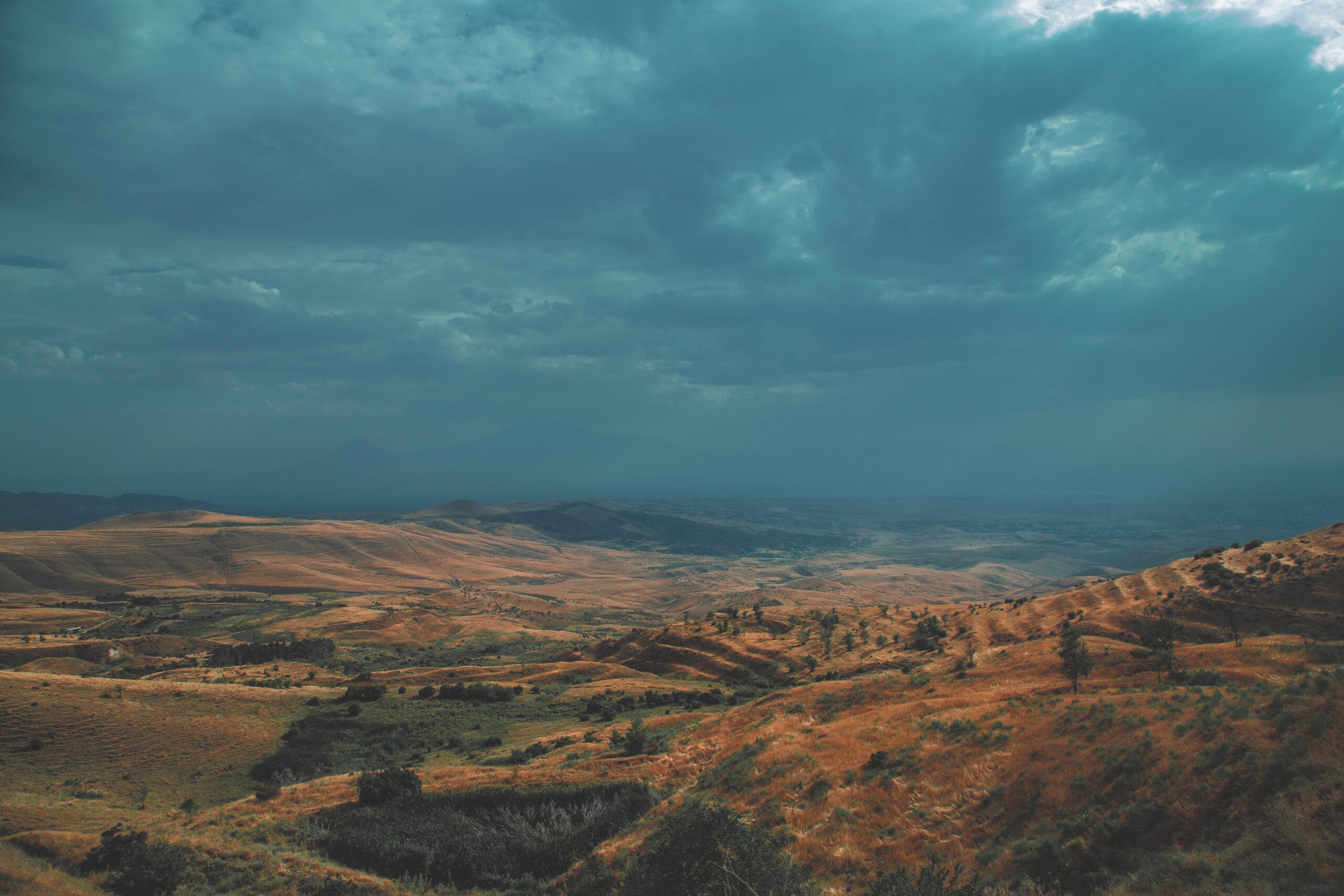
For those willing to adjust their expectations, rainfall in Agafay does something genuinely surprising: it makes the landscape come alive. The rocky plateau, which appears uniformly grey-brown in dry conditions, shifts almost immediately when wet.
Low-lying plants that are invisible in the dust suddenly show green. The iron-rich soil darkens to a deep terracotta. Puddles form in the shallow rock depressions, creating a scattered mosaic of reflected light across the plateau. The Atlas Mountains, often softened by summer haze, appear sharply and dramatically close after rainfall clears the air.
Photographers who visit Agafay in winter specifically plan around this dynamic. The contrast between dark wet rock and a clearing sky produces images that look nothing like the pale dusty shots from August. If you travel with a camera, do not write off a rainy Agafay day — the hour immediately after rain passes is often the most visually interesting of the entire visit.
The smell also changes. Agafay in rain carries the sharp mineral scent of wet stone, mixed with the green note of wet scrub — a combination that is striking precisely because the landscape looks so arid the rest of the year. It is a reminder that this is not a dead landscape but a living one that simply runs on a different timescale than a European garden.
These post-rain windows — sometimes just 30–40 minutes before the surface dries again — are worth experiencing once if you have the chance. Experienced local guides know exactly when to move and where to go for the best perspective.
Tip : If activities are delayed by rain, ask your guide to take you to a high point on the plateau once it clears. The light after a Moroccan winter shower is genuinely worth seeing.
Packing for Agafay in the wet season requires a slightly different mindset than a standard beach or city trip. The goal is layering that handles both heat and cold, dry and wet conditions, within the same day — because Agafay’s weather can shift from warm sunshine to a cold shower and back within a few hours.
A lightweight waterproof jacket is the single most useful item to add to your bag between November and March. It does not need to be heavy or technical — a packable rain jacket that fits into a small bag is ideal. You are not hiking in the Alps; you need protection from a short shower, not sustained mountain weather.
Footwear matters on the rocky terrain. Closed shoes with rubber grip soles outperform both sandals and smooth-soled trainers on wet Agafay rock. If you are quad biking in any season, closed shoes are required regardless of rain.
Layers are essential for evening events. The temperature swing between a 22°C afternoon and a 9°C night in October is significant enough to make a light jacket go from unnecessary to very welcome within 90 minutes. A thin fleece or wool layer works well under a wind-resistant outer shell.
Additional items worth considering for wet-season visits:
None of this requires specialist gear — practicality and layering cover most scenarios.
Tip : Avoid jeans in Agafay during the wet season. Denim takes hours to dry and becomes genuinely uncomfortable in cool temperatures. Lightweight hiking trousers pack small and handle both the heat and the cold far better.
Even with the best planning, a full day of rain in Agafay occasionally happens. Having a backup plan is not pessimism — it is practical travel sense, and Marrakech makes it easier than most destinations to pivot without losing the day.
The medina of Marrakech is an excellent rain-day destination. The covered souks provide full shelter while remaining fully operational, and the reduced foot traffic during a rainy morning makes the experience noticeably more pleasant than a crowded July afternoon. The labyrinthine streets around the spice souk and the coppersmiths quarter are worth exploring at a slower pace.
Cooking classes are another strong alternative that many Marrakech operators offer. Learning to make a proper chermoula or a slowly braised tagine in a riad kitchen is satisfying in any weather, and the output is something you can recreate at home. Sessions typically run two to three hours and include a shared meal.
For travellers who specifically want to stay in the Agafay area despite rain, some camps offer indoor hammam sessions, traditional tea ceremonies, and bread-making with local staff — activities that sit comfortably under a tent canopy and connect you to the place even without the outdoor adventure.
If you are travelling with children and the weather closes down outdoor activities, Marrakech’s Menara Gardens offer covered pavilion areas, and the Majorelle Garden — though it requires walking outside — is compact enough to explore with a light rain jacket without becoming a real ordeal.
The key is not to treat rain as a failure. It is a shift in format, not a cancellation of the trip.
Tip : Ask your Agafay operator if they can suggest a reputable medina guide or cooking class for rain days. Many established adventure operators have local networks and can connect you without you having to search cold.
There is a meaningful difference between an operator who checks a weather app the morning of your activity and one whose guides have spent years on the Agafay plateau in every condition it can produce. That accumulated knowledge shows up in small but important ways.
Experienced guides in Agafay know the terrain’s drainage patterns — which sections of the plateau shed water fast, which trails hold mud for hours, and which oueds can flood unexpectedly after upstream rain that the plateau itself never received. They also know how to read the sky: the specific cloud formations that signal a brief passing shower versus the grey-green light that precedes sustained rainfall.
At Quad Marrakech, this kind of on-the-ground expertise is built over 14 years of running activities through every season. Guides adjust departure times not from a generic policy document but from direct experience of what works on a damp Tuesday morning versus a clear autumn afternoon. That contextual judgement is something no weather app replicates.
What this means practically for travellers is that you should ask operators about their experience specifically with your activity in variable conditions. How many seasons have they operated? Do they have dedicated guides for each activity, or is it a seasonal team? Are routes adapted for wet conditions, or is the bad-weather response simply to cancel?
A confident, specific answer to those questions tells you more about reliability than any review score. Operators who know Agafay well are honest about when conditions require rescheduling — and equally clear about when they can safely proceed and show you something genuinely worthwhile despite the weather.
Tip : When booking, ask for a direct WhatsApp contact for your guide team. On weather-uncertain days, direct communication is far faster and more reliable than going through a booking platform’s messaging system.
Rain in the Agafay Desert is real, occasional, and entirely manageable — provided you know what to expect and book with people who do too. The wet season runs roughly from November through March, with December and January carrying the highest chance of disruption. But even in those months, most days are clear, and experienced operators have the knowledge and infrastructure to handle the rest.
The practical takeaways are straightforward: check the forecast in the final 48 hours, pack a light rain jacket between October and April, confirm your operator’s weather policy before you pay, and keep a Marrakech backup plan in your back pocket. The Agafay plateau in the hours after rain is one of the most quietly striking versions of the landscape — something most travellers never see.
Ready to book your Agafay adventure? Quad Marrakech offers quad biking, buggy rides, camel treks, and dinner shows with over 14 years of expertise on this terrain. Explore the full range of experiences and reserve your place.
Yes, but infrequently. Agafay is a semi-arid rocky plateau, not a sand desert, and it receives most of its annual rainfall between November and March. The summer months from June through August are effectively rain-free. Annual precipitation near Agafay averages around 250 mm, concentrated in the winter season.
June, July, and August offer the most reliable dry conditions, though the heat can reach 38–40°C. Late September, October, and April are excellent alternatives with lower temperatures and minimal rain risk. December through February carries the highest chance of rain and cold evenings.
It depends on intensity. Light passing rain often does not cancel a session, though departure may be delayed. Sustained rain or wet rocky terrain reduces traction and visibility, so responsible operators will postpone or reschedule. Always confirm the operator’s weather policy before booking.
Generally yes. Dinner shows use large covered Berber tents that provide shelter during rain. The meal and music continue under canvas. Some outdoor performance elements may be adjusted in heavy rain or strong wind, but the core experience remains. Severe weather may prompt rescheduling, which operators communicate in advance.
Layer for temperature swings. A packable waterproof jacket is essential between November and March. Wear closed shoes with rubber grip for rocky terrain. Avoid denim, which is heavy and cold when wet. Bring a warm layer for evening events, as temperatures after sunset can drop to 7–10°C even after a mild afternoon.
Flash flooding in dry riverbeds called oueds is possible after heavy or sustained rainfall, including upstream rain that the plateau itself may not have received. Experienced local guides know which routes to avoid after significant rain. This is one reason working with an operator who knows the terrain firsthand matters for safety.