No products in the basket.

 Zakaria Belkhay
July 5, 2026
Zakaria Belkhay
July 5, 2026
Ask a hundred tourists in Marrakech’s Jemaa el-Fna what animal they rode in the Agafay desert, and almost all of them will say “camel.” Almost all of them will be wrong — in the most forgivable way possible.
What you ride in Morocco is a dromedary: a one-humped animal native to North Africa and the Arabian Peninsula. The Bactrian camel, its two-humped cousin, lives thousands of kilometres away in Central Asia. Both belong to the family Camelidae, but beyond that shared ancestry, the differences are significant — in appearance, physiology, temperament, and the kind of experience they offer a rider.
This mix-up is so widespread that even reputable travel guides perpetuate it. But if you are about to book a desert excursion from Marrakech — whether a short camel trek in the Agafay or a longer journey toward the Atlas foothills — knowing what you are riding changes how you prepare, what you expect, and how much you appreciate the animal beneath you.
Below, we walk through 10 meaningful differences between dromedaries and camels, drawing on biology, history, geography, and practical riding experience. By the end, you will know exactly what to call the animal waiting for you at the starting point — and why that distinction is worth making.
This is where the conversation always starts, and for good reason: the number of humps is the single fastest way to tell a dromedary from a camel at a glance.
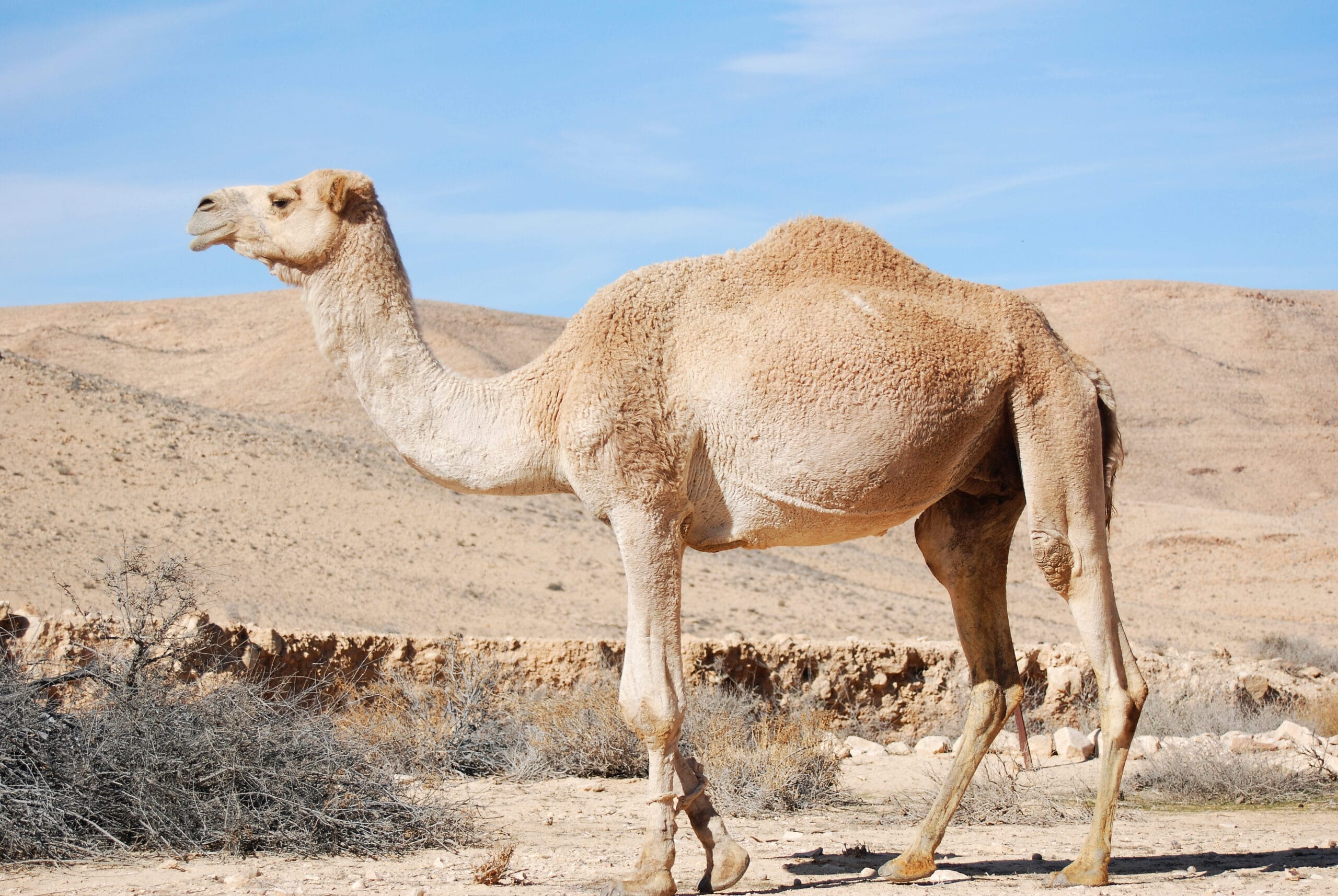
Dromedaries have one hump. Bactrian camels have two. That is the rule, and it holds without exception. If you are standing in Morocco looking at an animal with a single, rounded hump rising from its back, you are looking at a dromedary (Camelus dromedarius). If you see two humps, you are looking at a Bactrian camel (Camelus bactrianus) — an animal you are extremely unlikely to encounter anywhere in North Africa under normal circumstances.
This matters more than it might seem, because the hump is not just a visual identifier — it is a functional organ. Contrary to popular belief, the hump does not store water. It stores fat: a concentrated energy reserve the animal can metabolise when food is scarce. A healthy dromedary’s hump stands firm and upright. When the animal has been working hard or eating poorly, the hump can lean or even flop to one side as fat reserves deplete. A well-cared-for dromedary you encounter on a reputable trek will have a solid, upright hump — a small but reliable indicator of the animal’s welfare.
The single-hump design of the dromedary also makes it easier to saddle and more comfortable for a rider to sit on. Traditional riding saddles used across Morocco and the Sahara are engineered around that single hump, distributing the rider’s weight on either side of the hump rather than directly on top of it. Bactrian saddles are a different engineering challenge entirely.
So the next time someone in your group insists on calling the animal a camel, you now have a precise, confident answer — and the anatomy to back it up.
Tip : When you arrive at a camel trek departure point in Agafay or near Marrakech, look at the hump before you mount. A firm, erect hump is a good sign of a well-nourished, well-rested animal.
Geography is the second great separator between these two animals, and it explains why you will only ever encounter dromedaries in Morocco — or anywhere across North Africa and the Middle East.
Dromedaries are native to the Arabian Peninsula and the Horn of Africa, and they have been domesticated and spread across North Africa, including Morocco, for well over 3,000 years. Today, virtually all dromedaries in existence are domestic or semi-domestic. There are no truly wild dromedary populations left, though a feral population does exist in the Australian outback — descendants of animals imported in the 19th century.
Bactrian camels originate from Central Asia — the steppes and deserts stretching across Mongolia, China, Kazakhstan, and Afghanistan. Wild Bactrian camels (Camelus ferus) still exist in small, critically endangered populations in the Gobi Desert. Domesticated Bactrian camels are used as pack and riding animals in the same region, much as dromedaries are used in North Africa.
The two species evolved in response to very different climates. Dromedaries are built for the intense, dry heat of deserts like the Sahara and the Agafay plateau south of Marrakech. Bactrian camels evolved to cope with both extreme heat and extreme cold — temperatures in their native habitat swing between -40°C in winter and over 40°C in summer. Their thicker coats reflect this adaptation.
For travellers in Morocco, this geographic reality is absolute: every camel trek you take in Marrakech, the Agafay desert, or the Saharan dunes is on a dromedary. The geography alone makes this a certainty. Knowing this gives you a more honest connection to the landscape around you and the culture that has shaped it.
Tip : If you see an operator in Morocco advertising ‘two-humped camels,’ treat that as a red flag. It suggests either misinformation or animals brought in artificially — neither a good sign for a quality experience.
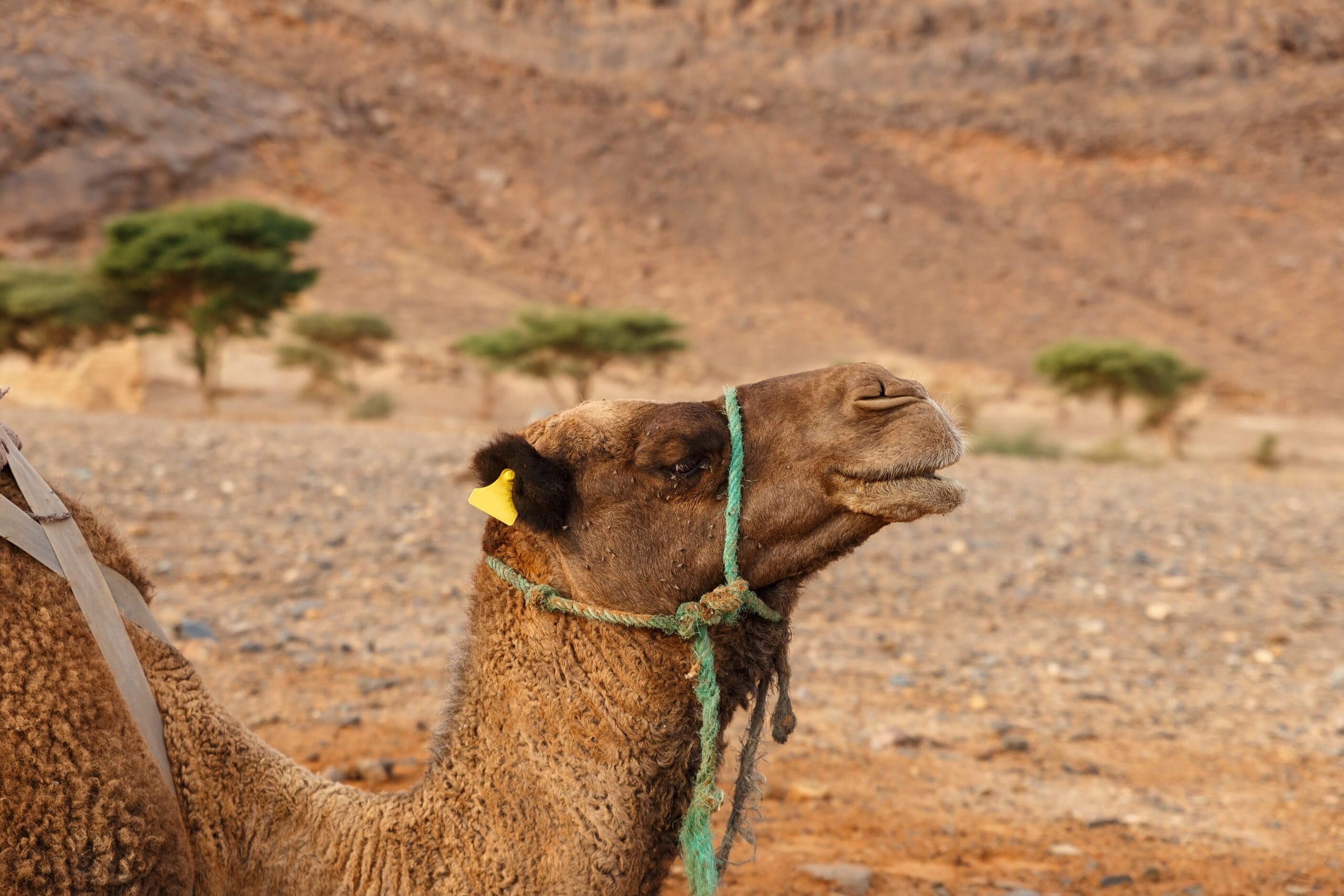
Beyond the hump, dromedaries and Bactrian camels differ considerably in their overall physical construction — and those differences have real implications for anyone planning to ride one.
Dromedaries are generally leaner and taller at the shoulder, standing between 1.8 and 2.1 metres at the hump. They weigh between 400 and 700 kilograms depending on age, sex, and condition. Their build is elegant relative to their size — long, slender legs; a narrow chest; and a relatively streamlined profile. This body type makes them efficient movers in open desert terrain.
Bactrian camels are stockier and more compact. They tend to weigh more — up to 1,000 kilograms in some individuals — and carry significantly more muscle mass, an adaptation for navigating rocky, mountainous terrain and surviving harsh winters. Their legs are shorter relative to body mass, and their overall silhouette is broader and heavier.
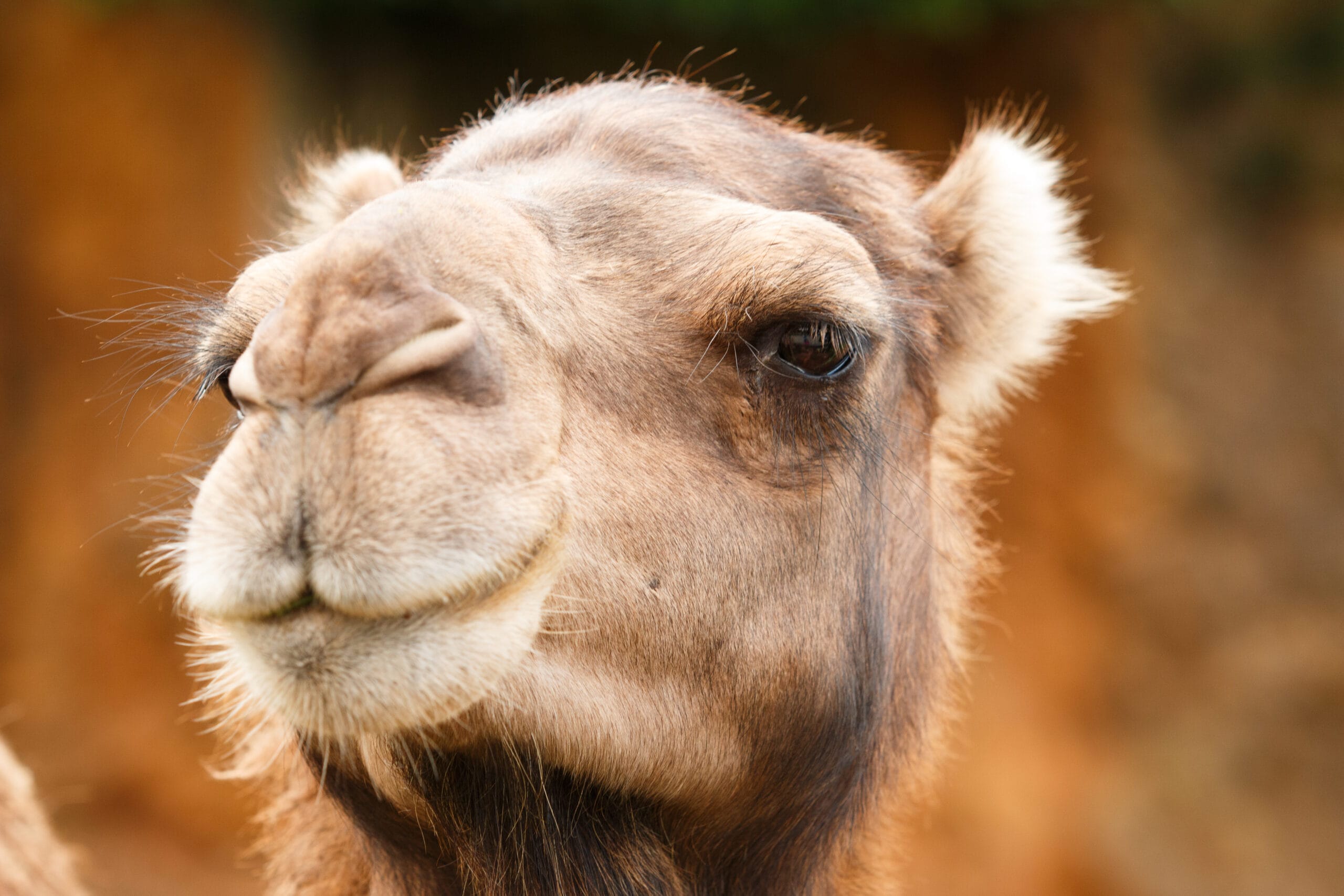
The coat difference is immediately visible. Dromedaries in Morocco have short, fine fur that ranges from cream to dark brown. Bactrian camels have a thick, shaggy double coat that moults dramatically in spring, leaving them looking temporarily ragged. The dromedary’s shorter coat reflects sunlight more efficiently and helps with heat dissipation in the Saharan climate — a genuine physiological advantage in the environments where they work.
For the rider, the dromedary’s higher centre of gravity and longer stride create a distinctive rocking motion that takes some getting used to. First-time riders often find the mounting and dismounting sequence — where the animal kneels, then lurches forward, then back — more surprising than the actual ride itself. A competent guide will always walk you through this before you go anywhere.
Tip : Wear long trousers rather than shorts for your camel trek, regardless of the heat. The saddle and the animal’s fur can cause friction on bare skin over longer rides.
The dromedary is one of the most physiologically sophisticated desert animals on the planet — a fact that becomes genuinely impressive once you understand the mechanisms involved.
Unlike most mammals, dromedaries can tolerate a wide internal body temperature range — roughly 34°C at night to 41°C during the day — without going into distress. This ability to let their core temperature rise during the day reduces the need to sweat and therefore conserves water. When they do sweat, they lose water from all tissues proportionally, not just from the blood, which means they can withstand dehydration levels that would be fatal to most other large mammals.
A dromedary can lose up to 25% of its body weight in water and recover fully by drinking. When water is available, they can consume over 100 litres in a single session. Their oval-shaped red blood cells — unique among mammals — remain functional even when the blood becomes highly concentrated.
Bactrian camels share many of these adaptations but are additionally equipped for cold: their thick coat insulates them in subzero temperatures, and their metabolism adjusts for long, harsh winters. They are broader-spectrum survivors, but in pure Saharan heat, the dromedary’s leaner, heat-optimised design gives it an edge.
For travellers trekking in the Agafay desert outside Marrakech or across Saharan terrain, this matters practically. The dromedary beneath you is genuinely in its element — not stressed by the heat the way a horse or a mule would be. That physiological ease shows in the animal’s calm, steady gait across terrain that would exhaust most other pack animals. You are riding a creature that has been shaped by millions of years of natural selection in exactly this kind of landscape.
Tip : Even though your dromedary handles the heat, you will not. Bring at least 1.5 litres of water per person for any trek over 90 minutes, and wear a hat with full brim coverage.
Both dromedaries and Bactrian camels have earned reputations for being stubborn, unpredictable, or difficult — reputations that are partly deserved and mostly misunderstood.
Dromedaries, when well-socialised and handled by experienced guides, are generally calm, manageable animals. They respond to voice commands and familiarity with their handlers, and a well-trained dromedary on a regular trek route is a reliable, steady animal for riders of all experience levels. That said, they are not passive creatures. They vocalise loudly when irritated, they will attempt to bite or spit if threatened or mishandled, and they have strong preferences that experienced handlers learn to respect.
Spitting — a behaviour often associated with camels and dromedaries in popular culture — is real but widely exaggerated. It is a stress response. A dromedary that spits regularly is a dromedary that is being handled poorly. On a well-run excursion with experienced guides, you are unlikely to see it at all.
Bactrian camels are generally considered slightly more temperamental than dromedaries, partly because they are less widely domesticated in the same intensive way and partly because their natural range puts them in closer contact with harsher, less predictable conditions. Working with Bactrian camels requires deep familiarity with the individual animal.
The key variable in both cases is the quality of the handler, not the species. A dromedary in the hands of someone who has worked with the same animals for years — the way guides do at established operators in the Agafay area — behaves entirely differently from one poorly managed by an inexperienced handler. When you book a camel trek in Marrakech, the relationship between the guide and the animal tells you everything about the quality of the experience.
Tip : Before mounting, watch how the guide interacts with the animal. Calm, quiet handling with no shouting or sharp movements is a good indicator of a reputable operator.
The dromedary and the Bactrian camel did not just enable human survival in harsh environments — they actively shaped the routes of trade, the spread of religion, and the development of entire civilisations across two continents.
The dromedary was the backbone of trans-Saharan trade routes for millennia. Salt, gold, ivory, and enslaved people were carried across thousands of kilometres of desert on the backs of dromedaries, connecting sub-Saharan Africa to the Mediterranean world and the Middle East. Morocco’s great trading cities — including Marrakech, which was founded in the 11th century partly as a staging post for these routes — were built on commerce that dromedaries made possible. The animal is woven into Moroccan history, law, poetry, and religious practice in ways that go far deeper than tourism.
Bactrian camels played an equivalent role on the Silk Road, carrying silk, spices, and ideas between China, Persia, and Rome across the mountains and deserts of Central Asia. The image of the caravan stringing across a mountain pass is as inseparable from Bactrian camel culture as the trans-Saharan caravan is from the dromedary.
Both animals are referenced in religious texts. In Islam, the camel — meaning the dromedary in North African and Middle Eastern context — holds a position of cultural reverence. The Prophet Muhammad spoke of camels frequently, and their care is considered a moral responsibility in Islamic tradition. This is part of why reputable operators in Morocco take animal welfare seriously: it is not only commercial sense, it is cultural expectation.
When you ride a dromedary in the Agafay desert, you are participating in a tradition that stretches back through centuries of Moroccan history. That context transforms a tourist activity into something with genuine depth.
Tip : If you want to understand the cultural weight of the dromedary in Morocco, spend time in a traditional weekly souk (market) where animals are traded. The markets in the Medina’s outskirts offer a glimpse of this living tradition.
Nobody tells you how strange the mounting process feels until you are in it. The dromedary kneels on its front legs first, pitching you sharply backward. Then the rear legs fold, and you lurch forward. Then — if the guide asks it to stand — the rear legs straighten first, tipping you sharply forward again before the front legs follow. By the time you are upright, you have already had a minor physical adventure before the trek has officially begun.
Once moving, the gait of a dromedary is unlike any other riding animal. It paces — meaning it moves both legs on the same side simultaneously, rather than alternating like a horse. This produces a side-to-side rolling motion rather than the up-and-down bounce of a trotting horse. Experienced riders often describe it as slightly nautical. Most first-timers find their balance within ten to fifteen minutes.
Bactrian camels, when ridden, offer a broadly similar experience — the pacing gait is shared — but the saddle position between two humps is very different. Riders sit in a kind of natural cradle between the two humps, which some people find more stable. The animal’s stockier build also makes the motion feel slightly different: heavier, more deliberate.
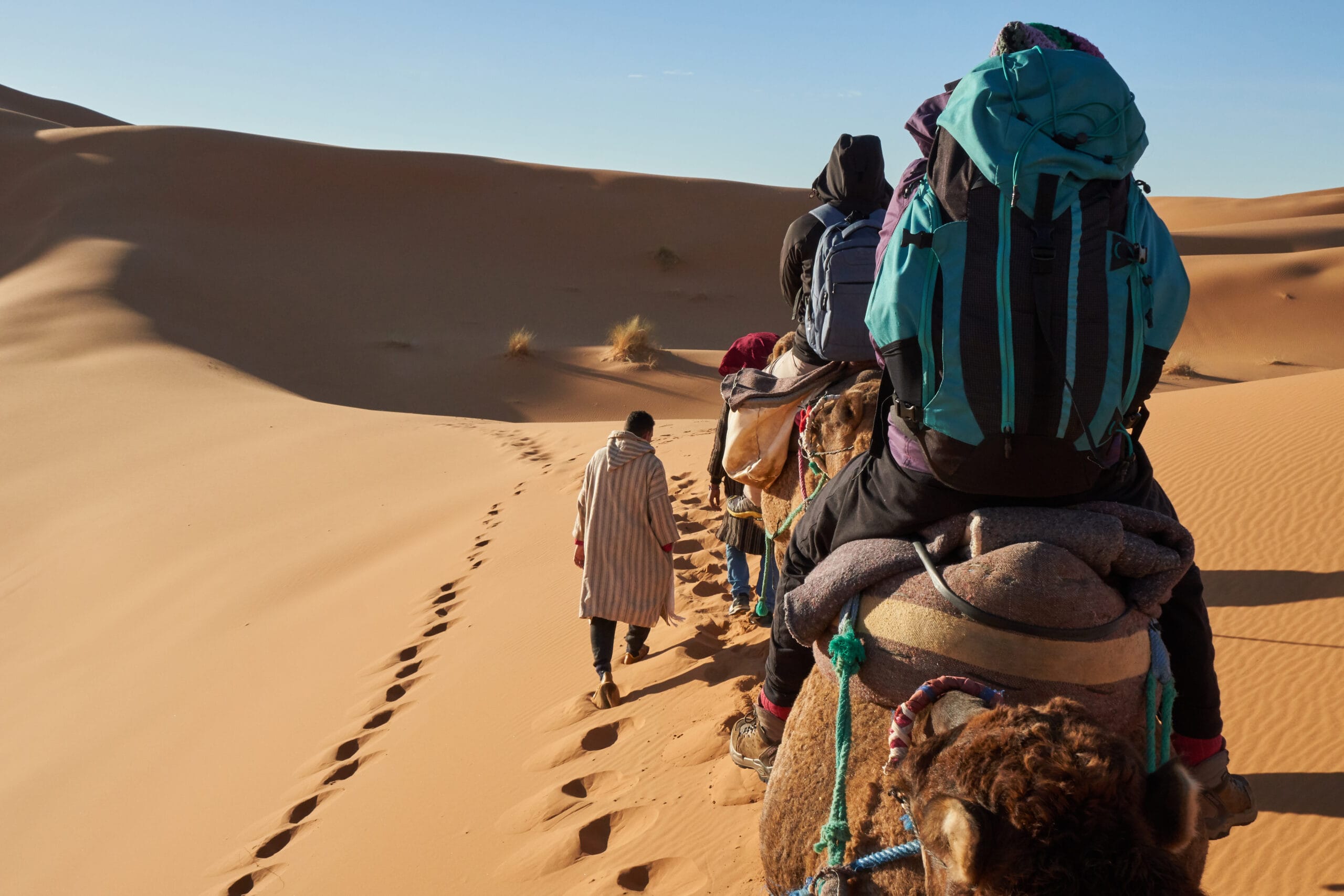
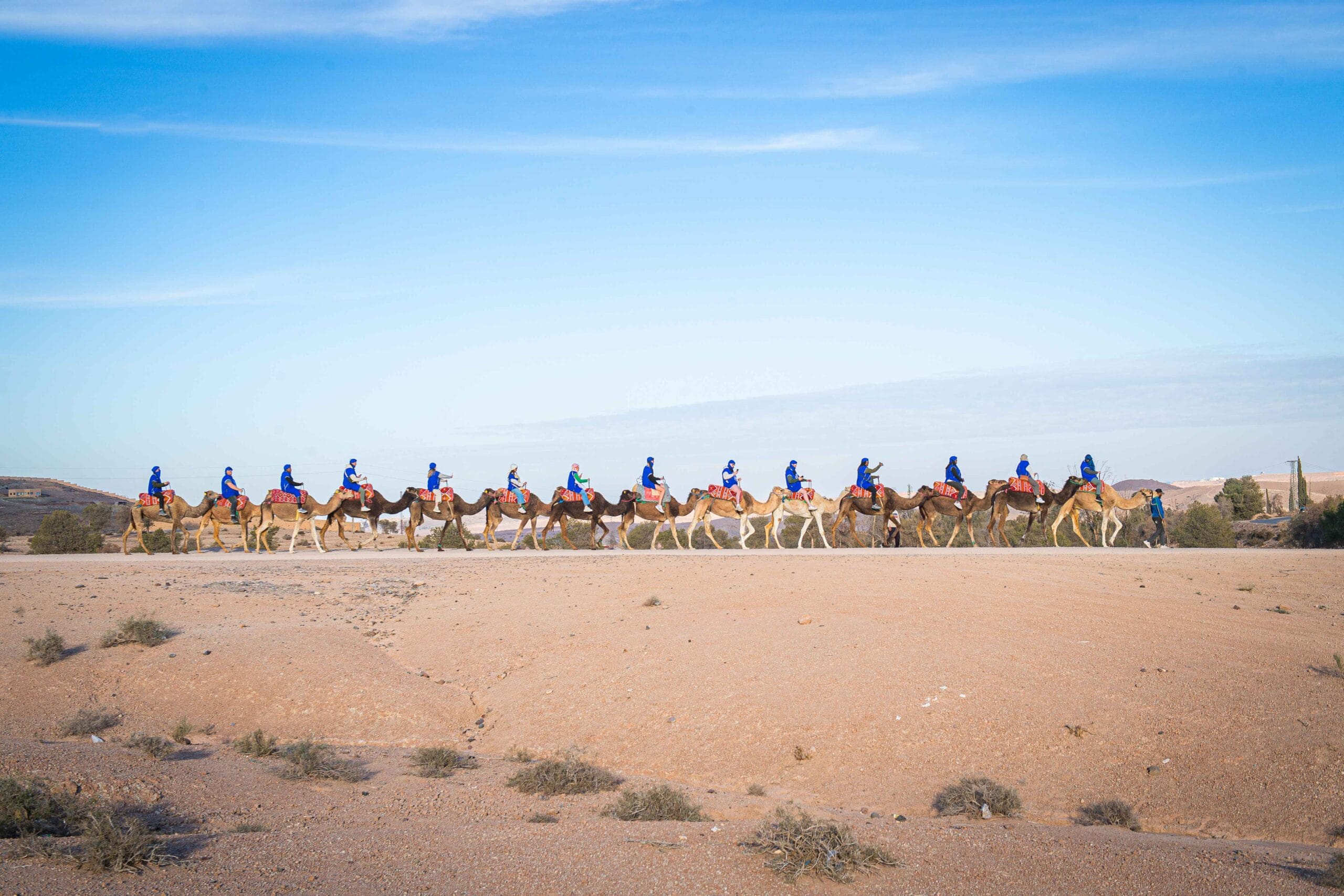
For a camel trek in the Agafay desert, most treks last between 30 minutes and two hours, which is comfortable for almost all fitness levels. The pace is calm. The desert plateau’s flat terrain is well-suited to dromedary movement. At sunset, with the Atlas Mountains visible on the northern horizon and the plateau turning amber, the riding experience becomes something you remember with your whole body — the rhythm of the gait, the warmth of the animal, the scale of the landscape.
Tip : If you are prone to lower back pain, mention it to your guide before mounting. They can adjust the saddle padding and suggest stopping points during longer treks.
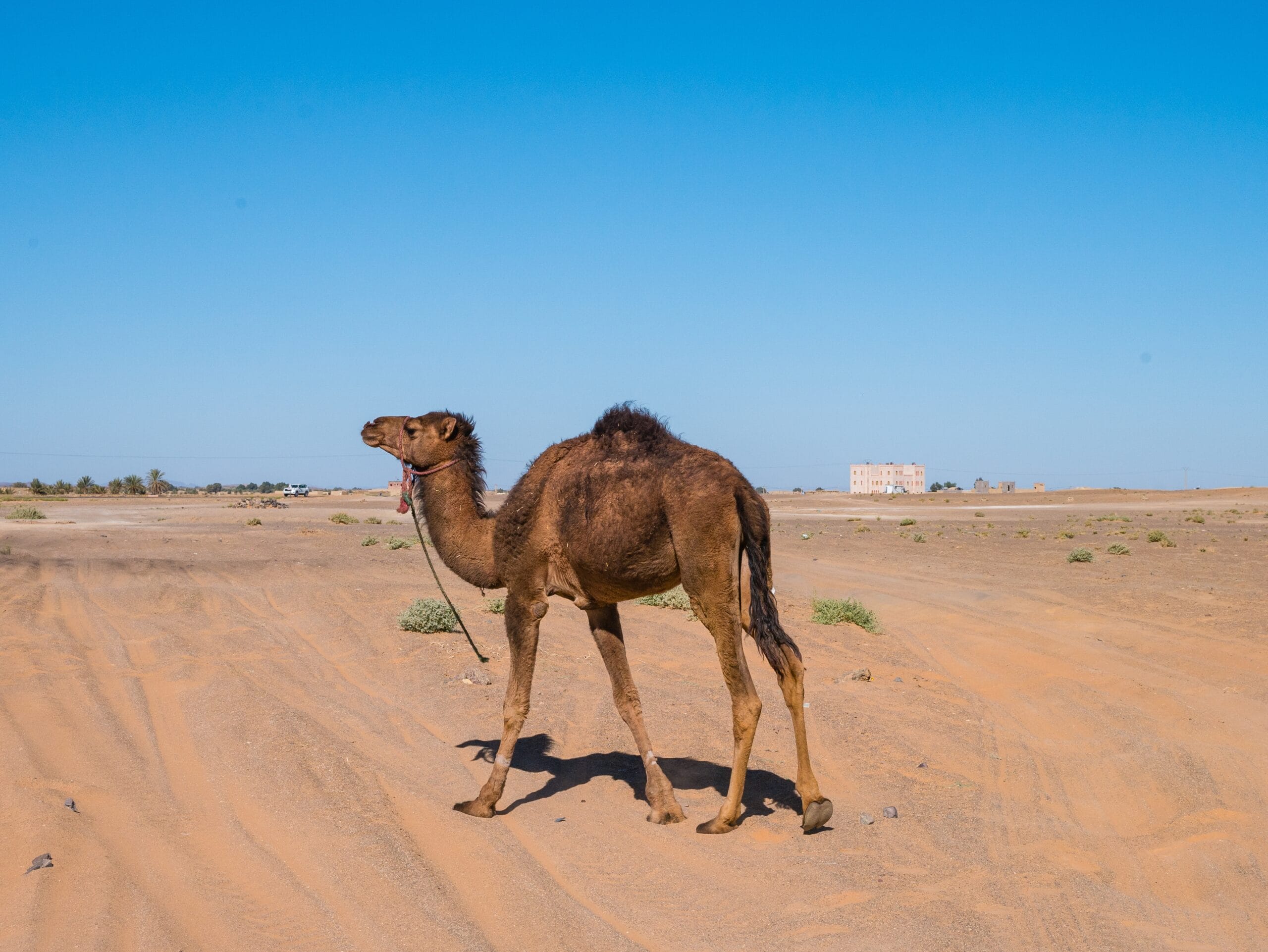
Understanding the biology of the animals you interact with makes you a more responsible traveller — and better equipped to choose operators who treat their animals well.
Dromedaries live between 40 and 50 years in domestic settings. They are not fast-maturing animals: females reach reproductive maturity at around 3 to 4 years of age, and males somewhat later. Gestation lasts around 13 months, and a healthy female typically produces one calf every two years. This means dromedary populations grow slowly, and each individual animal represents a significant long-term investment for the family or business that owns it.
Bactrian camels have comparable lifespans and reproductive timelines. Wild Bactrian camels are critically endangered — fewer than 1,000 are thought to remain in the wild — making domesticated populations in Central Asia important cultural and genetic resources.
Signs of good animal welfare in Morocco that you can observe before you book or on arrival: animals in a healthy weight range (hump upright, ribs not visible), clean hooves, no visible wounds or abrasions from poorly fitted equipment, calm behaviour around handlers, and appropriate resting time between treks. Reputable operators in the Agafay area maintain their dromedaries year-round as working animals with consistent care — not seasonally hired livestock.
Choosing a responsible operator is straightforward: ask how many treks the animals do per day, whether there is veterinary oversight, and how long the animals have been working with the current guides. These are not difficult questions, and a good operator will answer them without hesitation. Fourteen years of local operation, for example, means deep familiarity with the animals involved — a relationship built over the full working life of the dromedary itself.
Tip : Avoid any operator where animals appear visibly distressed, where equipment looks damaged or poorly maintained, or where guides are rough in their handling. A quality trek costs a little more — and it is worth it.
In Moroccan Arabic (Darija), the dromedary is most commonly called jmal (جمل) — the same root word that gives us the Arabic origin of “camel.” In classical Arabic, the word jamal covers both species, with context determining which one is meant. In Morocco, where Bactrian camels are essentially absent, jmal always means the dromedary.
In Tamazight, the Berber languages spoken widely in the Atlas Mountain communities around Marrakech, there are several regional terms for the dromedary, reflecting how deeply embedded the animal is in the linguistic and cultural life of communities who have depended on it for generations.
In French — which remains widely used in the Moroccan tourism and hospitality sector — the distinction is actually clearer than in English. Dromadaire means dromedary; chameau means the two-humped Bactrian camel. French-speaking guides and operators often use the correct term, which is why you may hear your guide say dromadaire even when the rest of the conversation is in English.
In English, the blurring of these two animals into “camel” is a linguistic accident of history — English-speaking cultures first encountered both species through texts and trade routes where the distinction was not always made clear. The confusion has calcified into habit. But habit is not accuracy.
Using the right word — dromedary — is a small act of respect: for the animal, for the culture that has depended on it, and for the landscape where you encounter it. Your Moroccan guide will almost certainly appreciate the precision. It signals that you are a traveller who pays attention.
Tip : Learning a few words of Darija before your trek goes a long way. ‘Shukran’ (thank you) and ‘zwina’ (beautiful, said of the landscape or the animal) are immediately useful and warmly received.
Everything covered in the nine points above converges here: what does the dromedary vs camel distinction actually mean when you are choosing an activity in Marrakech?
First, it tells you that every camel trek advertised in Morocco is a dromedary trek — full stop. That is not a problem; it is simply accurate. The dromedary is a magnificent animal, perfectly adapted to the terrain you will ride through, with deep roots in Moroccan culture and history. You are not getting a lesser experience — you are getting the authentic one.
Second, knowing the biology gives you a practical checklist for evaluating operators. A reputable provider will have animals in good condition, guides who know each dromedary by name, and a clear structure to the experience: briefing, mounting assistance, paced itinerary, and a safe dismount at the end. The Agafay desert, roughly 30 kilometres from Marrakech’s city centre, is one of the most accessible and scenically rewarding places to do this — a rocky plateau ringed by the first ridges of the Atlas, with enough open space to feel genuinely remote without requiring a full-day journey.
Third, the distinction between dromedary and camel is a conversation-starter with your guide. Ask where the animal was born, how long it has been working this route, what it eats in the off-season. Guides who have spent years with the same animals have stories worth hearing — and that exchange is what separates a real experience from a transaction.
The dromedary is not a prop. It is a working animal with a long relationship to this land and the people on it. Arriving with that understanding changes what the ride gives you back.
Tip : Combine your dromedary trek with a sunset or dinner experience in Agafay. The light in the late afternoon is exceptional, and the plateau cools significantly after dark — a completely different atmosphere from the midday heat.
The dromedary vs camel distinction is one of those details that seems minor until it reframes everything you thought you knew about a place. In Morocco, the dromedary is not a tourist prop — it is a living thread connecting the landscape, the trade routes, the culture, and the people who have made their lives here for centuries.
Knowing what you are riding, why it is built the way it is, and what kind of care it deserves makes you a more engaged traveller. It also makes the ride itself more meaningful. When you settle into the saddle on the Agafay plateau and the Atlas appears on the horizon, you are not just ticking off an activity. You are connecting with something real.
At Quad Marrakech, we offer dromedary treks in the Agafay desert led by guides who know this land — and these animals — by heart. Whether you want a short sunset ride or a full desert evening with dinner under the stars, we will put you on the right animal, with the right people, in the right place. Book your Agafay camel trek here and arrive knowing exactly what to expect.
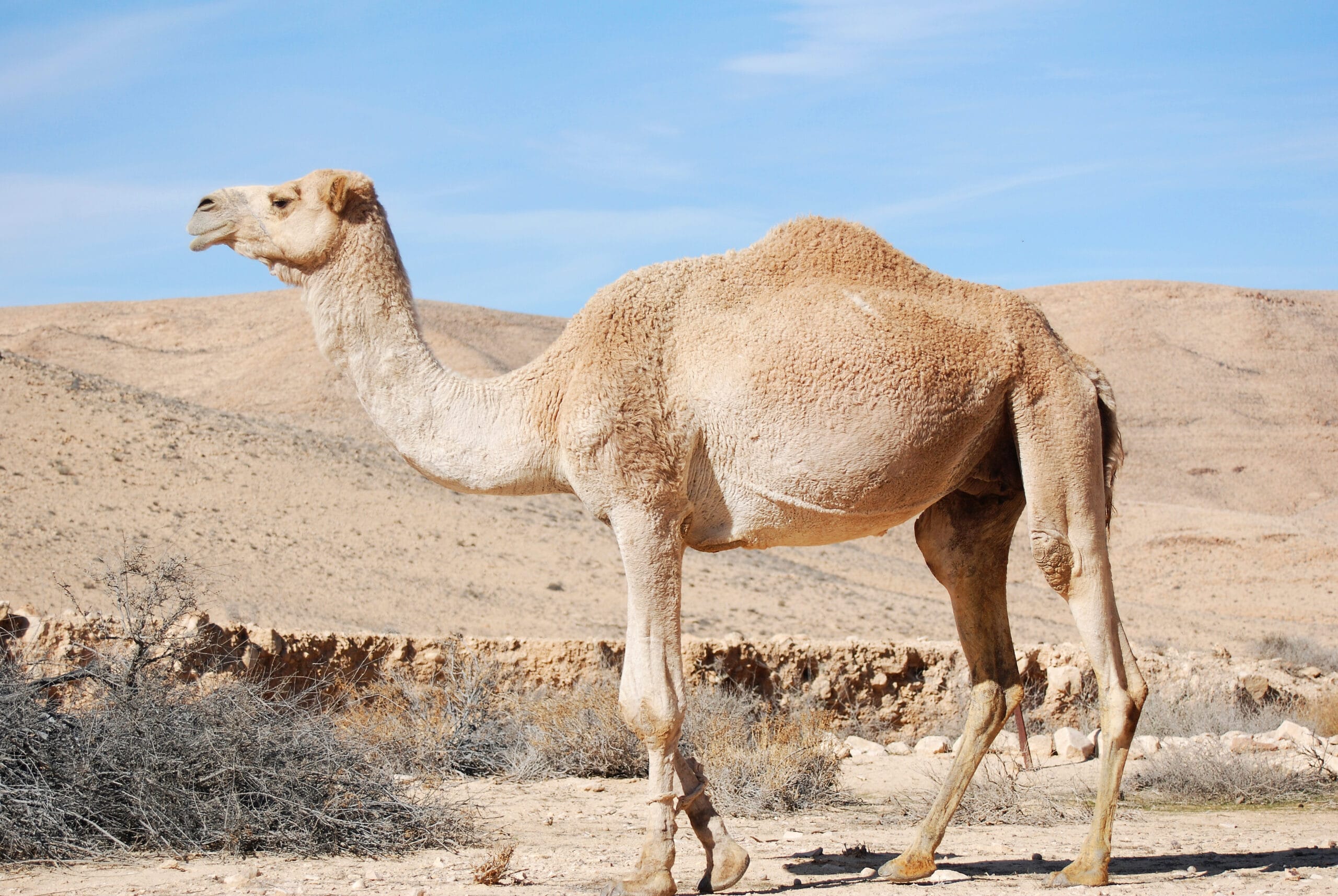
A dromedary has one hump and lives in North Africa and the Arabian Peninsula. A Bactrian camel has two humps and is native to Central Asia. Both belong to the family Camelidae, but they are different species with different physiology, temperament, and geographic ranges.
All the animals used for camel treks in Morocco are dromedaries. Bactrian camels — the two-humped variety — are not native to North Africa and are not used in Moroccan tourism or agriculture. When Moroccan guides say ‘camel,’ they mean dromedary.
Yes, dromedary treks in Morocco are suitable for most adults and older children, including complete beginners. The pace is calm, and guides assist with mounting and dismounting. The trickiest moment is the kneeling and standing sequence, which your guide will walk you through before departure.
No. This is one of the most common misconceptions about both dromedaries and camels. The hump stores fat, not water. The dromedary’s water efficiency comes from its physiology — its ability to tolerate wide body temperature swings, its specialised red blood cells, and its capacity to rehydrate rapidly after dehydration.
Most dromedary treks in the Agafay desert last between 30 minutes and two hours, depending on the package. The Agafay plateau is about 30 kilometres from central Marrakech. Sunset treks are among the most popular, often combined with a dinner experience at a desert camp.
Spitting is a stress response in dromedaries, not a default behaviour. A well-cared-for dromedary handled by an experienced guide is very unlikely to spit at anyone. If an animal spits frequently during a trek, it is usually a sign of poor handling or animal welfare issues — a reason to reconsider the operator.