No products in the basket.

 Zakaria Belkhay
April 26, 2026
Zakaria Belkhay
April 26, 2026
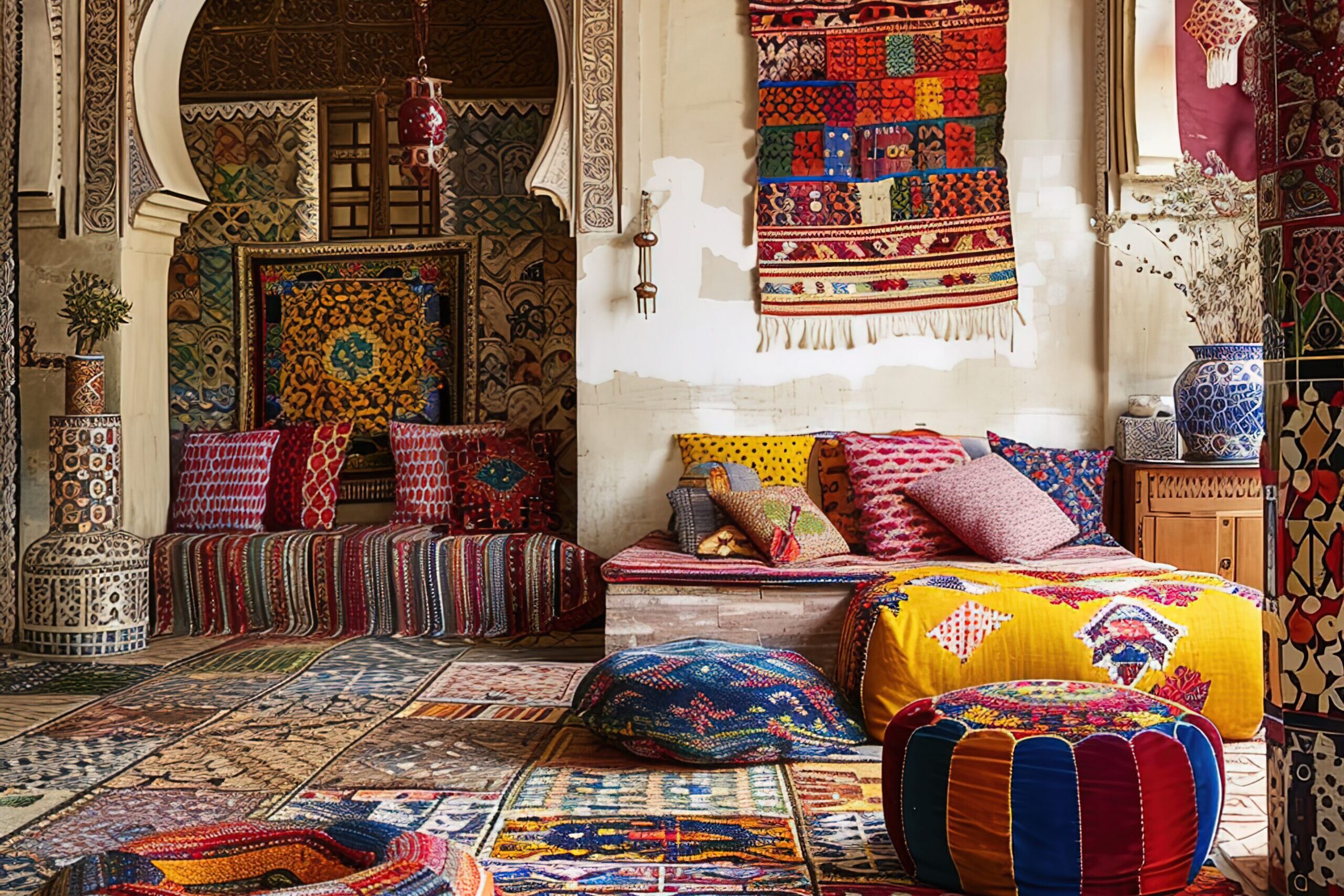
The best Marrakech travel tips are not the ones that tell you which mosque to photograph — they’re the ones that prevent the specific frustrations that catch first-time visitors completely off guard.
Marrakech is one of the world’s most exhilarating cities. It’s also one of the most disorienting for travelers arriving without preparation. The medina’s navigation logic defies GPS. The souk negotiation culture has unwritten rules. The heat in summer can be genuinely dangerous if you don’t adjust your schedule. The gap between a genuine local experience and a tourist-price theater can cost you hundreds of dirhams if you don’t know the signs.
This guide distills the most important Marrakech travel tips for first-time visitors into 20 practical, honest pieces of advice — organized from arrival logistics to daily survival to the experiences worth every dirham. Read it before you land and your Marrakech trip will be better, cheaper, safer and more genuinely Moroccan than 80% of visitors manage to make it.
| How to use this guide: This is a practical pre-trip reference, not a romantic travel essay. Each tip addresses a real situation that first-time Marrakech visitors encounter and explains exactly what to do. Bookmark it. Re-read it the evening before you arrive. |
Marrakech Menara Airport is directly served by Petit Taxis (small metered taxis — red, officially licensed) and Grand Taxis (larger shared or private taxis). The metered fare from the airport to the medina should cost 70–120 MAD (6.50–11 €). Unmarked drivers who approach you in arrivals will quote 200–400 MAD for the same journey and negotiate from there. The simple rule: only take clearly marked, licensed taxis or pre-booked transfers. If your riad offers airport pickup (typically 150–200 MAD), it’s often the smoothest option — your driver will be waiting with your name on a sign.
Google Maps and Apple Maps both struggle in Marrakech’s medina. The narrow, unlabeled alleys, dead ends and market passages that don’t appear on any satellite image make GPS navigation genuinely unreliable. Maps.me (free, offline) has better coverage of the medina’s footpaths and is widely used by travelers and expats. Download the Morocco offline map before you leave home. And accept that you will get lost. Getting lost in Marrakech is not a problem — it’s part of the experience, and every Moroccan you ask for directions will be genuinely helpful.
The most beautiful riads in Marrakech are hidden deep in the medina’s labyrinthine interior, down alleys too narrow for any vehicle. This creates a practical challenge: arriving with luggage. Most riads offer to collect guests from the nearest accessible street (Jemaa el-Fna, or the main medina gates) — always use this service. Attempting to drag wheeled luggage through the medina solo is a reliable way to arrive sweaty and frustrated before your trip has even begun.
Marrakech’s medina does not have significant crime risks for tourists, but persistent attention from touts, unofficial guides and vendors is a reality. The most effective response is not aggression or anxiety — it’s calm indifference. A simple “la shukran” (no thank you in Arabic) or a confident “non merci” (French works well) delivered without eye contact and without breaking stride is the gold standard response. Engaging — even to argue, even to say no repeatedly — signals availability for negotiation and increases attention. The key is disengagement, not confrontation.
The Moroccan dirham (MAD) is not available outside Morocco. Exchange rates at Marrakech Menara Airport are significantly worse than ATM rates in the city. The best strategy: withdraw MAD from any Wafa Bank, Banque Populaire, or CIH ATM in Gueliz (the new city) or near Jemaa el-Fna. ATM withdrawal limits vary — plan for multiple withdrawals if needed. Most restaurants, riads and organized tours accept credit cards, but street stalls, taxi drivers, souk vendors and many smaller establishments require cash.
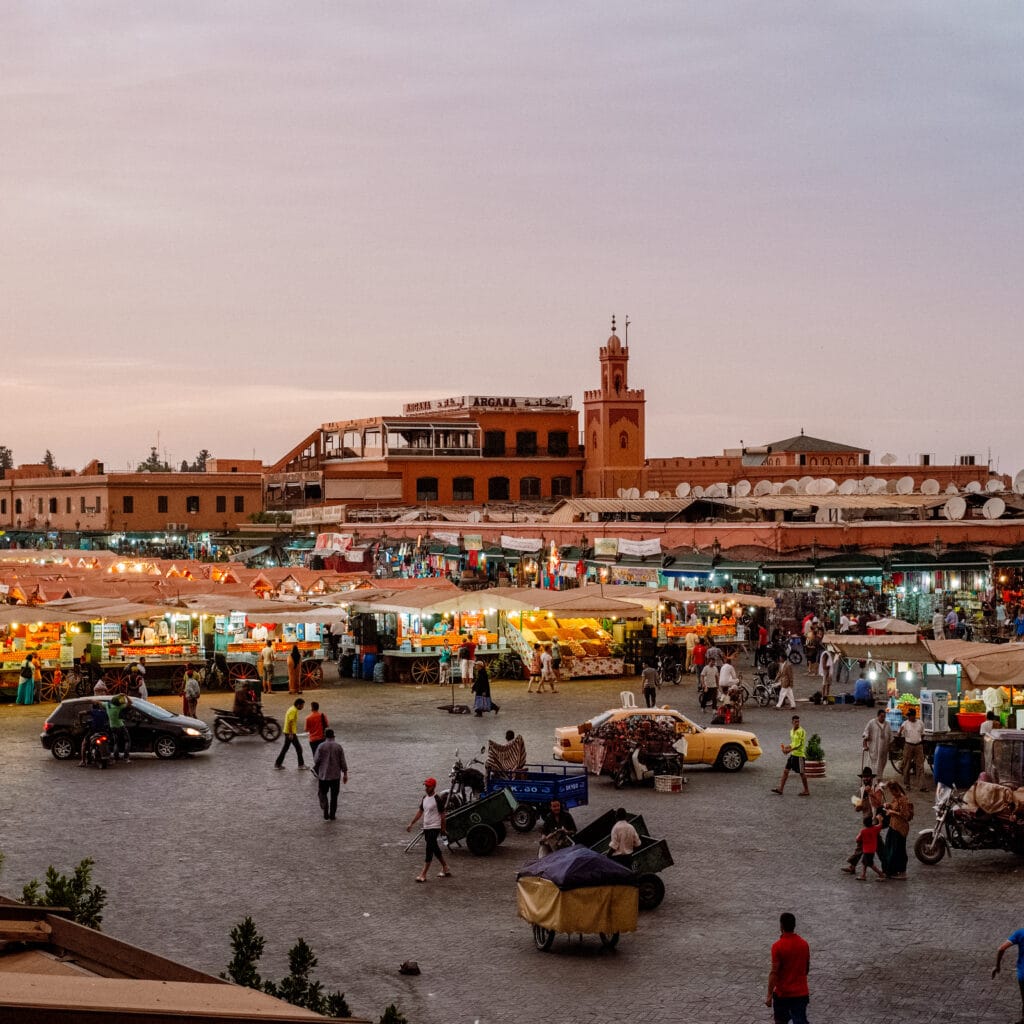
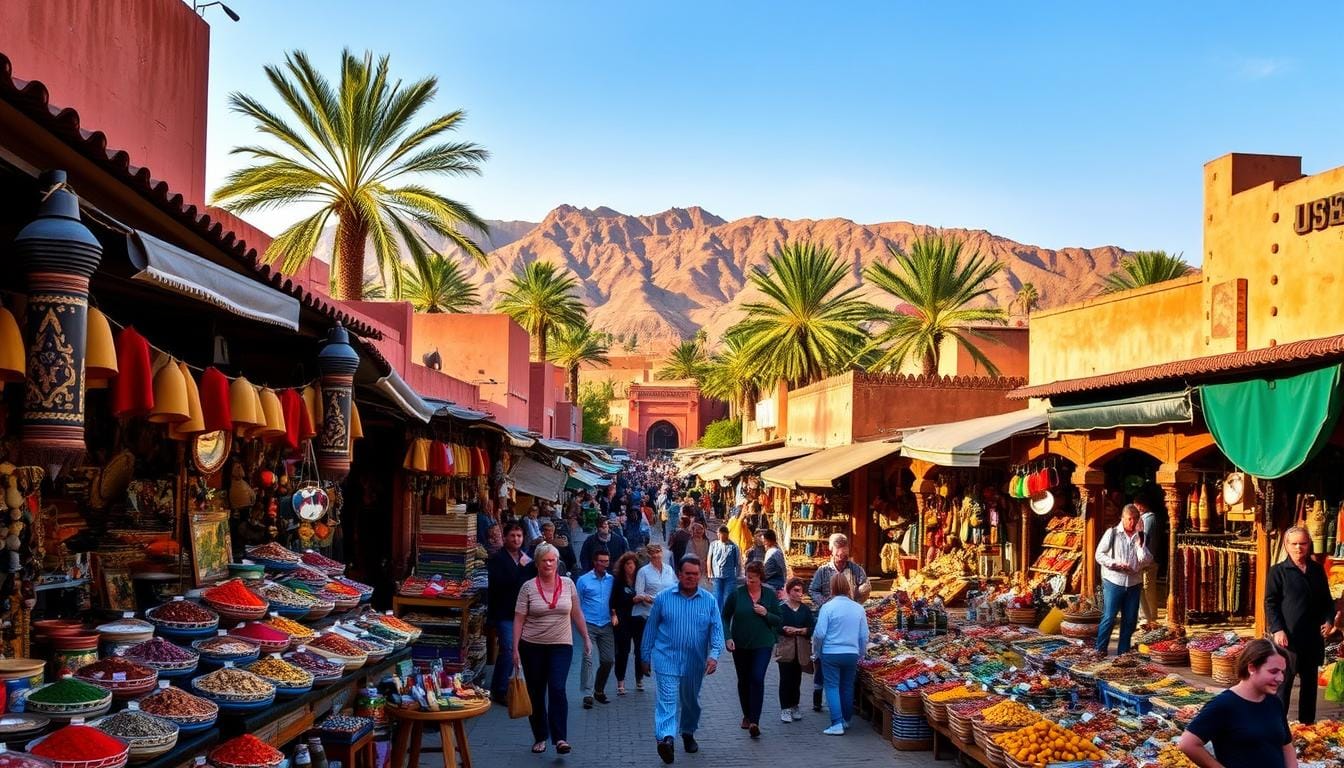
Negotiation is expected and enjoyable in the Marrakech souks. The opening price quoted by a vendor is typically 2 to 4 times the eventual sale price. A useful mental heuristic: offer approximately 40% of the opening price and expect to settle between 45% and 60% with goodwill on both sides. The “walking away” technique works well — if your price isn’t accepted, thank the vendor and move toward the door. You’ll often be called back. However, once you’ve agreed on a price and the vendor has prepared the item, backing out is considered poor form. Only negotiate if you genuinely intend to buy.
| Key insight: The souks sell the same items in hundreds of stalls. If a vendor won’t meet your price, the identical product is available 20 meters down the same alley. You have all the time and all the leverage — vendors know this and most will find a middle ground rather than lose the sale entirely. |
Restaurants with terrace views over Jemaa el-Fna charge a significant premium for the view. A tajine that costs 80–120 MAD on the square costs 50–80 MAD in a restaurant one street into the medina, and 30–50 MAD at a neighborhood eatery two streets back. The food quality is often inversely related to the tourist proximity. Explore one street back from any major sight and prices drop immediately and food quality frequently improves.
Unlike the souks, tourist hammams display fixed prices and are not generally negotiated. The prices (150–400 MAD for a full hammam, scrub and massage) are fair for what’s delivered and represent genuinely good value. Attempting to negotiate at a hammam is culturally awkward and usually unsuccessful. Accept the listed price, focus on finding a reputable establishment with recent positive reviews, and enjoy one of Morocco’s most restorative experiences without the souk-style mental math.
Marrakech is a predominantly Muslim city and the medina is a living, working community, not a theme park. Dressing modestly — shoulders covered, knees covered — is appropriate and expected in the medina’s alleys, mosques (when permitted entry), and local neighborhoods. This applies to all genders. Beyond cultural respect, covered clothing also provides practical sun protection in a city where UV levels are extreme. The dress code is significantly more relaxed in Gueliz (the new city), hotel pools and tourist restaurants.
Photography in Marrakech requires social awareness. People working in the souks, performing in Jemaa el-Fna, or going about their daily lives in the medina alleys are not automatically available as photographic subjects. Always ask before photographing a person directly. Some will say yes happily (especially performers who earn tips from photos). Others will decline or request payment (10–50 MAD is common for street performers and craftspeople). Photographing without asking is considered disrespectful and sometimes generates genuine hostility.
If your visit coincides with Ramadan (dates shift annually based on the Islamic calendar), expect significant changes to the city’s rhythm. Most restaurants in the medina close or limit service during daylight hours. The city quiets dramatically during the day and explodes into joyful life after iftar (sunset breaking of the fast). Alcohol service becomes harder to find. Eating publicly in the medina during daylight is considered disrespectful. However, Ramadan Marrakech has its own extraordinary atmosphere — the evening streets, the shared meals, the communal joy after sunset are genuinely moving for visitors who approach it with openness rather than frustration at the changed logistics.
Non-Muslims are not permitted to enter active mosques in Morocco. The Koutoubia Mosque — Marrakech’s most iconic landmark — can only be admired from outside and from the adjacent garden. The Ben Youssef Mosque in the medina is similarly closed to non-Muslim visitors. This is not unfriendly or exclusionary — it’s a standard practice throughout Morocco. The Bahia Palace, the Saadian Tombs and the Majorelle Garden are open to all visitors.
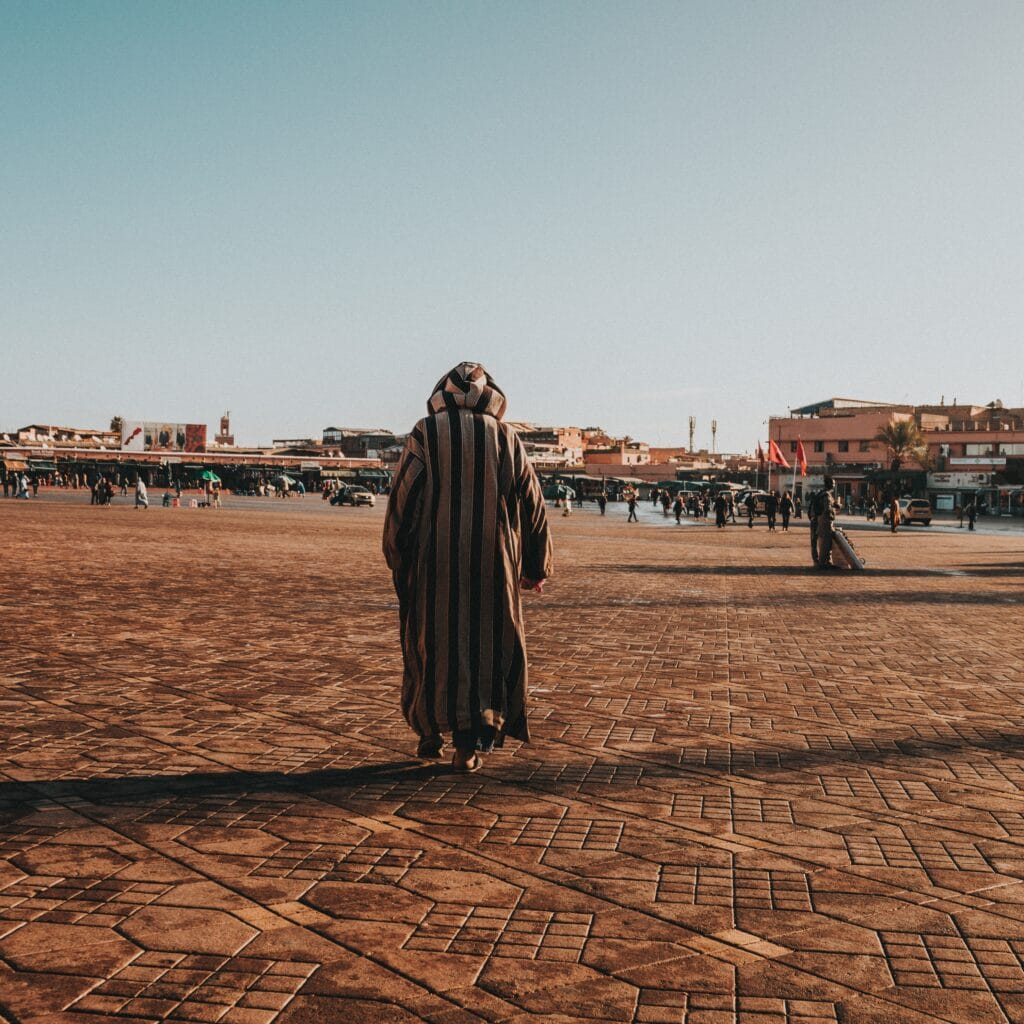
Between June and September, Marrakech regularly exceeds 38–42°C. This is not “pleasantly warm” — it is an active health risk for people who don’t manage it correctly. The only viable summer Marrakech schedule is: explore from 7:00–12:30 PM, rest in air-conditioned or shaded space from 1:00–4:30 PM, re-emerge for late afternoon and evening. Any deviation from this — prolonged walking in full afternoon sun without shade or water — risks genuine heat exhaustion. Spring (March–May) and autumn (September–November) are dramatically more comfortable and equally beautiful.
Tap water in Marrakech is technically treated but routinely causes stomach upset in unaccustomed visitors. Always drink bottled water. The same caution applies to ice in drinks from street stalls (ice in established restaurants is fine). The most reliable food safety rule for street food: eat where things are cooked fresh in front of you, avoid any food sitting in open containers at room temperature in summer heat. Most traveler stomach issues in Marrakech are caused by food handling, not water — and most are preventable with these two simple habits.
Standard travel insurance policies may exclude motorized activities (quad biking, buggy rides) and adventure sports (hiking above certain altitudes, camel riding). Before booking any activity in Morocco, check your policy specifically. If adventure activities are excluded, purchase a supplementary rider or choose a policy that explicitly covers them. Medical care is available in Marrakech (Clinique Internationale is the best private clinic) but evacuation from remote desert or mountain locations can be expensive without proper coverage.
The medina’s souks, historical sites and hidden neighborhoods make exponentially more sense with a licensed guide for the first visit. A 3-hour morning tour with a licensed guide (look for the official badge from the Moroccan Ministry of Tourism — 300–500 MAD) teaches you the geography, the craft traditions, the historical context and the navigation logic that makes subsequent solo explorations far more rewarding. Unlicensed “guides” who approach you in the street are not regulated and typically lead visitors to shops where they earn commissions on purchases — not the same experience.
The experiences that most travelers rate as the highlights of their Marrakech visit cost nothing: the hypnotic loop of Jemaa el-Fna at 10 PM, getting genuinely lost in the Mouassine neighborhood at dusk, watching bread being baked at a neighborhood fern (communal oven) at 7 AM, sitting in the Menara Gardens as the Atlas Mountains turn golden at sunset, or stumbling into a gnawa music performance in an alley. Plan your paid experiences carefully — and leave abundant time for the unplanned moments that cost nothing and stay with you forever.
Most guidebooks recommend visiting Jemaa el-Fna at sunset. That’s when it’s most crowded, most expensive and most photographed. The actual best times are early morning (7:00–9:00 AM) when the square belongs to locals — juice vendors, spice sellers, a few storytellers, the occasional snake charmer warming up — and late night (11:00 PM–1:00 AM) when tourists have retreated and the square becomes a more authentic, less performative version of itself. Both windows offer a Marrakech that most visitors never see.
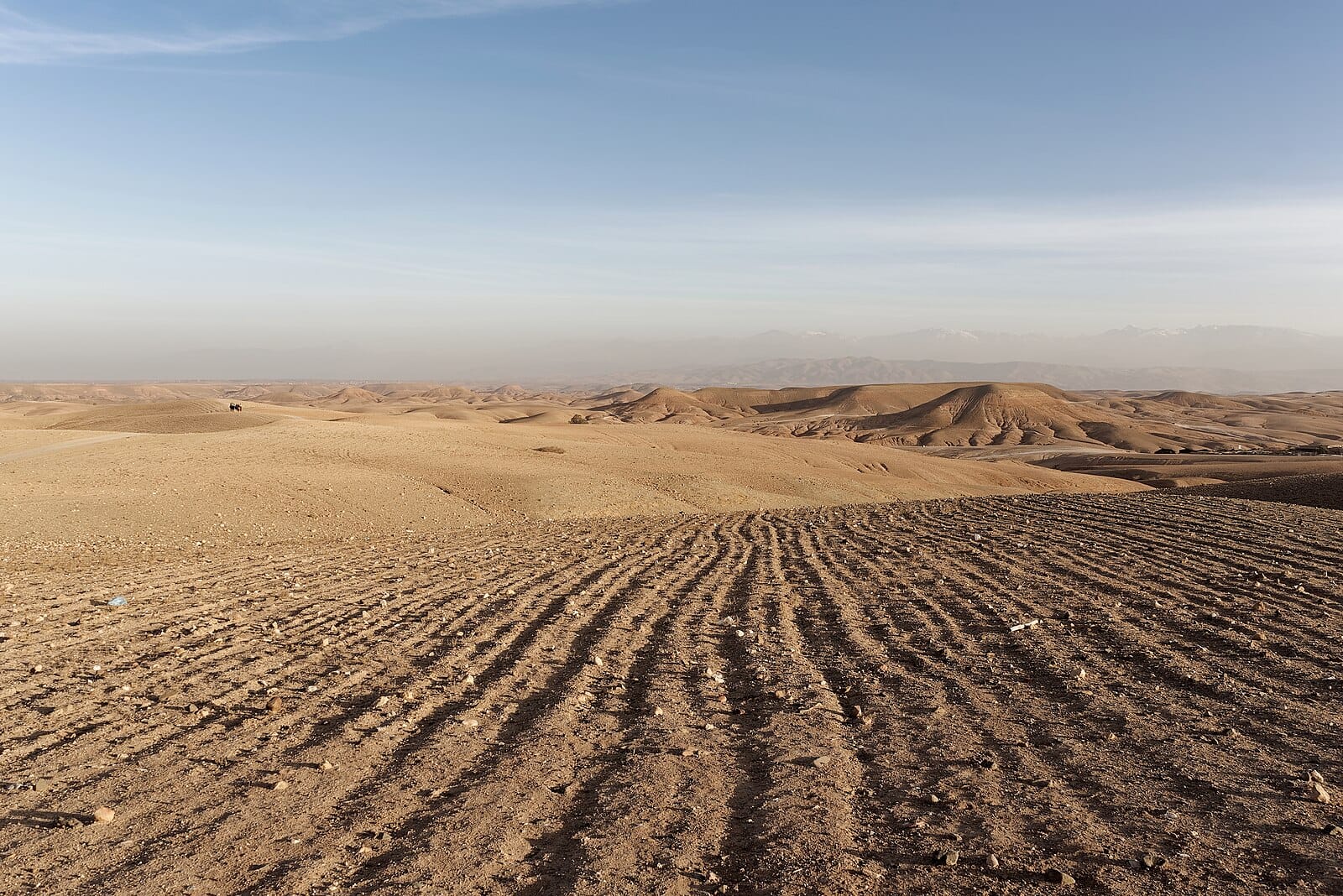
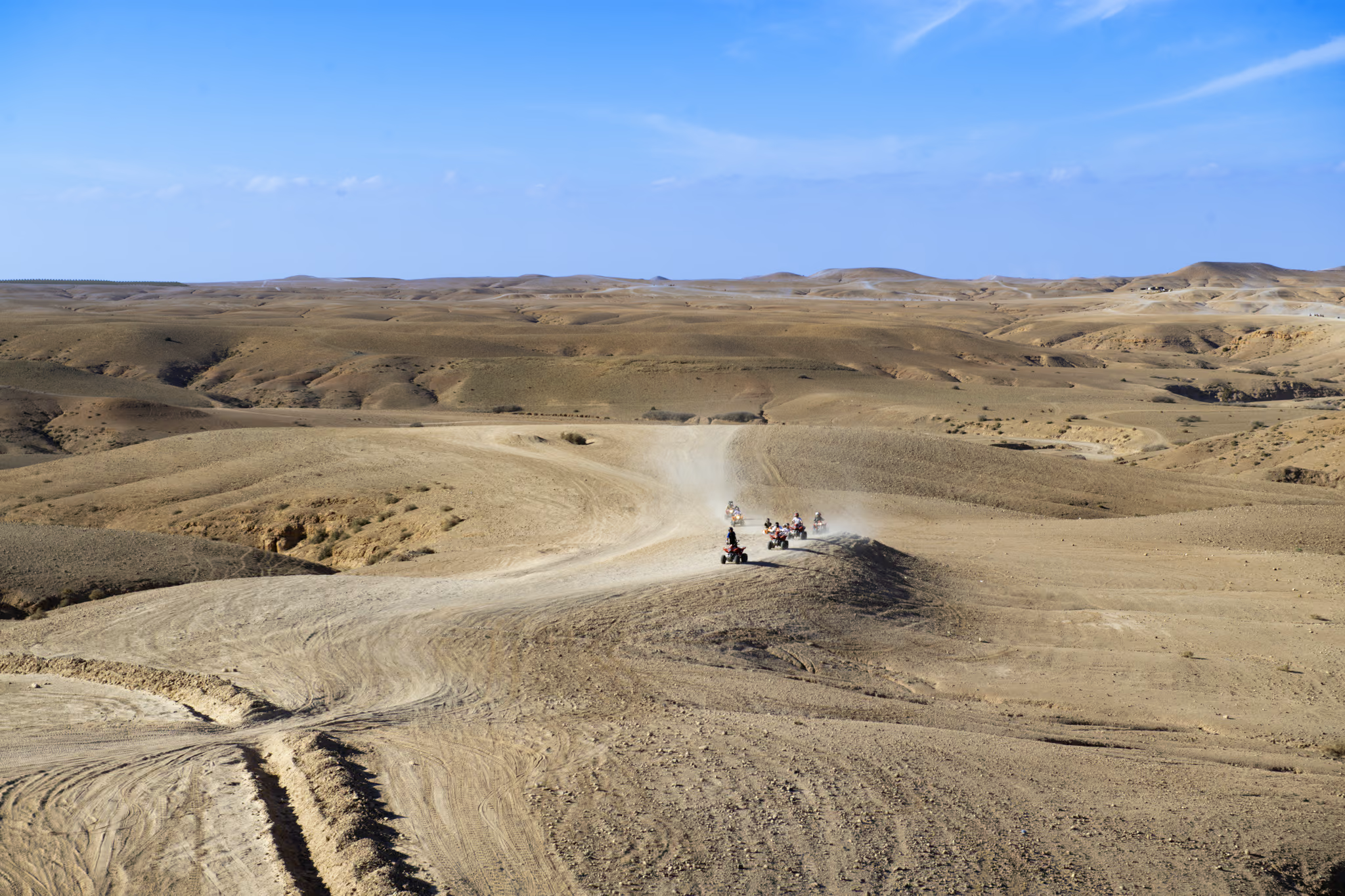
Travelers who spend their entire Marrakech visit inside the medina consistently rate their trip lower than travelers who dedicate at least one day or evening to the surrounding landscape. The Agafay Desert (30 km, 40–50 minutes) transforms any Marrakech trip — a sunset camel ride, quad biking circuit and Berber dinner under the stars creates the kind of memory that the souks, however beautiful, simply cannot replicate. The Atlas Mountains (60 km) add an entirely different dimension. The cost is modest compared to the impact on the overall trip.
| Excursion | Distance/Time | Why It’s Worth It |
| Agafay Desert (half day/evening) | 30 km / 45 min | Desert landscape, camels, dinner — unique to Morocco |
| Ourika Valley (full day) | 65 km / 1h10 | Mountain villages, waterfall, Berber culture |
| Imlil/Atlas Mountains (full day) | 60 km / 1h15 | Toubkal views, trekking, snow-capped peaks |
| Essaouira (full day) | 190 km / 2h30 | Atlantic coast, blue medina, windsurfing culture |
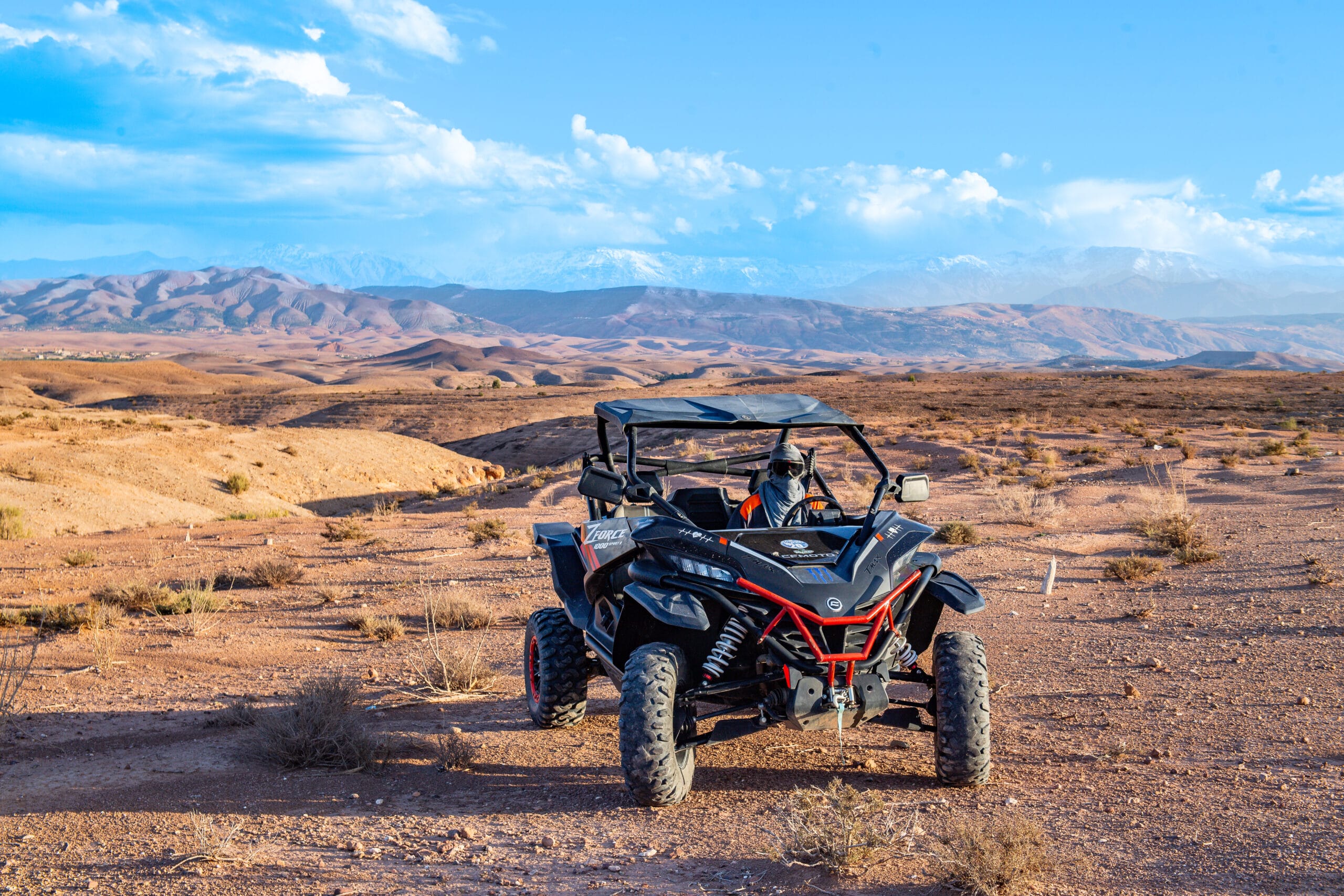
A quad biking + camel ride + Berber dinner combo in the Agafay Desert, including round-trip transfer from your Marrakech accommodation, typically costs 800–1,200 MAD per person (74–111 €). This 5 to 6-hour experience combines three completely different activities, delivers extraordinary photography opportunities at sunset, introduces visitors to Berber culture and Moroccan hospitality, and returns you to the city by 10:30 PM. No single experience in Marrakech itself comes close to this value-to-memory ratio. It is the one thing every first-time Marrakech visitor should do.
| Practical Information | Details |
| Currency | Moroccan Dirham (MAD) — not available outside Morocco |
| Exchange rate (approx.) | 1 EUR ≈ 10.8 MAD / 1 GBP ≈ 12.6 MAD / 1 USD ≈ 10 MAD |
| Language | Darija (Moroccan Arabic) + French + Tamazight. English widely spoken in tourist areas |
| Religion | Islam — call to prayer 5 times daily, Friday is the main religious day |
| Electricity | 220V, European 2-pin plug (Type C/E) — UK visitors need adapter |
| Airport to medina | 70–120 MAD by metered taxi, 20–30 min |
| Water | Drink bottled — tap water causes stomach upset in unaccustomed visitors |
| Tipping culture | 10–15% in restaurants, 10–20 MAD for hotel staff, 50–100 MAD for guides |
| Emergency number | 19 (Police) / 15 (Ambulance) / 177 (Gendarmerie) |
| Best seasons | March–May and October–November |
| Summer heat warning | 38–42°C June–September — rest 1:00–4:30 PM daily |
Marrakech rewards preparation more than almost any other city. The travelers who arrive knowing how to navigate the souks, how to handle negotiation, how to read the heat schedule, how to find the authentic experiences behind the tourist-facing facade — these travelers have extraordinary trips. The ones who arrive cold, without context, spend three days slightly on the back foot and leave feeling vaguely exhausted.
The 20 tips in this guide address the specific situations that determine which experience you have. Read them, remember the ones that matter most for your trip, and then give yourself permission to get lost, to be surprised, to make mistakes and to be changed by a city that does not accommodate the passive visitor.
Key reminders for your first visit:
Ready to experience the Agafay Desert from your Marrakech base? Our sunset quad biking, camel and desert dinner packages include door-to-door transfer and are specifically designed for first-time visitors looking for the most memorable experience near Marrakech.
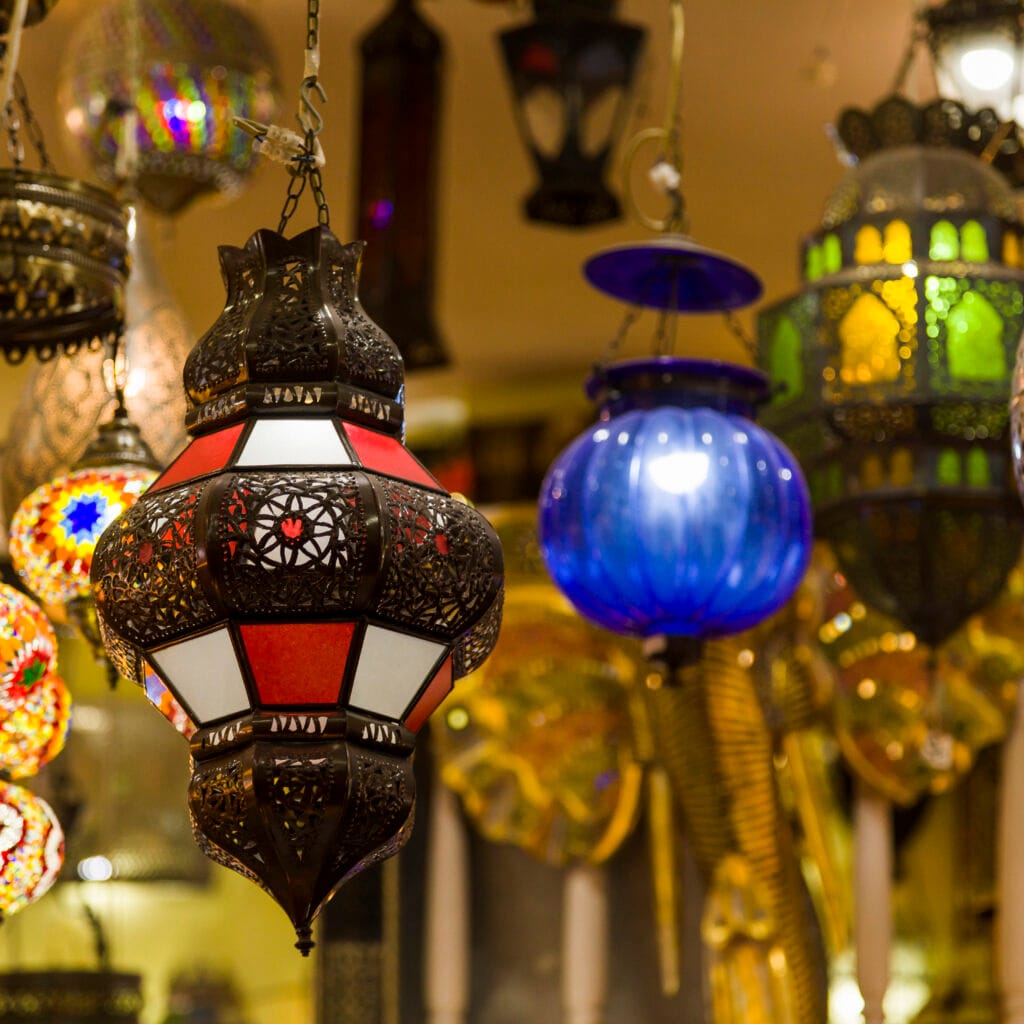
Three to four days is the ideal duration for a first visit to Marrakech. Two days is enough for the medina highlights (Jemaa el-Fna, souks, Bahia Palace, Majorelle Garden) but leaves no time for day trips. Three days allows a full medina experience plus one excursion (Agafay Desert or Ourika Valley). Four days adds a second excursion and the luxury of unscheduled exploration time — which is often when the best Marrakech moments happen. More than five days in the city alone starts to feel repetitive; combine with a Sahara or coastal extension for longer trips.
Yes — Marrakech is manageable and increasingly popular with solo female travelers, but it requires more vigilance than equivalent European destinations. Verbal attention in the medina is common and can be persistent. The effective strategies: confident body language, indirect eye contact, “la shukran” without engagement, and staying on well-populated streets after dark. Gueliz (the new city) is significantly more relaxed than the medina. Dressing modestly in the medina significantly reduces unwanted attention. The vast majority of solo female visitors have positive experiences — the key is preparation rather than avoidance.
The most reliable options are: a metered Petit Taxi (70–120 MAD, 20–30 minutes), a pre-booked transfer from your riad or hotel (typically 150–200 MAD, driver meets you in arrivals with your name), or the No. 19 bus (RAMBus, 30 MAD, 45–60 minutes including stops). Avoid unmarked taxis and drivers who approach you in arrivals — they charge 2 to 3 times the official fare. Always agree on the price before getting in any unlicensed vehicle.
No — English is widely spoken in tourist-facing businesses, riads, restaurants and organized tour operations. However, knowing a few words of French or Darija (Moroccan Arabic) dramatically improves your medina experience and generates genuine warmth. The most useful: “la shukran” (no thank you), “shhal hada?” (how much is this?), “bezzef” (too much — used in price negotiation), “shukran” (thank you), “safi” (that’s enough / OK), “l’addition” (the bill in French). You’ll use all of these every day.