Is quad biking in Agafay safe?
Is quad biking safe in Marrakech? What we provide on every Agafay ride, what is up to you, the age and licence rules, heat, weather and insurance.
Quad biking in Marrakech is a supervised activity: on our Agafay tracks, every rider is fitted with a helmet, hears a safety briefing and rides a practice loop before setting off, and a guide stays with the group from start to finish. What remains up to you is short — closed shoes, a safe distance, following the guide — and it matters as much as anything we provide.
People ask whether quad biking is safe in Marrakech before they book, and they are right to. This guide says what happens on our tracks, what the rules are, and where the desert itself asks for care. It sticks to what we can vouch for.
Is quad biking safe in Marrakech? What we provide
Four things come with every quad and buggy outing, whatever its length.
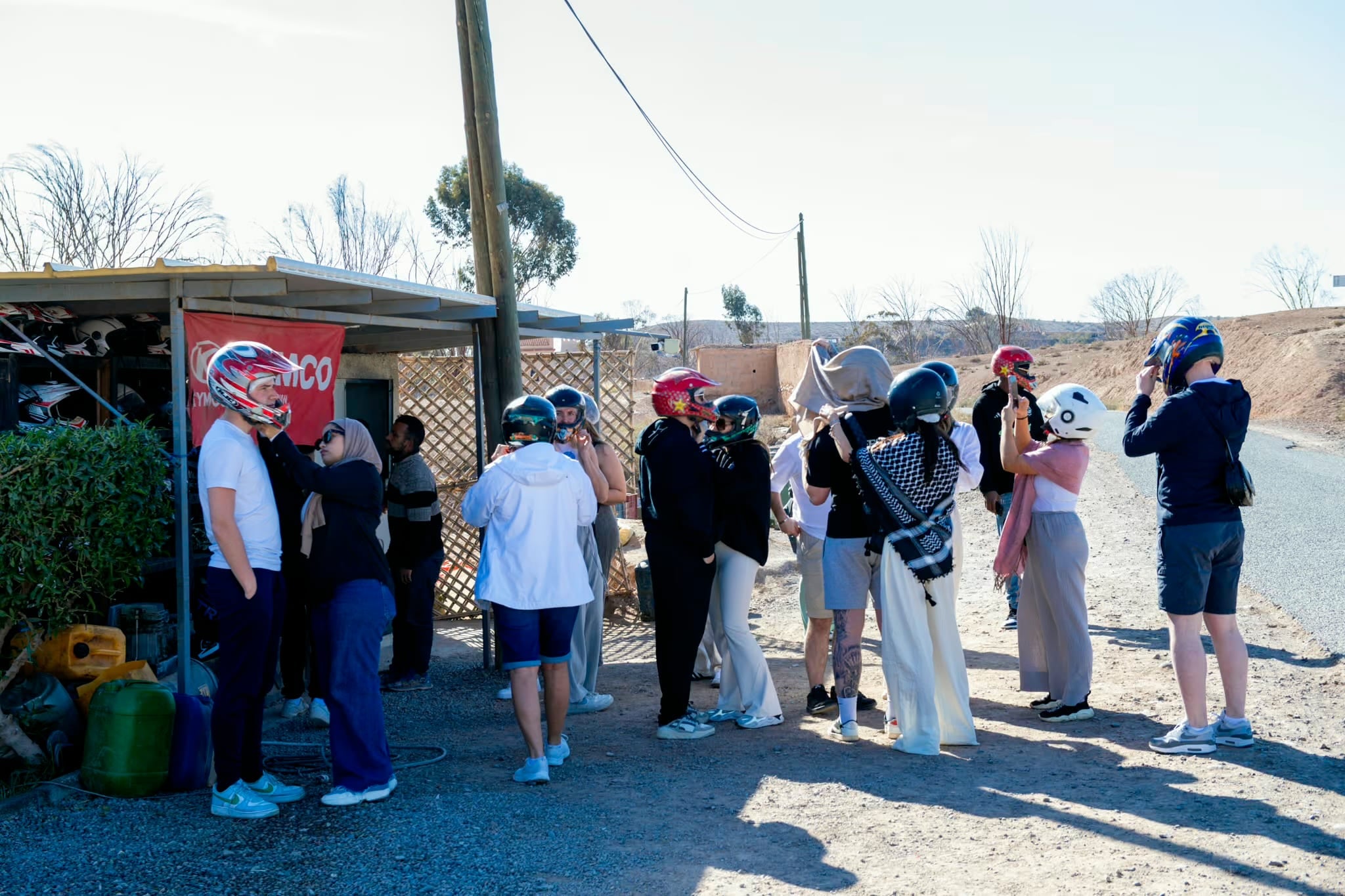
A helmet, fitted at the base. It is handed out and adjusted before anyone starts an engine, and it must be worn on every motorised activity. The helmet has a visor; sunglasses still help, because dust finds its way around it.
A safety briefing, before every departure. It covers the controls, braking and the spacing to keep on the track, and it is given in English, French or Spanish — tell us at booking which you prefer. Welcome, paperwork and helmet fitting take about fifteen minutes; the briefing and the practice loop take about fifteen more.
A practice loop on flat ground beside the base. Nobody leaves for the tracks until the guide is satisfied, including you. It is where the throttle stops feeling strange, so that the first real bend is not the first bend you have ever taken. The machines are automatic: there are no gears to think about.
A guide with the group, from start to finish. The pace is set by the group rather than by its fastest rider, and the guide stops when the group needs to. If you would rather ride where the guide can see you, say so at the briefing.
Quad or buggy: how does the protection differ?
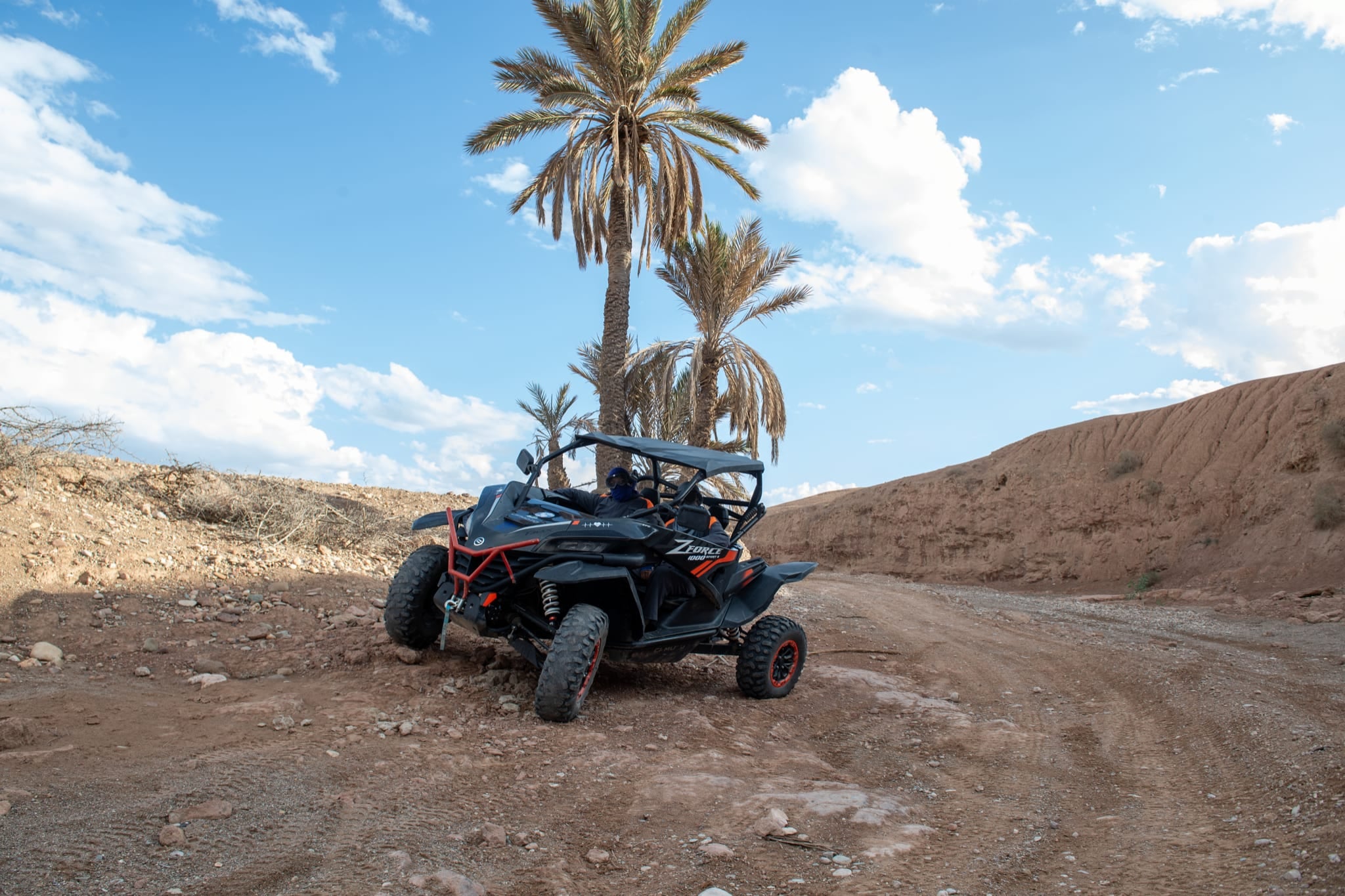
A quad is ridden, a buggy is driven — and the buggy adds a roll cage and a harness. The briefing, the practice loop, the helmet and the guide are the same for both.
| Criterion | Quad | Buggy |
|---|---|---|
| How you sit | On the machine, astride | In the vehicle, side by side |
| Protection | Helmet | Helmet, roll cage, a harness at each seat |
| Seats | One rider, with a passenger behind on machines that allow it | Two: a driver and a passenger |
| Driver’s minimum age | 16 | 18 |
| Driving licence | Not needed | Required to drive — bring it on the day |
| Dust | Dusty | More than a quad |
Families with a younger child often find the buggy the easier option: the child sits beside the parent, in a seat with its own harness, rather than behind. The quad suits anyone who wants to handle their own machine. The choice has a cost side too — a quad is priced per rider, a buggy per vehicle — and the quad biking in Marrakech and buggy tours in Marrakech pages carry the price tables.
Who can ride, and who should not?
The age and licence rules are fixed, and the booking engine applies them.
- Quad driver: 16 or over. No driving licence, no previous experience.
- Buggy driver: 18 or over, with a driving licence.
- Passenger: from the age of 6, accompanied by a responsible adult.
- Anyone under 18 takes part with a responsible adult present on site for the whole activity.
The engine refuses a driver’s place for anyone below the minimum age when you book, rather than at the base. Quad biking with children goes through which outing suits which age.
A guide can refuse to let someone set off, or stop them during the ride, if their safety or the group’s is at stake: under the influence of alcohol or drugs, for not following the briefing, or where they are plainly unable to handle the vehicle. No refund is due in that case.
Our quad and camel ride pages advise against the ride for pregnant women and people with back problems. Apart from that, our quad and buggy pages set no medical restriction beyond age and licence. If you have a health question about riding a quad or a buggy, ask us before you book rather than at the base.
Anyone who would rather not drive can ride as a passenger. It is a normal thing to ask for, not a failure.
What is up to you on the track?
Four things are yours, and they are the ones that make the difference.
Closed shoes. Not sandals. Your feet sit next to a hot engine and near moving wheels, and the ground is loose stone. Add sunglasses and something over your face against the dust — what to wear quad biking in Agafay goes through it piece by piece.
Your distance. The briefing gives you a distance to keep from the machine in front. Riding too close puts you in its dust, where you see less and brake later. Keeping that gap is the most useful thing you will do all ride.
Your speed on unfamiliar ground. Agafay is firm stone, not sand. It grips well and it forgives less: a slide on gravel ends against something hard. The tracks are not a race, and the guide is not timing you.
Following the guide, and speaking up. Say at the briefing if you are nervous, riding with a child, or would rather be a passenger — not halfway down a track. Do not hold a phone while driving; pockets that close are worth more than large ones.
If something goes wrong, stop, stay on your machine or beside it, and wait for the guide. Do not walk back along a track that other vehicles are using. The group stops with you.
Are you insured on a quad or buggy ride in Marrakech?
Third-party liability insurance is included; personal accident insurance is not. Our activities are covered for the damage you might cause to others. Wider cover — bodily injury, repatriation, cancellation — is at your own expense.
Check what your travel insurance says about motorised activities before you leave home: many policies exclude them by default, and it is better to know before the ride than after it.
Is the Agafay desert dangerous?
The Agafay desert is not a remote wilderness: it is a stony plateau 45 minutes by road south-west of central Marrakech, towards Lalla Takerkoust. The road is fine for any car, and our Agafay outings share one meeting point on the plateau.
It is not the Sahara either. Agafay has pale folded hills and dry riverbeds rather than sand dunes, and its tracks are firm stone. What asks for care there is the exposure: the plateau is open, with little shade in any season, so the sun is hard by day and the temperature drops quickly once it goes down.
In short, the hazards are the sun, the heat, the cold after dark and the dust — and, on a machine, the speed you choose. None of them is a reason to stay away; all of them are a reason to plan the time of day. The Agafay desert page covers the place itself: what there is to do, how to get there, when to go.
How do heat and weather affect safety in Agafay?
Heat is the main factor in summer, and cold in the evening all year round.
| Season | What to expect | What to do |
|---|---|---|
| June to September | Average highs of 32 to 38 °C in Marrakech; between roughly noon and four the plateau is hard work | Ride in the morning or late afternoon; long sleeves, a hat, more water than you think |
| October to May | Average highs of 19 to 29 °C; evenings turn cold quickly | A warm layer if your outing ends after sunset |
| After rain | The stone tracks stay open, with more mud than dust | Clothes you do not mind ruining |
The late departures exist because of the summer heat. Drinks are not included in the rides, so bring your own water. The month-by-month figures are in Marrakech weather month by month.
Rain rarely stops an outing, as the tracks are stone rather than sand. We may still cancel or move a departure for safety reasons — weather, the state of the tracks, an incident on site. If we do, you choose between a new date and cancelling at no cost, and we contact you rather than letting you find out at the base. Cancellation on your side is free up to 24 hours before the start.
What we do not claim
You will find sites in Marrakech advertising certified first-aid guides, daily mechanical inspections and European safety standards. We do not repeat those claims here, because we cannot show you the paperwork behind them. Nor do we quote accident figures we could not source.
What is on this page is what happens at our base: a helmet fitted, a briefing, a practice loop, a guide from start to finish, the age and licence rules, and the insurance as it stands. You can hold us to it.